
 Worksheets
Unit 7 Test Review_PHS
Total questions: 83
Worksheet time: 47mins
Anatomy is the study of:
Medical imaging
How the body works
Diseases of the body
The structure of the body
Physiology focuses on:
Body planes
Body structure
Medical terms
How the body functions
The body’s ability to maintain internal balance is called:
Anatomy
Homeostasis
Physiology
Organization
Which sequence lists body organization from smallest to largest?
Tissue → Cell → Organ → System
Organ → Tissue → Cell → System
Cell → Tissue → Organ → Body system
Body system → Organ → Tissue → Cell
Why is homeostasis important?
It describes body structure
It replaces medical care
It keeps internal conditions stable
It controls growth only
Which example BEST represents homeostasis?
Sweating to cool the body
Sleeping
Running faster
Eating
The standard anatomical position describes the body as:
Sitting with palms down
Facing sideways
Standing upright, facing forward, palms forward
Lying flat
The term anterior means:
Front of the body
Back of the body
Side of the body
Bottom of the body
The term posterior refers to the:
Front
Back
Middle
Side
Which directional term means “toward the middle of the body”?
Inferior
Medial
Distal
Lateral
Which term means “away from the point of attachment”?
Distal
Medial
Deep
Proximal
Which term means “closer to the surface of the body”?
Distal
Superficial
Deep
Inferior
Which body plane divides the body into left and right sections?
Sagittal
Oblique
Transverse
Frontal
A cut that divides the body into equal left and right halves is called:
Frontal plane
Transverse plane
Sagittal plane
Midsagittal plane
Which body plane divides the body into top and bottom portions?
Frontal
Sagittal
Transverse
Midsagittal
Why are body planes important in healthcare?
They help with memorization
They describe body regions
They allow accurate imaging and communication
They replace directional terms
Cells join together to form:
Systems
Tissues
Cavities
Organs
Groups of tissues working together form:
Cavities
Regions
Organs
Cells
Which tissue type is responsible for movement?
Nervous
Connective
Muscular
Epithelial
Which tissue type conducts impulses?
Nervous
Epithelial
Connective
Muscular
Body systems work together to:
Support and maintain life
Prevent injury only
Diagnose disease
Replace organs
The acronym SLIC MEN R RED helps students remember:
Body planes
Directional terms
Body systems
Tissue types
Why is correct anatomical terminology important in healthcare?
It sounds professional
It prevents errors and miscommunication
It replaces patient descriptions
It saves time only
Directional terms are always based on:
The healthcare worker’s position
The room setup
The injury location
The patient’s perspective
Which term describes the front body cavity that contains the thoracic cavity?
Ventral
Spinal
Dorsal
Cranial
Match the term to its correct description.
Inferior
Anterior
Deep
Proximal
A patient’s imaging results show a problem located toward the back and lower part of the body. Identify the two directional terms that would be used and explain what each term means.
Choose two terms and define them
Posterior and inferior with clear definitions
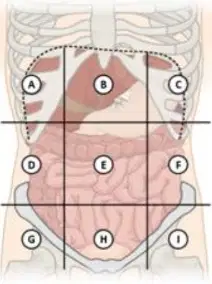
In the standard nine-region abdominal map, which region is located directly inferior to the epigastric region and superior to the pubic symphysis?
Right lumbar abdominal region
Left iliac abdominal region
Right hypochondriac region
Umbilical region in the abdomen
Hypogastric region of abdomen
Which body plane divides the body into front and back sections?
Frontal
Transverse
Sagittal
Midsagittal
Which tissue type lines the surfaces and cavities of organs?
Nervous
Connective
Epithelial
Muscular
Which directional term means “toward the side of the body”?
Lateral
Medial
Proximal
Distal
Which term describes a body plane that divides the body into front and back sections?
Frontal
Midsagittal
Transverse
Sagittal
Which directional term means “farther from the point of attachment”?
Distal
Medial
Lateral
Proximal
Which directional term means “closer to the head”?
Inferior
Distal
Superior
Deep


midsagittal/median

The heart is ________ compared to my ribcage.

Which TWO terms mean towards the head. (based on the photo)
Lateral, Posterior
Dorsal, Posterior
Anterior, Ventral
Cephalic, Superior
Which TWO terms mean towards the feet. (based on the photo)
Lateral, Posterior
Dorsal, Posterior
Inferior, Caudal
Cephalic, Superior

My radius is (a) to my ulna
My digits are (a) to my humerous.
The patellar is (a) to the tarsal.

My calcaneal is (a) to my femoral.

My nasal is (a) to my acromials.
Anatomical terms that apply to the backside of the body when it is in anatomical position:
Ventral and Anterior
Back and Rear
Posterior and Dorsal
Cephalic and Lateral
Which directional term means “toward the back of the body”?
Anterior
Posterior
Superior
Medial
What is the name of the body plane that divides the body into left and right sections?
Transverse
Frontal
Sagittal
Oblique
Which term describes a position farther from the surface of the body?
Inferior
Distal
Superficial
Deep


The RED arrow is pointing to the ________side of the leg
anterior
posterior


The spine is _______ compared to the face.
anterior
lateral
posterior
proximal

The RED arrow is _______to the other arrow
Proximal
Distal

The right shoulder is ______ to the sternum. (see pic for sternum)
medial
proximal
distal
lateral


The clavicle is _____ compared to the cranium
Superior
Distal
Medial
Lateral

The arrow is pointing which direction?
medial
lateral
Maya is learning about anatomy. Her teacher asks, "If you move your hand away from your shoulder, what is the correct directional term for this movement away from the origin or trunk?"
Deep
Distal
Proximal
Posterior
above another part of the body
superior
inferior
distal
proximal
front of the body
ventral
dorsal
medial
lateral

What abdominal region is #1?
Right Hypochondriac Region
Left Hypochondriac Region
Right Lumbar Region
Right Lumbar Region

What abdominal region is #6?
Hypogastric
Right Inguinal
Left Lumbar
Umbilical
What abdominal region is #2?
Hypogastric
Right Inguinal
Epigastric
Umbilical
What abdominal region is #3?
Hypogastric
Left Hypochondriac Region
Epigastric
Umbilical
What abdominal region is #4?
Right Lumbar
Left Hypochondriac Region
Epigastric
Umbilical
What abdominal region is #5?
Right Lumbar
Left Hypochondriac Region
Epigastric
Umbilical
What abdominal region is #7?
Right Inguinal
Left Hypochondriac Region
Epigastric
Left Inguinal
What abdominal region is #8?
Right Inguinal
Left Hypochondriac Region
Epigastric
Hypogastric
What abdominal region is #9?
Left Inguinal
Left Hypochondriac Region
Epigastric
Hypogastric

What is a?
Right Upper Quadrant
Left Upper Quadrant
Right Lower Quadrant
Left Lower Quadrant
What is b?
Right Upper Quadrant
Left Upper Quadrant
Right Lower Quadrant
Left Lower Quadrant
What is c ?
Right Upper Quadrant
Left Upper Quadrant
Right Lower Quadrant
Left Lower Quadrant
What is d ?
Right Upper Quadrant
Left Upper Quadrant
Right Lower Quadrant
Left Lower Quadrant

