
 Worksheets
Economic I
Total questions: 108
Worksheet time: 58mins
study of how people try to satisfy their needs through the careful use of scarce resources
Economics
Trade-offs
Wealth
Standard of living
people with all their efforts, abilities, and skills
Capital
Value
Labor
Good
condition of not having enough resources to produce all the things people want
Economics
Scarcity
Wealth
Opportunity cost
worth that can be expressed in dollars and cents
Labor
Value
Standard of living
Scarcity
tangible item that is economically useful or that satisfies an economic want
Economics
Labor
Value
Good
alternative choices made by consumers in the marketplace
Opportunity cost
Wealth
Standard of living
Trade-offs
quality of life based on the ownership of the necessities and luxuries that make life easier
Good
Standard of living
Value
Labor
sum of those economic products that are tangible, scarce, useful, and transferable
Wealth
Standard of living
Capital
Labor
cost of the next-best alternative use of money, time, or resources when one choice is made rather than another
Opportunity cost
Scarcity
Labor
Trade-offs
tools, equipment, machinery, and factories used in the production of goods and services
Wealth
Capital
Standard of living
Economics
The situation in which some necessities have little value while some non necessities have a much higher value is known as
Paradox of value
Opportunity cost
Trade-offs
Manufactured goods needed to produce other goods and services are called
Nondurable goods
Capital goods
Consumer goods
To arrive at an economic decision, a decision making grid may be used to evaluate
Productivity
Only durable goods
Alternative choices of action
Division of labor is a characteristic of
Home craft businesses
Assembly line production
Classroom education
The study of economics is important because it enables us to
describe our standard of living
increase our consumption of consumer goods
become better decision makers
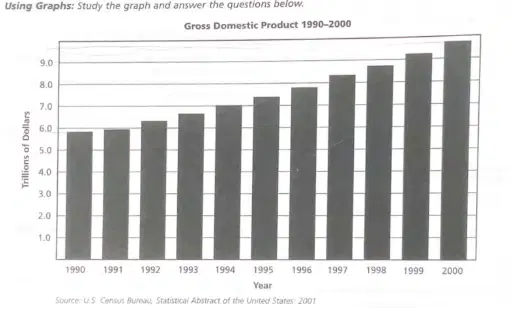
In which year was the Gross Domestic Product at its lowest?
What was the GDP in 1994?
Estimate the percentage increase in GDP between 1990 and 2000.
(9.8-5.9)/5.9 x 100 = 66.102%
7 trillion of dollars
In 1991
9 trillion of dollars
In 1990
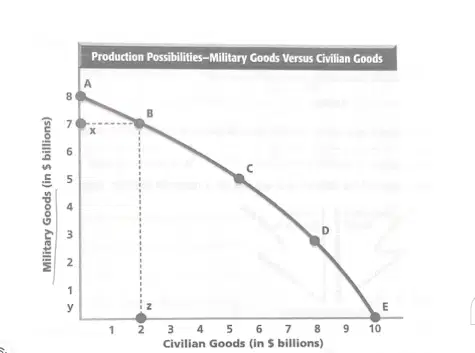
Study the graph. Suppose this nation starts with producing all military goods (point A). It then decides to produce a mix of civilian and military goods (point B). What represents the cost of military goods given up?
the vertical distance between point x and point y
the horizontal distance between point z and point E
the horizontal distance between point y and point z
the vertical distance from point A to point
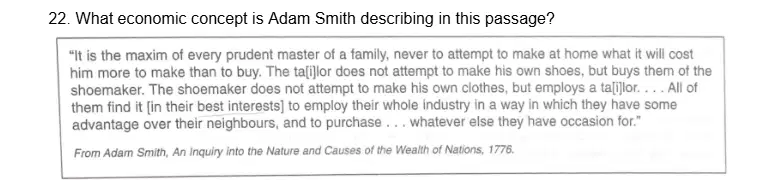
division of labor
specialization
productivity
paradox of value
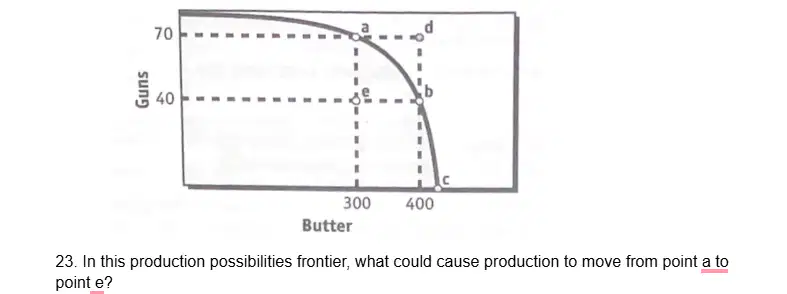
factories that are available but idle
increases productivity
the availability of additional resources
economic growth
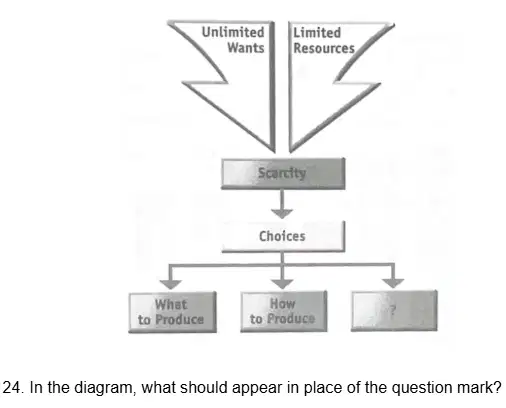
(a)
Diagram representing various combinations of good and/or services that an economy can produce when all productive resources are fully employed
Production possibilities curve/frontier
Service
Want
Capital good
Any good that lasts three years or more when used regularly
Free Enterprise
Need
Durable good
Factor Market
Process of using up goods and services to satisfy needs and wants
Want
Productivity
Factor Market
Consumption
A measure of the amount of goods and services produced with a given amount of resources in a specific period of time
Factor Market
Productivity
Need
Want
Where factors of production are bought and sold
Service
Covers
Must
Factor Market
Economy in which consumers and privately owned businesses make the majority of the what, how, and for whom decisions
Should
Free Enterprise
Consumption
Product
Basic requirement for survival
Should
Want
Need
Required
Manufactured good that is used to produce other goods and services
Capital Good
Want
Service
Factor Market
Something we would like to have but is not necessary for survival
Want
Durable good
Productivity
Capital Good
Work that is performed for someone
GDP
Financial capital
Service
Benefit
The dollar value of all final goods and services and the most comprehensive measure of a country's total production output
A cost-benefit ananlysis
Its standard of living
Financial capital
Gross Domestic Product (GDP)
A popular model used to illustrate the concept of opportunity cost is
entrepreneurship
the production possibilities frontier
the factors of production
the paradox of value
An economy at its production possibilities frontier is operating
at full potential
with slow economic growth
as a free enterprise economy
without division of labor
The money used to buy the tools and equipment needed for production is known as
capital goods
the factors of production
wealth
financial capital
Actions in one part of the country or world that have an economic impact on what happens elsewhere are examples of
Trade-offs
Specialization
Economic interdependence
Opportunity costs
form of business organization recognized by law as a separate legal entity having all the rights of an individual.
Interest
Multinational
Corporation
Limited liability
corporation that has manufacturing or service operations in a number of countries.
Multinational
Consumer cooperative
Labor union
Principal
voluntary association that buys bulk amounts of goods on behalf of its members.
Depreciation
Inventory
Principal
Consumer cooperative
business owned and run by one person.
Corporation
Interest
Proprietorship
Labor Union
price paid for the use of another's money
Interest
Multinational
Inventory
Limited liability
investor's responsibility for the debts of a business which is limited by the size of his or her investment in the business.
Proprietorship
Depreciation
Principal
Limited liability
organization of workers formed to represent its members' interests in various employment matters.
Proprietorship
Consumer cooperative
Labor Union
Inventory
money that is borrowed.
Need
Principle
Want
Inventory
non-cash charge a firm takes for the general wear and tear on its capital goods.
Corporation
Depreciation
Interest
Limited liability
stock of finished goods and parts in reserve
Inventory
Interest
Labor Union
Principal
Unlike a general partnership, in a limited partnership
All partners share equal financial responsibility for the firm's decisions.
The inactive partner has limited liability for the business's debts.
The partners must pay special business taxes.
The business does not end with the death of a partner.
This regulates the sale of stock in a corporation.
labor unions
Securities and Exchange Commission
Stockbrokers
chamber of commerce
A merger of corporations involved in different steps of manufacturing or marketing is known as a
multinational merger.
Horizontal merger.
Vertical merger.
Conglomerate.
Nonprofit organizations may.
issue stock
pay dividends
provide goods and services to members
pay income taxes.
The local chamber of Commerce works to
promote the welfare of its members in the community
for dividends for members.
protected members from consumer complaints
aid member companies in negotiating with labor unions.
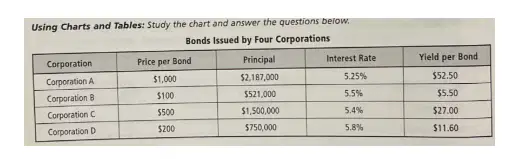
1. How much did Corporation B borrow by selling bonds?
2. Which corporation pays the highest yield per bond?
3. Which bonds are the best investment? Why?
$521,000
$251,000
Corporation A with $52.50
Corporation D. Because it has the highest interest rate (5.8%)
Corporation C with $27.00
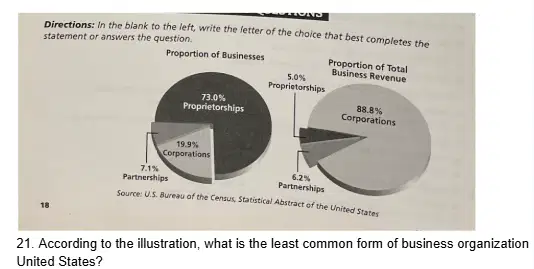
Proprietorships
Partnerships
Corporations
Joint ventures
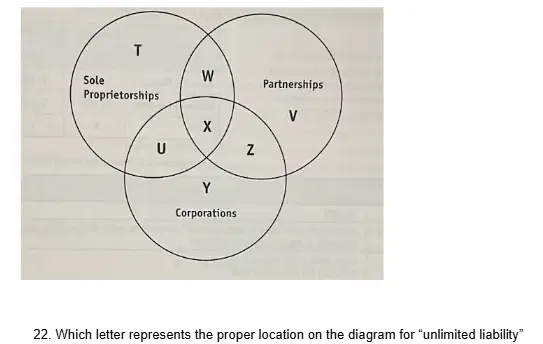
T
W
V
Y
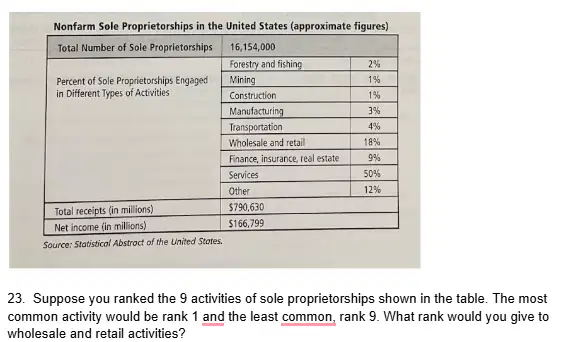
Rank 1
Rank 2
Rank 3
Rank 4
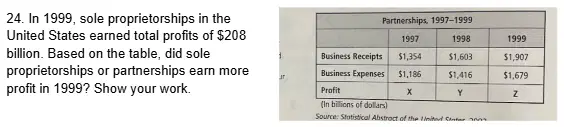
Profit = Business Receipts - Business Expenses: 1603-1416 = 187 (Billion Dollars)
Profit = Business Receipts - Business Expenses: 1907-1679 = 228 (Billion Dollars)
Sole Partnership
Sole Proprietorships
Court-granted permission to an individual or business to cease or delay paying debts.
Net income
Credit union
Bankruptcy
Nonprofit organization
Organization that promotes the collective interests of its members other than seeking profit for its owners.
Nonprofit organization
Dividend
Proprietorship
Cash flow
Business that is owned and run by one person.
Proprietorship
Net income
Credit union
Dividend
Negotiation by a labor union with management over issues such as pay, working hours, and vacation.
Stock
Partnership
Collective bargaining
Credit union
Payment of a portion of the corporate earnings to a stockholder.
Cash flow
Dividend
Proprietorship
Net income
Financial organization that accepts deposits from and makes loans to members from a company or government agency.
Credit union
Collective bargaining
Bankruptcy
Proprietorship
Business that is jointly owned by two or more persons.
Dividend
Cash flow
Nonprofit organization
Partnership
Revenues minus expenses, including taxes.
Credit union
Proprietorship
Net income
Stock
Sum of net income and non cash charges, such as depreciation.
Collective bargaining
Bankruptcy
Cash flow
Partnership
Ownership certificate in a firm
Stock
Cash Flow
Net Income
Dividend
In a general partnership
the business continues, even if one partner dies
partners must pay specific business taxes
partners usually draw up legal papers called articles of partnership
Partners are only liable for the business debt up to the amount of their investment
An advantage of a corporation is that
owners pay fewer taxes than owners of other forms of business.
the business is subject to little government regulation.
owners have limited liability for debt.
owners have direct and immediate control over daily management of the business.
All the following are examples of the government playing a direct role in the economy EXCEPT
public utility regulation
police and fire protection
court system
libraries
Which of the following is not a nonprofit organization?
multinational
producer cooperative
chamber of commerce
Labor union
In its direct role as an economic organization, American government
regulates public utilities
acts as an umpire to make sure the market operates smoothly
owns and manages public utilities
makes grants to people in the form of Social Security
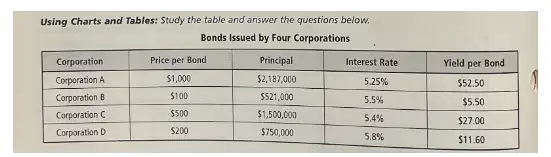
How much did Corporation A borrow by selling bonds?
(a)
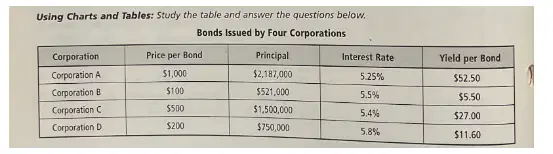
Which corporation pays the highest interest on its bonds?
(a)
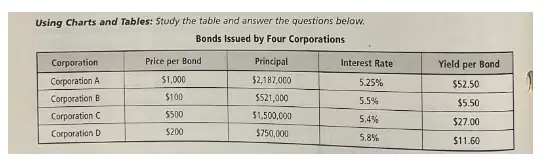
If an investor had $5,000 to invest in bonds from one corporation, which bonds, which bonds should he or she buy? How much interest would be paid on the investment in one year?
Interest= $5,000 x 0.055 x 1= $275
Interest = Principle x Rate x Time
Interest= $5,000 x 0.058 x 1= $290
Interest = Principle x Bonds x Time
Corporation D bonds because it has the highest interest rate (5.8%)
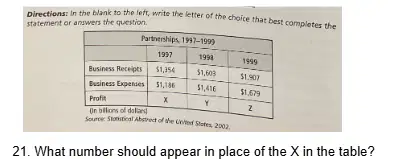
$2,540
$187
$3,019
$168
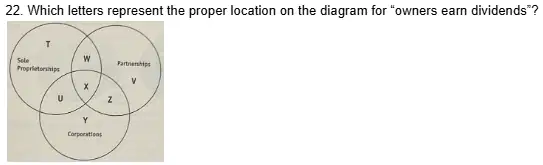
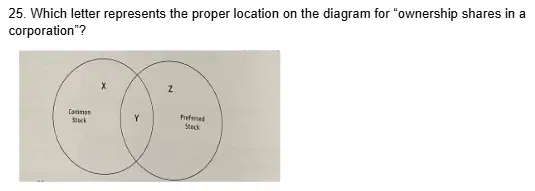
W
X
Y
Z
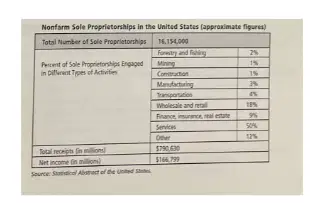
Based on the table, approximately what number of sole proprietorships are engaged in mining?
323,080
3,230,800
1,615,400
161,540
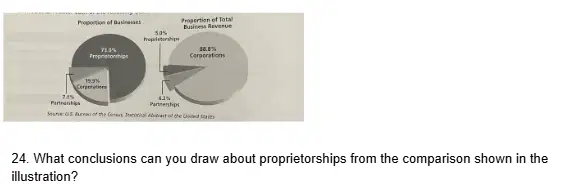
Proprietorship for large proportion of businesses but create a small proportion of total business revenue
Proprietorship for small proportion of businesses but create a large proportion of total business revenue
(a)
Alternate choices made by consumers in the marketplace.
Trade Offs
Free Enterprise
Inflation
Conglomerates
Item that is economically useful or that satisfies an economic want.
Conglomerates
Needs/ Neccessity
Cooperative
Good
Market, in which people and firms act in their own best interest to answer the what, how, and for who questions.
Partnerships
Market Economy
Free Enterprise
Inflation
Economy in which competition is allowed to flourish with a minimum of government interference.
Scarcity
Trade Offs
Free Enterprise
Conglomerates
The condition of buying unlimited wants
Cooperative
Inflation
Market Economy
Scarcity
increase in prices reduction purchasing power
Inflation
Partnerships
Conglomerates
Free Enterprise
Businesses run by two or more people
Partnerships
Free Enterprise
Cooperative
Market Economy
a corporation that has at least four businesses, each making unrelated products, none of which is responsible for a majority of it sales
Inflation
Trade Offs
Conglomerates
Needs/ Neccessity
food, clothing, and shelter are defined as
Good
Needs/ Neccessity
Partnerships
Market Economy
A voluntary association of people formed to carry on some kind of economic activity that will benefit its members
Conglomerates
Scarcity
Inflation
Cooperative
Which of the following is NOT a characteristic of a free enterprise economy?
Voluntary exchange
Competition
Public Property
Government Intervention
Economics may best be defined as a
scientific study of supply and demand
study of efforts to satisfy seemingly unlimited wants with scarce resources
limited description of economic activities
branch of sociology
When two corporations that produce the same kind of product merge, it is known as a:
Horizontal merger
Vertical merger
Conglomerate merger
Hostile takeover
A risk taker in search of profits is an __________.
Consumer
Entrepreneur
Capitalist
A popular model used to illustrate the concept of opportunity cost is
the production possibilities frontier
entrepreneurship
the paradox of value
the factors of production
The tools, equipment, machinery and factories used in the production
Multinational
Producer Cooperative
Capital
Want
Voluntary association that people helps promote or sell their products
Producer Cooperative
Economic System
Corporation
Nondurable good
Company with manufacturing our service operations in 2 or more countries.
Nondurable good
Multinational
Fixed income
Opportunity costs
Way of expressing a need
Producer Cooperative
Voluntary Exchange
Corporation
Want
Organized way by which society provides for the wants and needs of its people.
Multinational
Corporation
Nondurable good
Economic System
legal entity having all the rights of an individual.
Voluntary Exchange
Corporation
Opportunity costs
Producer Cooperative
Item that lasts for less than 3 years
Economic System
Opportunity costs
Nondurable good
Durable good
Income, most impacted by inflation.
Fixed income
Nondurable good
Opportunity costs
Capital
Next best alternative use of money, time, or resources. When one choice is made, rather than another.
Corporation
Opportunity costs
Economic System
Nondurable good
When buyers and sellers freely and willingly enter into transactions.
Voluntary Exchange
Corporation
Economic System
Producer Cooperative
Increased competition, higher profits, more better paying jobs, and healthy tax revenues are all benefits of successful
Entrepreneurship
Labor Union
Central planning
Mergers
Which of the following is not a characteristic of the market economy?
does not provide for everyone's basic needs.
individual freedom to hold the experienced consumers
change directions rapidly in response to new social or economic goals
the consumers play a key role in what is produced.
Land, labor, capital, and entrepreneurs are the
is also supply demand
the results of production
the basis of employment
the factors of production
When corporations involved in different steps of manufacturing or market thing merge is known as a
Vertical merger
Horizontal merger
Hostile takeover
Conglomerate merger
Public utilities are businesses that
our government owned
usually have no competition.
distribute natural resources
are unregulated.

