
 Worksheets
Course Introduction and Syllabus
Total questions: 74
Worksheet time: 37mins
Which statement best describes the core aim of a country's financial system?
Controlling household budgets and daily spending habits
Setting prices for consumer goods in retail markets
Managing production, distribution, exchange, and holding of financial assets
Maximizing tax revenues for the government
Which items are components of the Indian financial system? Select all that apply.
Financial Markets
Financial Institutions
Financial Assets
Financial Services
What role does the financial system play in economic development?
It discourages savings to boost consumption immediately
It encourages both savings and investment, supporting growth
It replaces private markets with central planning mechanisms
It only provides short-term loans to households
Which feature involves connecting surplus savers with those needing funds?
Expanding fiscal policy through government budgets
Forming a link between the investor and the one saving
Creating new payment technologies for retailers
Eliminating risk from all financial transactions
In capital formation, how does the financial system contribute most directly?
By setting national interest rates without market input
By mobilizing and allocating savings into investments
By restricting entry of new financial institutions
By converting financial assets into consumer goods
Which outcomes are facilitated by a well-functioning financial system? Select all that apply.
Expansion of financial institutions and markets
Provision of funds to the economy
Mandatory wage controls across industries
Fixed prices for all financial instruments
Which statement best describes the mediator role of financial institutions between investors and borrowers?
They directly lend only their own capital
They trade commodities to hedge borrower risk
They match savers’ funds with borrowers’ needs
They issue currency to control market liquidity
Which functions illustrate how financial institutions transform financial positions?
Replace deposits with government taxation
Expand money supply by printing currency
Turn risky investments into risk-free investments
Convert short-term liabilities into long-term investments
Which entity is a depository institution?
Commercial bank collecting public deposits
Mutual fund managing equity portfolios
Insurance company offering term policies
Brokerage facilitating stock trades
Which features characterize non-depository institutions?
They sell financial products to customers
They primarily provide loans from gathered deposits
They collect public monetary deposits for interest
They include insurance and mutual funds
How are financial institutions classified into regulatory, intermediates, and non-intermediates?
By ownership structure of each firm
By geographic location and market share
By profitability and capital adequacy ratios
By whether they regulate, lend, or aid corporates
Which bank type controls and regulates the entire banking system of the country?
Public sector banks under government ownership
Private sector banks owned by companies
Central bank with monetary authority role
Cooperative banks serving members
Which set lists public sector bank examples in India?
SBI, PNB, BOB as government-owned
HDFC, ICICI, Axis as privately-owned
EXIM, Small Finance, Payments banks
Citibank, HSBC, Standard Chartered
Which description best fits private sector banks in India?
Headquartered abroad but operating in India
Formed on cooperative principles to serve members
Owned by private individuals or companies
Owned and controlled by the Government of India
Which banks are headquartered abroad but operate within India?
Regional Rural Banks like APGVB
Foreign banks such as Citibank, HSBC
Development banks like NABARD, SIDBI
Specialized banks focused on payments
Regional Rural Banks primarily serve which customer segment?
Large corporates seeking global services
Farmers and small traders in semi-urban areas
High-net-worth urban retail clients
Government ministries and regulators
Which statement correctly distinguishes cooperative banks from private sector banks?
Private sector banks are headquartered abroad
Private sector banks primarily fund agriculture
Cooperative banks serve members under cooperative principles
Cooperative banks are owned by the government
Which are development banks providing long-term finance for agriculture and industries?
NABARD and SIDBI as development institutions
SBI and PNB as public sector lenders
Citibank and HSBC as foreign banks
HDFC and ICICI as private sector banks
Which group is classified as specialized banks serving specific purposes like trade, inclusion, and payments?
SBI, PNB, Bank of Baroda
HDFC Bank, ICICI Bank, Axis Bank
EXIM Bank, Small Finance Banks, Payments Banks
Urban and Rural Cooperative Banks
Which feature best distinguishes non-banking financial institutions from banks?
They accept public deposits like savings accounts
They primarily lend money to retail borrowers
They mobilize funds by selling financial products
They issue currency and regulate monetary policy
Which role do non-banking institutions commonly perform in financial markets?
Provide central banking and lender-of-last-resort services
Operate payment clearing and settlement systems
Act as intermediaries between investors and capital markets
Offer deposit insurance for commercial banks
Which regulators are associated with non-banking institutions in India?
PFRDA managing corporate bond issuance
RBI running postal savings schemes
IRDAI regulating insurance sector
SEBI overseeing securities markets
Insurance companies primarily collect which type of inflow from customers?
Demand deposits from the general public
Units purchased in mutual funds
Premiums paid for risk coverage
Brokerage fees on equity trades
Mutual funds offer investors which key benefit?
Guaranteed fixed returns and capital protection
Unlimited margin lending for stock purchases
Direct ownership of bank term deposits
Diversification and professional fund management
Which statement about mutual funds is accurate?
Units are identical to insurance policies
Managers cannot invest in hybrid instruments
Investors buy units rather than make deposits
Funds only invest in government securities
Brokerage companies primarily earn revenue through what activity?
Interest on customer deposits
Premium collection from policyholders
Brokerage and commissions on trades
Management fees from pension accounts
Which combination correctly matches institution type to its core function?
Insurance: provide risk coverage for life and health
Mutual funds: pool money to invest in equity and debt
Brokerage: accept deposits and lend to investors
Brokerage: facilitate buying and selling of securities
Which statement best describes financial assets?
Contracts with guaranteed physical delivery
Ownership tied to physical inventory
Intangible claims to future cash flows
Physical assets with tangible form
Equity-based financial assets primarily represent which relationship?
Fixed-income annuity
Creditor–debtor obligation
Ownership in a company
Government fiscal policy
Which characteristic most accurately applies to equity returns?
Fixed and predetermined payments
Uncertain and market-linked outcomes
Inflation-indexed coupons only
Government-guaranteed interest rates
Equity shareholders typically earn returns through which mechanisms?
Dividends paid by the company
Capital appreciation of shares
Tax rebates from government
Guaranteed coupon interest
Preference shares are best described as which type of financial asset?
Pure equity with highest risk
Hybrid combining equity and debt
Short-term government security
Derivative based on an index
Debt-based financial assets generally provide what kind of returns?
Variable and speculative returns
Fixed or predetermined returns
Returns only via capital gains
Returns solely from dividends
Which option correctly matches the issuer and purpose of corporate bonds?
Issued by mutual funds to track indices
Issued by individuals to hedge risk
Issued by companies to raise long-term capital
Issued by central banks to control inflation
Debentures are typically characterized as what?
Long-term debt instruments issued by companies
Assets with no contractual claim or ownership
Short-term equity instruments
Government-backed derivative contracts
Government securities are primarily issued to achieve which objective?
Increase corporate dividends
Provide equity ownership to citizens
Finance public expenditure
Fund mutual funds
Which statements are true about derivative financial assets?
Grant ownership rights in a company
Provide fixed coupon payments
Used for hedging or speculation
Value derived from an underlying asset
Which example best illustrates a futures contract?
Government bond with fixed coupon rate
Standardized agreement to buy or sell later
Perpetual claim to dividends forever
Right but not obligation to buy shares
An option contract gives the holder which benefit?
Right, but not obligation, to buy or sell
Guaranteed capital appreciation of equity
Obligation to purchase at maturity
Fixed predetermined interest payments
Which characteristic best defines cash and cash equivalents in finance?
Illiquid long-term investments
Highly liquid financial assets
Speculative derivative contracts
Tangible physical commodities
Treasury Bills are primarily described as which type of instrument?
Long-term corporate equity
Short-term government debt
Medium-term secured loans
Perpetual preferred shares
Commercial Paper is best characterized as
Secured long-term corporate bond
Unsecured short-term corporate debt
Government-backed savings certificate
Equity instrument with voting rights
Select all items that are commonly considered cash and cash equivalents.
Treasury bills under one year
Fixed deposits with short maturities
Equity shares in listed firms
Long-dated debentures
Match each financial asset to its classification type.
Bonds or debentures
Futures and options
Mutual fund units
Equity shares
Which statement about the maturity of Treasury Bills is accurate?
Typically mature in less than one year
Always mature exactly in one year
Typically mature in five to ten years
Have no stated maturity date
Which activity best fits banking services within India’s financial sector?
Selling insurance policies to retail clients
Granting a loan and opening deposit accounts
Undertaking brokerage for equity trades
Managing foreign currency exchange rates
Select all that are typical activities of insurance services.
Insurance underwriting and brokerages
Issuing insurance and selling policies
Exchanging domestic currency for foreign currency
Opening savings and current accounts
Investment services in this context primarily focus on what?
Currency conversion for travelers
Issuing debit and credit cards to clients
Asset management for investors’ portfolios
Retail payments and settlements systems
Foreign exchange services typically include which function?
Collecting insurance premiums from policyholders
Approving mortgage loans for households
Exchanging currency across national denominations
Providing brokerage accounts for equity trading
What is the main aim of financial services as described?
Maximizing bank profits through high interest
Assisting with selling, borrowing, and purchasing securities
Restricting lending and investment activities
Eliminating payments, settlements, and transfers
Which classification dimension groups markets into Debt Market and Equity Market?
Nature of claim
Maturity of claim
Timing of delivery
Organizational structure
Which markets primarily trade instruments with maturity within one year?
Debt markets
Capital markets
Money markets
Equity markets
In which market are newly issued securities offered to investors for the first time?
Cash market
Primary market
Futures market
Secondary market
Which statement best distinguishes the secondary market?
Operates only through decentralized dealers
Settles transactions at a future date
Trades already issued securities among investors
Issues new securities to raise capital

Which pair correctly matches timing of delivery with the market type?
Deferred settlement — Cash market
Real-time settlement — Futures market
Real-time settlement — Over-the-counter
Real-time settlement — Cash market
Which examples are typical of the futures market?
Commodity futures contracts
Stock index futures
Treasury bills issuance
Commercial paper trading
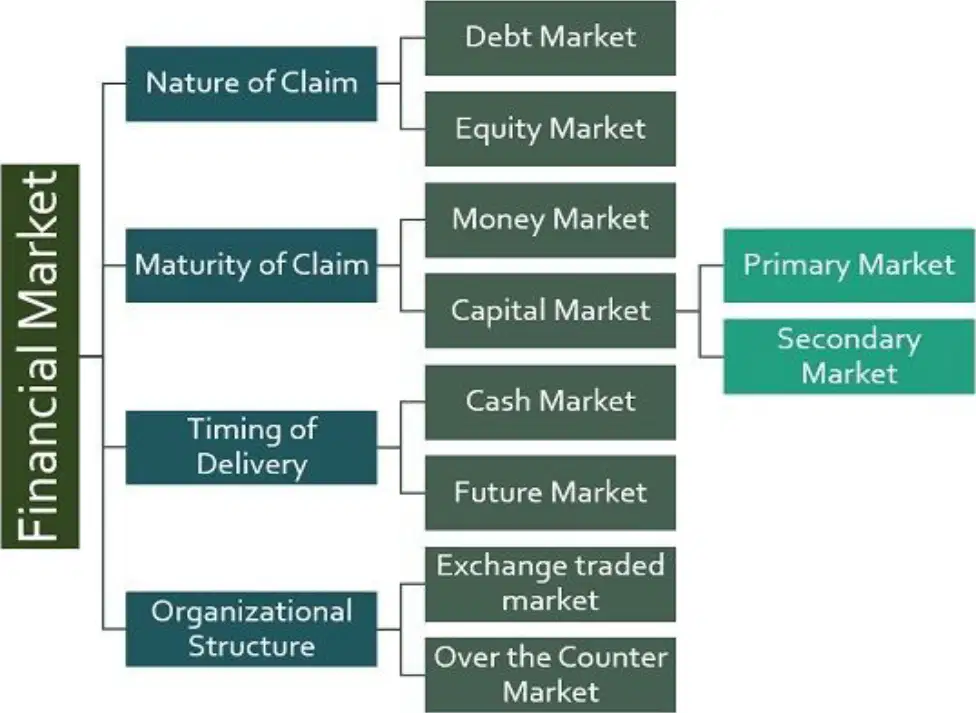
Which characteristics define an exchange-traded market?
Decentralized network
Customized bilateral contracts
Centralized organization
Standardized procedures
Which instruments are most likely traded in the money market?
Certificates of deposit
Debentures with 15-year maturity
Commercial paper
Treasury bills
Which statement about equity markets is accurate?
They handle residual claims in equity instruments
They only list government debt securities
They settle exclusively in real time
They require decentralized dealer networks

Which organizational structure describes over-the-counter markets?
Centralized exchange with uniform rules
Real-time settlement for cash equities
Decentralized network with customized procedures
Mandatory clearing through the exchange
Which markets are classified under maturity of claim?
Debt and Equity markets
Cash and Futures markets
Primary and Secondary markets
Money and Capital markets
Which description best fits the capital market?
Trades short-term monetary assets
Facilitates medium and long-term financial assets
Organizes only futures contracts
Operates solely via virtual networks
Which statement best describes the primary objective of Payment Banks in India?
Enable financial inclusion through basic digital services
Facilitate large corporate lending nationwide
Manage foreign exchange reserves for RBI
Regulate capital markets and brokerage firms
Identify the feature that Payment Banks are NOT permitted to offer.
Domestic remittances and bill payments
Savings accounts with digital onboarding
Issuing credit cards or providing loans
Mobile banking through apps
Which combination accurately lists services typically provided by Payment Banks?
Domestic remittances and bill payments
Large business term loans
Cross‑border derivatives trading
Savings accounts with deposit limits
What is a key significance of Payment Banks for underserved regions?
Reduce government tax rates in metros
Provide venture capital to startups
Promote cashless transactions in rural areas
Expand stock market participation
Which institutions are cited as examples of Payment Banks?
State Bank of India
Paytm Payments Bank
Airtel Payments Bank
India Post Payments Bank
Monetary policy reforms in India primarily aim to achieve which outcomes?
Price stability over the medium term
Controlled inflation within a target band
Rapid unsecured credit growth
Sustainable economic growth
Which reform formalized inflation control in 2016?
Fiscal Responsibility Act revision
Launch of Payment Banks licensing
Inflation Targeting Framework introduction
NPL resolution under IBC
What is the role of the Monetary Policy Committee (MPC)?
Regulate insurance premium pricing
Decide policy rates to manage inflation
Set tax slabs for households
Oversee bank mergers and acquisitions
Which set correctly lists common policy rate tools used by RBI?
Repo Rate
CRR and SLR
LIBOR and EONIA
Reverse Repo Rate
Which impact is associated with recent monetary policy reforms?
Elimination of deposit insurance
Reduced transmission to banking system
Improved credibility and predictability
Lower transparency in announcements

Match each reform area with its distinguishing characteristic.
Payment Banks: no lending, digital services
Monetary Policy: price stability, policy rates
Monetary Policy: corporate credit expansion
Payment Banks: inflation targeting, MPC tools

Which statement best contrasts Payment Banks and Monetary Policy Reforms?
Payment Banks are structural institutions for inclusion
Both introduced solely by Government of India
Monetary reforms are policy changes for inflation
Both primarily aim at equity market regulation

