
 Worksheets
Television Production: Chapter 3 Introduction
Total questions: 21
Worksheet time: 11mins
Which factor primarily determines how much light reaches a camera sensor when using a zoom lens?
F-stop setting on the lens
Frame rate selected in menu
Tripod height and angle
Battery capacity remaining
Match each camera-related term to its role.
F-stop
Numerical value indicating aperture size
Iris
Mechanical part that opens or closes
Focal length
Distance from lens to image sensor
Focal point
Specific spot where light converges

Which camera type is typically mounted in a studio and operated from a control room for live broadcasts?
Studio camera used on fixed pedestals
Smartphone camera for social clips
Camcorder for casual field recording
POV camera attached to helmets

Select all devices commonly used for mobile, hand-held shooting outside the studio.
Camcorder for portable coverage
Smartphone camera with stabilizer
DSLR adapted for video work
Studio camera on heavy pedestal

Match each camera type to a typical use case.
Studio camera
Live multi-camera studio production
POV camera
Action shots from wearer’s perspective
Convertible camera
Configured for studio or field roles
DSLR camera
Shallow depth-of-field creative video
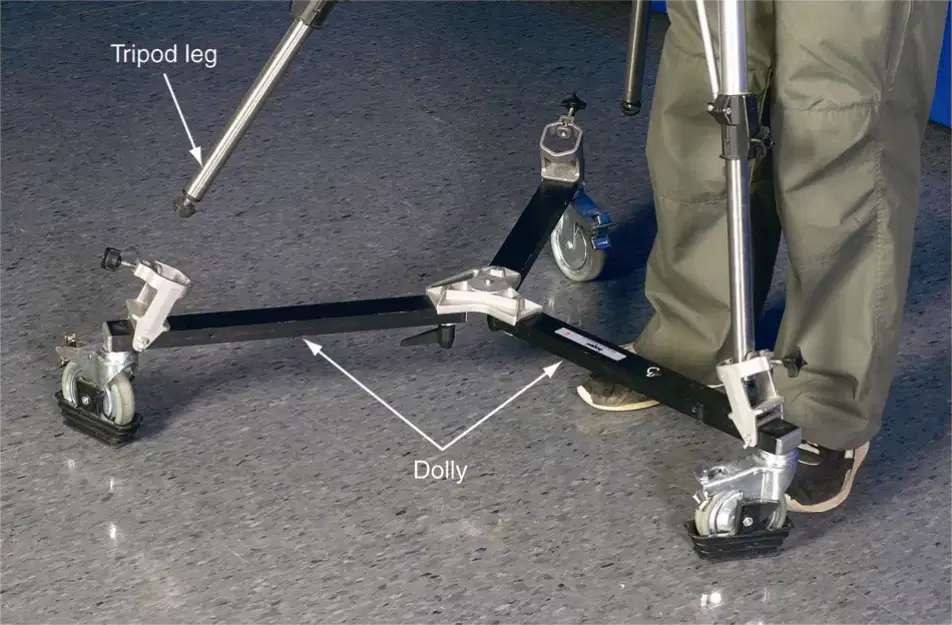
What is the main purpose of adding a dolly to a tripod, as shown in the image?
Increase vertical height range
Enable smooth rolling movement
Allow quick lens changes
Reduce camera vibration only
Match each support system to its characteristic.
Tripod with dolly
Three wheels hold tripod legs
Studio pedestal
Vertical column with steering ring
Studio camera
Paired with a Camera Control Unit (CCU)
A producer needs smooth lateral moves and quick repositioning on a flat studio floor. Which support setup fits this need best?
Monopod without wheels
Fixed wall mount bracket
Handheld shoulder rig
Tripod mounted on a dolly
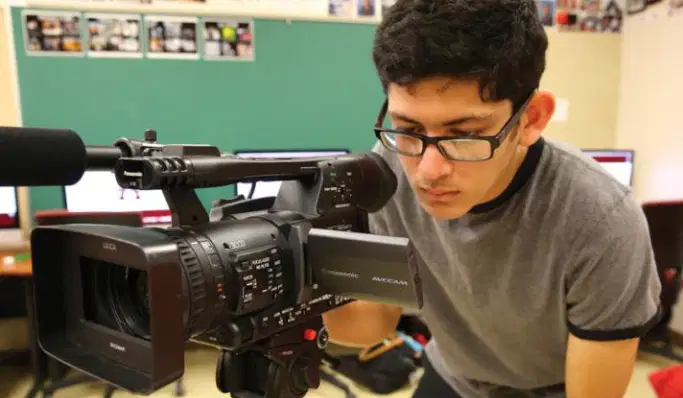
Which statement best describes a camcorder in field reporting?
A studio-only camera without recording
A stationary device for switching feeds
A CCU used to adjust image signals
A portable unit combining camera and recorder
Which feature makes convertible cameras suitable for both studio and field work?
Fixed lens and single output
Modular accessories and adaptable setup
Permanent CCU and large tripod
Built-in teleprompter and dolly
Match each camera type to its typical strength.
Convertible camera
Versatile studio or field use
Smartphone camera
Portable HD with social media apps
Action POV camera
Mountable for immersive movement shots
DSLR camera
Interchangeable lenses with strong video
A reporter needs to quickly capture HD video and post it to social media from the scene. Which choice fits best?
Tape-based camcorder rig
Full studio camera with cart
Smartphone with video apps
Convertible camera kit with CCU
Which statement best describes smartphone cameras for news gathering?
They fully replace professional camcorders
They require a CCU to function
They are weak and unsuitable for HD
They are powerful, convenient, good in a pinch
Select all configurations commonly associated with convertible cameras.
Small built-in view screen for remote use
Large studio viewfinder with CCU
Fixed action mount and waterproof body
Only optical viewfinder without screen
A viewfinder’s diopter adjustment is primarily used to do what?
Enable external recording
Match focus to your eyesight
Change image exposure
Switch sensor readout mode
Which combination correctly matches parts of the camera to their primary roles?
Camera head
Processes and routes video
Viewfinder
Provides framing and exposure aids
Lens
Focuses light onto sensor

Where is the fold-out viewfinder located and why is it useful?
On the camera top, improves microphone pickup
On the camera side, convenient for tripod use
On the lens front, helps focus manually
On the rear body, reduces battery drain

What do viewfinders allow camera operators to do during a shot?
Balance the camera weight
Hear audio levels precisely
Lock focus mechanically
See images in the frame
What is the job of the lens?
Changes light into electrical energy
Allows light to enter the camera body
Changes sound waves into electrical energy
Shows you what your camera is recording
What does the aperture do?
Changes the time light can enter the camera?
Changes the size of the opening that light comes through.
Changes the sensitivity of the image sensor
If you want a smaller depth of field you could get _______ your subject.
farther away from
closer to

