
 Worksheets
Five Principles of Teaching
Total questions: 67
Worksheet time: 34mins
Which principle focuses on sparking curiosity by building on what children already like to explore?
Enhance natural interest and disposition
Limit exploration to textbook activities
Standardize assessments for all classes
Prioritize teacher-led demonstrations only

A teacher invites families to share counting games from home and uses them in class. Which principle is being applied?
Ignore linguistic diversity for consistency
Strengthen memorization instead of reasoning
Build on children’s cultural and community backgrounds
Use play-based learning exclusively

Which classroom activity best strengthens young children’s problem-solving skills?
Copying equations from the board
Repeating facts in unison after the teacher
Exploring multiple strategies to sort objects
Listening to a lecture without questions
Deep interaction in early science and math lessons most commonly involves which practice?
Silent reading of formulas only
Guided questioning during hands-on investigations
Fast pacing to cover every topic
Individual worksheets without discussion
Which example aligns with play-based learning for math understanding?
Memorize definitions from a glossary
Role-play a market to compare prices
Timed drills with flashcards only
Watch a video without participation

A child explains a pattern they built and justifies why it repeats every two blocks. Which principle is most directly supported?
Strengthen reasoning processes and problem solving
Focus on cultural festivals exclusively
Enhance memorization of color names
Avoid discussion to save class time
Which principle best supports children building robust understanding of math and science ideas over time, as suggested in the image?
Frequent testing with short quizzes
Deep and sustained interaction with key ideas
Brief exposure to many isolated topics
Rapid coverage of advanced technical content
A classroom aims to integrate science and math with art and language while allowing children to manipulate ideas during play. Which practice aligns with this aim?
Limiting exploration to teacher demonstrations
Separating math stations from all other activities
Embedding measurement in building blocks play
Scheduling play only after formal lectures
Why is providing ample time in play emphasized for young learners exploring math and science?
Play reduces classroom noise and disruptions
Play lets children explore and manipulate ideas meaningfully
Play keeps children physically active during lessons
Play replaces the need for concept instruction
Which approach reflects concept integration rather than fragmented teaching?
Explaining gravity using only textbook definitions
Drilling equations in isolated worksheets
Integrating data collection in a nature walk journal
Teaching counting without reference to daily activities
Which factor best explains why young children benefit from hands-on activities in science and math?
They memorize procedures without context
They construct ideas through direct experience
They avoid mistakes by following scripts
They learn faster with silent demonstrations
In early science learning, what is the primary role of social interaction?
Eliminating misconceptions quickly
Replacing exploration with instruction
Limiting peer talk to reduce confusion
Sharing observations to build meaning
Which practice most effectively supports language development during science inquiry with young children?
Using only technical vocabulary lists
Minimizing conversation to maintain focus
Encouraging talk about observations and predictions
Correcting grammar before discussing findings
A teacher asks, "What did you notice when the ice melted?" and then says, "How could we show that change?" What key consideration is the teacher emphasizing?
Reflection on experiences to deepen understanding
Strict adherence to experimental protocols
Immediate instruction on scientific terminology
Assessment through timed recall quizzes
When guiding math exploration with manipulatives, which adult action best balances support and autonomy?
Demonstrate every step for the child
Ask open questions that prompt reasoning
Correct answers before explanations
Limit materials to prevent free choice
A small group compares shadows at different times and discusses why they change. Which combination of considerations is most central to the learning?
Adult explanation without exploration
Reflection replaced by quick answers
Experience and social interaction together
Language drills and silent practice
Which statement best captures how language supports young children learning science and math?
Labels connect experiences to shared meanings
Silent observation ensures deeper comprehension
Technical jargon accelerates concept mastery
Formal symbols replace everyday conversation
A teacher asks children to describe how their block tower fell, then draws their ideas. What role is primarily being used to deepen learning?
Competition to motivate persistence
Memorization of fixed procedures
Reflective thinking after an event
Immediate correction of mistakes
Which practice shows an informed adult supporting language development in early STEM?
Replacing play with direct lecturing
Avoiding drawings to prevent confusion
Limiting open questions to reduce talk
Modeling precise yet everyday vocabulary
Children explore water flow with cups and tubes. Which teacher prompt best fosters reflective thinking?
What changed when you tilted the tube?
Hurry up and pour faster now
That is wrong; stop doing that
Keep going; do it the same way
Which scenario best illustrates how language, reflection, and informed adults interact to build understanding?
Children repeat terms without any exploration
Children work alone with no feedback given
Children predict, discuss outcomes, and revise plans
Teacher explains while children sit silently
A child says, "The big cup fills slower." Which adult response most effectively advances conceptual understanding?
What do you notice about cup size and time?
No, big cups always fill faster
I will tell you the correct formula now
Stop talking and just watch quietly
Which outcome is most consistently linked to exposing young children to math early?
Immediate algebra mastery
Enhanced memorization of stories
Higher later reading achievement
Improved fine motor skills only
A kindergarten program wants to foster dispositions that support learning. Which set best matches benefits attributed to early math?
Isolation, independence, secrecy
Curiosity, imagination, persistence
Speed, competition, ranking
Obedience, repetition, conformity
Which statement best captures the predictive relationship highlighted in the material?
Early math predicts later reading achievement
Early reading predicts later math curiosity
Later math predicts early reading fluency
Early science predicts later writing speed
Which classroom practice most directly cultivates persistence through math for young children?
Structured problem-solving with feedback
Timed drills without reflection
Memorizing long word lists daily
Silent independent reading only
Why might early math be emphasized alongside literacy in early childhood curricula?
It delays language growth on purpose
It supports logical development and reading
It replaces the need for phonics entirely
It focuses only on shapes and colors
A parent asks how early math helps beyond school subjects. Which response aligns with the material?
It reduces interest in books overall
It teaches advanced calculus quickly
It mostly changes playground behavior
It strengthens personal life applications
An educator wants to integrate fields in a thematic unit. Which choice shows math’s role in integration for young children?
Linking math with science observations
Separating math from art activities
Using math only in isolated worksheets
Avoiding math in story contexts
Which statement best explains why early math experiences develop logical reasoning in children?
They rely on social imitation and peer feedback
They focus mainly on creative storytelling skills
They practice pattern recognition and rule-based thinking
They memorize many formulas repeatedly
A preschool activity asks children to sort blocks by shape and size. What math concept most directly supports building logic in this task?
Classification and attribute comparison
Motor skill repetition only
Random guessing strategies
Narrative sequencing of events
Which scenario shows practical math supporting personal life decisions?
Selecting paint colors by personal taste
Estimating grocery costs to stay within budget
Choosing a song playlist by mood
Writing a poem with vivid imagery
A young teacher integrates math into a science lesson by measuring plant growth each week. What interdisciplinary benefit does this provide?
It eliminates the need for any hypotheses
It replaces qualitative observation entirely
It connects numerical trends to biological processes
It focuses only on memorizing measurement units
You must plan a cooking activity for kindergarten. Which choice applies math logically and supports daily life?
Focus only on decorating after baking
Ignore time and bake without timers
Use standard measuring cups for fractions
Let children guess ingredient amounts freely

Which example best illustrates math integrated across multiple fields in early childhood?
Counting steps during music and movement
Reciting numbers without context
Coloring shapes without measuring
Telling stories with no data
Which statement best captures children’s natural tendency related to science learning?
They prefer memorizing scientific terms only
They learn science solely through lectures
They enjoy observing and thinking about nature
They avoid outdoor environments and organisms
What is a primary benefit of early science experiences for young children?
Replacing playtime with formal lessons
Preparing for standardized testing
Understanding the world around them
Mastering advanced laboratory techniques
Which classroom activity most directly supports information organization in early science learning?
Watching unstructured videos
Silent reading for long periods
Sorting leaves by shared features
Free drawing without discussion
A teacher asks children to predict which objects float, then test their ideas in water. What key process is being emphasized?
Copying notes from the board
Applying and testing ideas experimentally
Avoiding mistakes during activities
Memorizing definitions from a list
Which practice best fosters positive attitudes toward science in young children?
Using complex jargon frequently
Punishing incorrect predictions harshly
Creating playful, curiosity-driven explorations
Limiting questions to save class time
A nature walk is planned to leverage a natural tendency in children. Which goal aligns with that tendency?
Reciting unrelated math formulas
Ignoring plants and animals encountered
Observing patterns in the environment
Staying indoors to avoid distractions
Which sequence reflects developmentally appropriate science engagement for young children?
Observe, collect, organize, test ideas
Listen, memorize, repeat facts daily
Lecture, worksheet, graded exam
Copy, drill, recite definitions only

In the diagram, what primary outcome do quality early science learning experiences claim to provide for children’s later academics?
An immediate mastery of advanced laboratory skills
A preference for reading over mathematical reasoning
A solid foundation for subsequent scientific concepts
A flexible curiosity for playful activities
Which statement best captures the role of engaging science experiences shown in the diagram?
They replace math proficiency with hands-on projects
They mainly improve test-taking strategies
They limit experimentation to memorized procedures
They allow for the development of scientific thinking
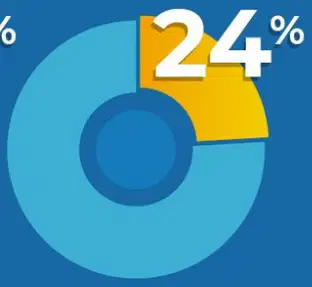
According to the infographic, which subject shows the highest percentage reaching basic proficiency among Filipino students?
All subjects at twenty-five percent
Science at twenty-four percent
Reading at twenty-three percent
Math at sixteen percent
What core problem does early childhood science learning aim to address, as indicated by the diagram sequence?
Lack of classroom resources nationwide
Achievement gaps in science performance
Decline in interest in university research
Overemphasis on literacy curricula
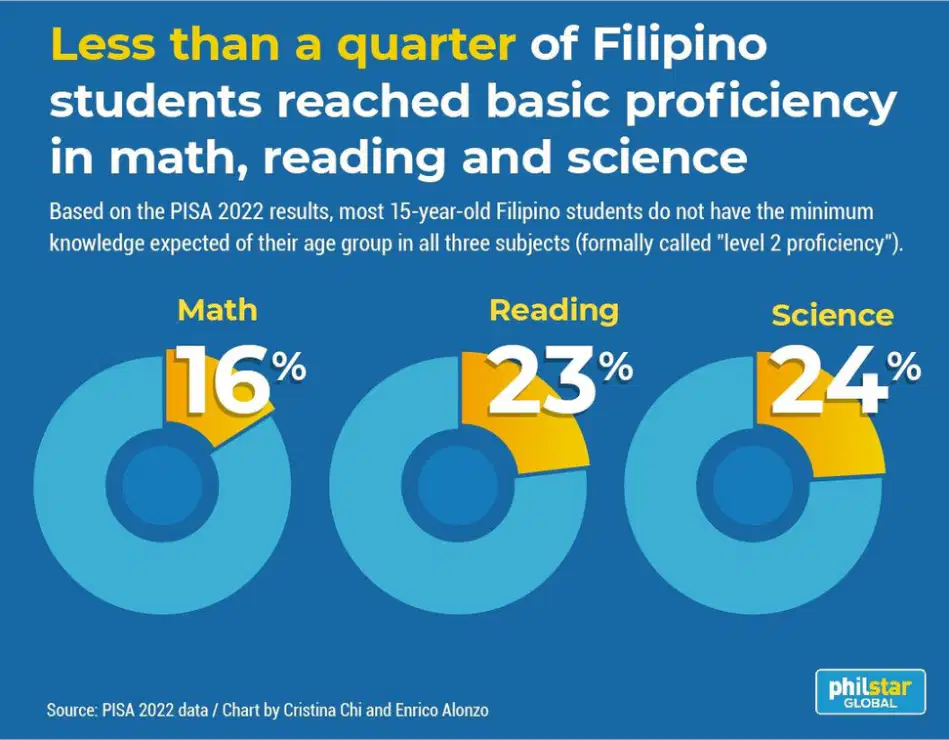
Which interpretation of the proficiency data aligns with the infographic?
More than half reached proficiency in reading and math
Exactly one quarter reached proficiency in science only
No students met basic proficiency in any subject
Less than a quarter reached basic proficiency in all three subjects
Which educational strategy logically follows from the diagrams’ claims?
Focus solely on test drills in grade school
Integrate engaging science in early childhood
Delay science until secondary grades
Replace inquiry with direct lecture methods
Which concept is most directly supported by the slide on scientific thinking?
Observation, questioning, and evidence use
Rote memorization of fact lists
Exclusive dependence on authority statements
Prioritizing speed over accuracy
Given the percentages, which planning decision best targets the documented gap?
Reduce science time to emphasize remedial reading
Allocate resources to enrich early inquiry experiences
Ignore science until students reach age fifteen
Redirect all funds to high-stakes testing preparation
Which goal best emphasizes nurturing children’s curiosity about phenomena they encounter every day?
Practicing lab safety rules
Memorizing scientific laws
Developing procedural fluency
Cultivating a sense of wonder
Flexible thinking in early science learning most directly supports which classroom behavior?
Considering multiple explanations
Following one correct method
Repeating a fixed routine
Ignoring conflicting evidence
Scientific literacy, as framed for citizenship, primarily enables individuals to do what?
Win science competitions
Make informed public decisions
Perform complex experiments
Avoid all technological risks
A child designs several ways to test which soil grows beans fastest and revises the plan after observing results. Which science education goal is best illustrated?
Inquire and solve problems
Copy a teacher’s model
Memorize plant vocabulary
Recite steps without change
Which scenario shows informed citizenship arising from scientific literacy?
Ignoring reports on air quality trends
Voting based on celebrity opinions
Choosing a favorite color for posters
Evaluating vaccine data to support policy
Constructing understanding of the world in early science most closely involves which practice?
Linking evidence to ideas
Repeating facts verbatim
Following instructions only
Copying textbook diagrams
Which age range best represents Piaget’s sensorimotor stage relevant to early mathematical concept formation?
Six to eight years
Four to six years
Two to four years
Birth to two years
A child who looks for a toy after it is hidden under a blanket demonstrates which foundational concept for later mathematical understanding?
Object permanence
Symbolic play
Conservation of number
Deferred imitation
During infancy, handling blocks of different sizes and shapes primarily supports which emerging skill linked to mathematics?
Classification skills
Probability judgment
Algebraic manipulation
Formal reasoning
Why are sensorimotor experiences (grasping, touching, moving objects) considered important for early math concept development?
They teach arithmetic facts directly
They prevent cognitive conflict entirely
They build schemas through action
They replace language altogether
A teacher designs activities where infants sort large and small blocks. Which outcome most directly aligns with Piaget’s view of early mathematical understanding?
Immediate conservation of quantity across transformations
Mastery of formal operations in algebra
Strengthened object permanence and classification
Advanced proportional reasoning with ratios
Which age range typically defines the preoperational stage in cognitive development?
Approximately ages eleven to sixteen
Around ages seven to eleven
Approximately ages two to seven
From birth to around age two
In the preoperational stage, what key capability emerges related to abstract thinking?
Use and manipulation of symbols or representations
Direct manipulation of physical objects only
Metacognitive regulation of problem strategies
Formal logical proofs with variables
What does conservation mean in early mathematical understanding?
Quantities change when rearranged in space
Materials stay the same despite changes in form or arrangement
Objects gain mass when stretched or compressed
Numbers lose value when represented with different symbols
A child who cannot conserve may still succeed at which task?
Performing routine calculations by rote
Solving complex, multi-step word problems
Planning solutions with evidence and justification
Generalizing number properties across contexts
Why is conservation important for later mathematical learning?
It replaces the need for arithmetic facts
It enables understanding beyond surface appearances
It teaches symbol names without meanings
It reduces the need for problem-solving strategies
Which classroom scenario best illustrates conservation?
Two equal clay balls remain equal after one is flattened
A longer row of spaced coins means more coins
A taller narrow glass holds more water than a short wide glass
Counting faster always gives a larger total

