
 Worksheets
Unit 7: 7.7 & 7.8
Total questions: 106
Worksheet time: 53mins
Which concept best describes governments committing all resources, industry, and civilians to the war effort during World War II?
Proxy war fought by client states
Limited warfare under strict rules
Guerrilla war focused on sabotage
Total war mobilizing entire society
Japan’s plan to organize conquered territories into a hierarchical economic and political bloc was called what?
Pan-Asian Nonalignment Pact
New Order in East Asia
Sino-Japanese Security Forum
Greater European Co-Prosperity
Which agreement in 1939 constrained Japan’s northern expansion by stabilizing borders between two major powers?
Tripartite Military Protocol
Atlantic Charter Accords
German-Soviet Nonaggression Pact
Washington Naval Treaty
U.S. sanctions threatened Japan’s economy primarily because Japan depended on imports of which materials from the United States?
Copper and bauxite
Rubber and tin supplies
Coal and steel billets
Oil and scrap iron
Blitzkrieg, first demonstrated in Poland in 1939, relied most on which coordinated elements?
Slow infantry and naval bombardment
Rapid tanks with air support
Trench lines and attrition
Long-range artillery duels
After the invasion of Poland, how was the country divided by the two occupying powers?
Shared zones per Atlantic Charter
Partition under German-Soviet pact
Annexed solely by Germany
Placed under League of Nations
What political entity established in southern France collaborated with German occupation after 1940?
Free French Republic
Paris Commune Defense
Vichy regime under Pétain
Bordeaux Emergency Council
Which 1940 arrangement exchanged U.S. naval vessels for access to British bases in the Western Hemisphere?
Cash-and-Carry Program
Destroyers-for-Bases Agreement
Naval Neutrality Proclamation
Seven-Nation Defense Pact
Which policy in 1941 allowed the United States to supply war materials without formal neutrality to nations resisting aggression?
Lend-Lease Act provisions
Munich Assistance Scheme
Kellogg-Briand commitment
Smoot-Hawley relief plan
The Atlantic Charter set postwar goals including which principle for peoples deprived of political control?
Permanent colonial trusteeship
Mandatory military conscription
Restoration of self-government
Expansion of imperial mandates
During the Battle of Britain, the Luftwaffe shifted from targeting bases to bombing cities after which British action?
A civilian evacuation order
A treaty with neutral states
A Royal Air Force raid on Berlin
A naval blockade of Hamburg
What factor most helped Britain withstand sustained air raids and prevent invasion by mid-1941?
Superior tanks and artillery
Radar and faster fighter planes
Fortified land borders
Mass conscription of civilians
Germany’s 1941 invasion of the Soviet Union aimed to achieve which ideological and strategic objectives?
Spread democracy and free trade
Eliminate Bolshevism and gain Lebensraum
Force British surrender by blockade
Secure oil in North Africa alone
Which prolonged urban defense from 1941 led to immense casualties and stalled the German advance in the east?
Siege of Leningrad resistance
Defense of Kiev operation
Siege of Stalingrad campaign
Battle of Kursk offensive
Japan’s surprise attack on December 7, 1941, targeted which location, triggering U.S. entry into the war?
Manila Bay naval yards
Pearl Harbor in Hawaii
Guam airfields
Singapore docklands
Following early Pacific victories, Japan seized territories in Southeast Asia primarily for what strategic need?
Religious missions and schools
Resettlement for Japanese civilians
Testing atomic weapons sites
Access to raw materials and bases
How did U.S. public opinion change immediately after the Pearl Harbor attack?
Support for isolation strengthened
Demand for retaliation surged
Preference for appeasement grew
Calls for neutrality increased
What was Hitler’s response to the U.S. declaration of war against Japan?
Signed a truce with Britain
Withdrew forces from the Atlantic
Declared war on the United States
Offered mediation to both sides
Which statement best explains why U.S. industry had a production advantage during World War II?
Workers received double wages and unlimited overtime
Labor unions were banned to prevent production delays
States nationalized all heavy industries for wartime use
Factories operated without direct enemy bombing threats
Which feature of German home front mobilization reduced productivity despite increased labor?
Extensive use of paid overtime and incentives
Universal conscription of women into industry
Mass evacuation of children to rural regions
Heavy reliance on forced labor with poor treatment
In Japan’s wartime home front messaging, what stance was promoted regarding women’s mobilization?
Publicly discouraged using women, citing family system
Required all women to work in munitions factories
Encouraged women to enlist for naval combat roles
Promoted equal industrial participation with men
Which 1942 battle marked a turning point by halting German advances in North Africa?
Bulge with Allied victory in the Ardennes
Stalingrad with urban combat destroying Sixth Army
Kursk with Soviet tanks encircling German armor
El Alamein with British forces defeating Rommel
Why was the Battle of Stalingrad pivotal for the Eastern Front?
Destroyed the German Sixth Army after Soviet counteroffensive
Opened a rapid Allied path to Rome and southern Italy
Enabled amphibious landings on the beaches of Normandy
Allowed Japan to focus more ships on the Pacific theater
What describes the island-hopping strategy under General Douglas MacArthur?
Launching only submarine blockades against shipping
Establishing permanent colonies on occupied islands
Concentrating on one fortified island at a time
Attacking weakly defended islands and bypassing strongholds
Which technological development most increased the range and flexibility of Allied naval power in the Pacific?
Aircraft carriers enabling takeoffs and landings at sea
Long-range infantry rifles with improved accuracy
Armored trains supplying forward island bases
Heavy coastal artillery protecting major harbors
Which event signaled the beginning of Allied offensives reclaiming Italy in 1943?
Soviet invasion of the Balkans through Bulgaria
American landings in Normandy establishing beachheads
German capture of Rome after intense street battles
Allied conquest of Sicily leading to Mussolini’s fall
What was the primary objective of D-Day on June 6, 1944?
Bomb Tokyo to force Japanese surrender immediately
Capture Rome and compel Italy to switch alliances
Destroy Germany’s Sixth Army inside Stalingrad
Establish a beachhead in Normandy for the drive on Paris
Which statement best characterizes the Battle of the Bulge?
British defeat of Rommel at El Alamein
Soviet encirclement of German forces near Kursk
Japan’s decisive naval victory preventing invasion
Germany’s last major offensive in the Ardennes Forest
What combination of actions precipitated Germany’s final collapse in spring 1945?
Allied Rhine crossings and Soviet advance toward Berlin
Italian naval blockade and guerrilla warfare in Greece
Japanese surrender enabling troops to redeploy to Europe
Successful German counterattacks restoring western control
Which factor most influenced U.S. decision-making on ending the war with Japan in 1945?
Projected casualties from invading the Japanese mainland
Pressure from Italy to withdraw forces from Europe
Failure of aircraft carriers to support Pacific raids
Soviet refusal to enter the war against Japan
Which immediate outcomes followed the atomic bombings of Hiroshima and Nagasaki?
Collapse of Italy and Mussolini’s removal from power
Allied landings on Normandy beaches in northern France
German surrender and the end of the war in Europe
Mass civilian deaths and unconditional Japanese surrender
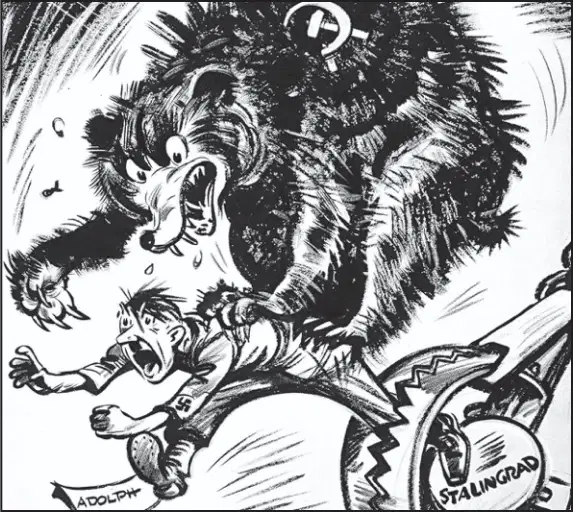
Which development set the stage for the event depicted in the cartoon showing a bear mauling a young man labeled with a swastika near the word “Stalingrad”?
Signing Destroyers‑for‑Bases Agreement in 1940
Formation of the Vichy regime in 1940
Acceptance of the Atlantic Charter in 1941
Creation of the Nonaggression Pact in 1939
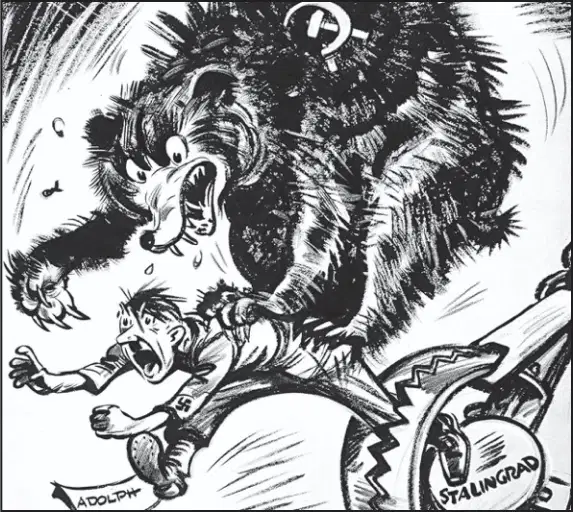
What World War II development does the cartoon with the bear attacking a swastika‑marked figure best represent?
Alliance between Hitler and the Soviet Union
Surprise Nazi invasion of the Soviet Union
Successful Soviet defense of Stalingrad
Rise of Soviet communism during the war
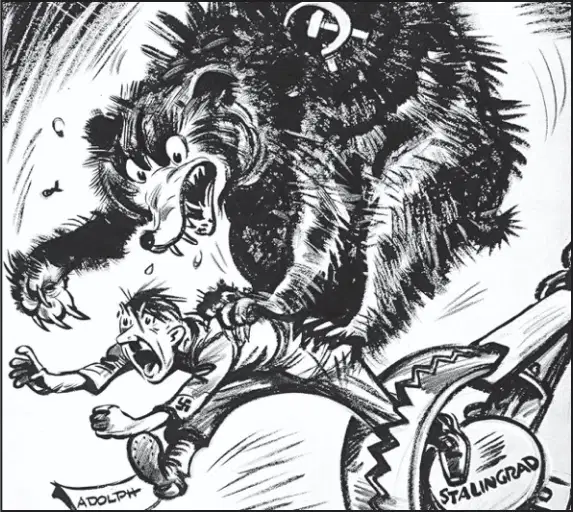
Why was the event depicted in the bear‑and‑Stalingrad cartoon historically important?
An Allied victory crucial to defeating Germany
The last Allied victory in Europe
The battle that brought Britain and France into war
Direct response to the invasion of Poland
Identify ONE short‑term result from the service of American women during World War II, based on the passage about their roles.
Rapid demobilization of male workers
Immediate expansion of voting rights for women
Freeing more men to fight at the front
Abolition of gendered job assignments
Identify ONE long‑term result from the service of American women during World War II described in the passage.
Decline of women’s participation in the workforce
Immediate equal access to all combat roles
Increased recognition through decorations for bravery
Permanent elimination of wage gaps nationwide
Which role listed in the passage illustrates women directly supporting aviation during World War II?
Drafting surrender terms at Potsdam
Commanding frontline infantry divisions
Repairing airplanes and test‑flying new planes
Serving as radio opera conductors
According to the passage, which statement about risks faced by women in uniform is accurate?
None served near front lines or faced enemy fire
All were restricted to stateside clerical work
Several were killed by direct enemy action
POW status was impossible for servicewomen
Which evidence from the passage best supports the claim that women’s contributions were essential to D‑Day?
Women solely commanded airborne divisions
Eisenhower called their role a sine qua non
All nurses landed on D‑Day itself
Women ended the war without male units
Which continuity between World War I and World War II warfare is most defensible?
Absence of aerial combat throughout both wars
Dominance of cavalry charges across Europe
Use of machine guns and artillery on battlefields
Reliance on trench warfare in all theaters
Which change from World War I to World War II warfare is most accurate?
Complete end of chemical weapons worldwide
Decreased use of armored vehicles overall
Elimination of submarines from naval war
Introduction of strategic bombing by aircraft
Which key term refers to the German air force used in early World War II campaigns?
Luftwaffe
Atlantic Charter
Blitzkrieg
Vichy
The term “island‑hopping” is best associated with which theater and strategy of World War II?
African desert warfare by Rommel
Soviet urban defense in Leningrad
European land offensives by Allies
Pacific campaign seizing key islands
Which agreement outlined shared goals between the United States and Britain before America entered World War II?
V‑E Day
Destroyers‑for‑Bases
Atlantic Charter
Nonaggression Pact
Which battle marked a decisive turning point in the Pacific by crippling Japanese carriers?
Battle of the Bulge
Battle of Kursk
Battle of the Coral Sea
Battle of Midway
Which leader is correctly matched to the nation and theater emphasized in World War II?
Vichy—United States Pacific Marine Corps
Winston Churchill—Soviet Far East operations
Erwin Rommel—German North Africa campaigns
Douglas MacArthur—British naval Atlantic command
Blitzkrieg is best described as which type of warfare?
Rapid combined‑arms shock offensives
Slow attrition with trenches and mines
Exclusive reliance on naval blockades
Guerrilla resistance by civilians
Which event is commemorated by V‑E Day?
Victory over Japan in the Pacific
Victory in Europe against Germany
Signing of the Nonaggression Pact
Invasion of Normandy landings
Which statement best evaluates Karl T. Compton’s 1946 position on atomic bombs?
He denied any link to the Potsdam Ultimatum
He maintained bombs prolonged the Pacific war
He claimed bombs prevented greater bloodshed
He argued Japan would surrender regardless of bombs
Which sequence aligns with Compton’s timeline for Japan’s surrender?
Ultimatum, Suzuki’s statement, Nagasaki, Hiroshima
Suzuki’s statement, ultimatum, Hiroshima, surrender
Hiroshima, Nagasaki, ultimatum, surrender
Ultimatum, Suzuki’s statement, Hiroshima, Nagasaki, surrender
Which interpretation would refute Compton’s claim that atomic bombs were necessary to avoid greater casualties?
Evidence of imminent Japanese capitulation before August
Data showing increased aircraft production in July
Reference to Potsdam terms demanding unconditional surrender
Accounts of the emperor’s decision after Nagasaki
Which historian’s interpretation emphasizes the Soviet entry into the war against Japan on August 8, 1945 as the most important factor in Japan’s surrender?
Harry Truman’s official presidential statements
Michael Barone’s assessment of invasion casualties
Robert James Maddox’s critique of proof standards
Tsuyoshi Hasegawa’s Japan-sourced study findings
Michael Barone’s argument claims Japan would not have surrendered without the atomic bombs. What key evidence does he cite to support this claim?
Projected American invasion casualties around one million
Proof that Soviet entry ended the war immediately
Documentation that Truman aimed to impress the Soviets
Harvard press reviews of Japanese sources
Robert James Maddox rejects the charge that Truman used the bombs mainly to impress the Soviets. What standard does Maddox insist must be met before making such claims?
Eyewitness testimony from Japanese civilians
Consensus among Allied military leaders
Substantial documentary evidence clearly presented
Immediate surrender after Soviet invasion proof
Which statement best distinguishes the main disagreement between Hasegawa and Barone?
Whether Truman intended to impress the Soviets politically
Whether Okinawa casualties were historically significant
Whether Harvard should publish controversial studies
Whether Soviet entry or atomic bombs drove surrender
Choose the most accurate evaluation method for comparing government approaches to conducting war, as requested in the reflection prompt.
Focus only on moral judgments about leaders
Narrate events without comparing specific methods
List weapons used by each side without context
Identify similarities and differences with clear criteria
Which statement best defines genocide in the context of the early 20th century?
Unintentional mortality from natural disasters
Systematic killing of a group based on identity
Random wartime deaths among combat soldiers
Legal execution of criminals by state courts
During World War I, which ruling faction in the Ottoman Empire orchestrated policies that led to Armenian mass deaths?
Kemalist reformist assembly
Pan-Arab nationalist committee
Young Turks leadership clique
Sultanate conservative council
What common misconception did Allied propaganda often promote regarding German conduct in Belgium during WWI?
Reports of systematic rapes and family murders
Beliefs that Belgium allied with Central Powers
Claims of widespread desertion by German troops
Assertions of German surrender in early 1916
Armistice Day marks which key event at the end of World War I?
Russia’s withdrawal from the war in 1917
U.S. declaration of war against Central Powers
Formal creation of the League of Nations in 1919
Germany's agreement to cease fighting on November 11, 1918
Which outcome describes the Armenian experience between 1915 and 1917 under Ottoman policy?
Autonomous self-rule in eastern Anatolia
Conscription into Ottoman elite military units
Voluntary migration to neutral European states
Mass deportations to camps in Syria and Iraq
What argument has the Turkish government advanced to contest labeling the Armenian deaths as genocide?
No deportations or executions ever occurred
Deaths resulted from war, conflict, and disease
Events were fabricated by Allied reporters
Armenians were protected as loyal citizens
Which process transformed the 1918 influenza from a regional epidemic into a global pandemic?
Mutation triggered by trench conditions alone
Soldiers returning home spreading infection widely
Medical advances rapidly curing most patients
Quarantine measures eliminating local outbreaks
Approximately how many people died worldwide in the 1919 influenza pandemic?
About 20 million across multiple regions
Roughly 2 million concentrated in Europe
Nearly 100 million in the United States
Around 500,000 limited to South Asia
What does the term Lost Generation broadly come to signify after World War I?
A political movement advocating isolationism
A group of soldiers promoted for battlefield valor
A cohort marked by shock, suffering, and hopelessness
An artistic school rejecting modernist literature
What key factor triggered famines in Ukraine during Stalin’s collectivization?
Government subsidies incentivizing overproduction
Foreign embargoes blocking grain imports
Peasant resistance leading to crop and livestock destruction
Prolonged droughts reducing yields across regions
Which policy embodied the Nazis’ institutionalized anti-Semitism in the 1930s?
Zimmermann Telegram proposing a German-Mexican pact
Treaty of Brest-Litovsk ending war with Russia
Marshall Plan rebuilding Western European economies
Nuremberg Laws restricting professions and schooling
Which term describes the Nazi plan initiated in 1942 to exterminate Jews across Europe?
Operation Barbarossa policy
Final Solution campaign
Nuremberg Laws system
Anschluss integration
Approximately how many Jews were murdered by the Nazis by the end of World War II?
About twelve million Jews
About two million Jews
About six million Jews
About ten million Jews
Which camps are identified as major Nazi death or concentration camps?
Buchenwald and Bergen-Belsen
Auschwitz and Treblinka
Sobibor and Chelmno
Mauthausen and Flossenbürg
What illustrates Nazi use of technology to make genocide more efficient?
Underground bomb shelters
Cremation ovens for bodies
Armored personnel carriers
Mobile field kitchens
During the Second Sino-Japanese War, what event saw at least 100,000 Chinese soldiers and civilians killed?
Battle of Midway massacre
Rape of Nanking atrocity
Marco Polo Bridge truce
Shanghai Peace Accords
Under the program 'Asia for Asiatics,' what did Japan impose on conquered peoples?
Enrollment in universities
Forced labor programs
Universal suffrage voting
Compulsory cultural assimilation
What term refers to women forced into sexual slavery by the Japanese army in occupied territories?
Hostesses of honor
Nurse auxiliaries
Comfort women
Factory matrons
Which cities suffered heavy Allied firebombing resulting in large civilian casualties?
Leipzig and Bonn
Frankfurt and Cologne
Hamburg and Dresden
Berlin and Munich
Which city did the United States use firebombing tactics against in the Pacific War?
Taipei in Taiwan
Seoul in Korea
Osaka in Japan
Tokyo in Japan
What broader impact did the atomic bombings of Hiroshima and Nagasaki have beyond immediate casualties?
Reduced need for radar systems
Created fear of future nuclear wars
Eliminated submarine warfare
Ended airplane carrier use
After World War II, which leader in Yugoslavia attempted to suppress separatism until his death in 1980?
Josip Broz Tito
Slobodan Milošević
Radovan Karadžić
Franjo Tuđman
What term describes the breakup of Yugoslavia into separate states accompanied by ethnic conflict and cleansing?
Collectivization
Balkanization
Industrialization
Neutralization
Which term describes the fragmentation of a region into smaller hostile states, exemplified by events in the Balkans during the 1990s?
Ethnic cleansing of minorities
Balkanization into rival states
Decolonization of territories
Genocide of civilians
In the 1994 Rwandan genocide, which two main ethnic groups were central to the violence and political tensions?
Nuba and Beja
Bosniaks and Serbs
Armenians and Kurds
Tutsis and Hutus
What immediate event in 1994 intensified violence in Rwanda, leading to mass killings over three months?
UN arms embargo lifted suddenly
President’s airplane crash blamed on rebels
Peace treaty signed by militias
Election victory by opposition party
Which international limitation hampered UN effectiveness in Rwanda during the genocide?
Peacekeepers ordered to use force
Too few peacekeepers deployed
Sanctions imposed immediately
Full evacuation of all civilians
Which description best characterizes ethnic cleansing as practiced in Bosnia during the 1990s?
Economic embargoes on minorities
Cultural assimilation initiatives
Systematic removal of ethnic groups
Voluntary resettlement programs
Which group in Darfur, translated as “evil men on horseback,” carried out attacks alongside Sudanese forces?
Lord’s Resistance Army
Janjaweed mounted militias
Bosnian paramilitary groups
Interahamwe militia units
Who was charged by the International Criminal Court with war crimes related to the Darfur conflict?
Paul Kagame of Rwanda
Omar al-Bashir of Sudan
Heinrich Himmler of Germany
Slobodan Milošević of Serbia
Approximately how many civilians were killed during the Rwandan genocide over about three months?
Two hundred thousand civilians
Fifty thousand civilians
Five hundred thousand to one million
Two to three million total
Which outcome followed international evacuations after Belgian peacekeepers were killed in Rwanda?
Rapid UN military surge
Swift ICC prosecutions began
Broader civilian evacuation failed
Immediate cease-fire agreement
Which country and region were the primary locations of the 2003 genocide involving the Janjaweed?
Bosnia in the Balkans
Sudan in Darfur
Chad in N’Djamena
Rwanda in Kigali
What broader lesson did the Rwandan genocide highlight for the United Nations regarding violent conflicts?
Focus on cultural heritage programs
Reassess role in protecting human rights
Avoid involvement in civil wars
Prioritize economic sanctions
Which set correctly pairs a key term with its category from the provided list?
Armistice Day — Technology: Warfare
Janjaweed — Environment: Disease
Genocide — Government: Policies
Bosnia — Culture: Ethnic Groups
Which best helps explain the passage in its broader historical context?
World War II included the first use of atomic weapons in human history.
Several European countries reached an agreement in Munich, in 1938, that allowed Germany to seize the Sudetenland.
Political conflicts before and during World War II led to acts of genocide and other large-scale ethnic violence.
During Kristallnacht in 1938, Jews throughout Germany and Austria were beaten and killed.
The policy of the Japanese that most closely paralleled the conditions described in the passage was
invading Manchuria after an attack on a Japanese railway station there
attempting to liberate the people of Asia from Western imperialism
engaging in surprise military attacks, such as the one on Pearl Harbor
forcing conquered peoples into deadly forced labor programs
The campaign of genocide represented in the passage is most similar to which of the following examples?
the killing of 26 Republicans between August and September 1936 by fascists belonging to Franco’s regime
the massacre of a band of Lakota people on their way to the Pine Ridge Reservation for shelter from the winter by the U.S. 7th Cavalry in December 1890
the deportation and execution of 1.5 million Armenians by the Ottoman Empire
the assassination of Archduke Franz Ferdinand
Identify ONE historical development of the mid-20th century that might explain why Japan acted as described in the passage. Explain ONE way in which the actions of Japan described in the passage are similar to the actions of Nazi Germany. Explain what the title of Chang’s book indicates about her point of view about events she describes.
Japan’s imperial expansion and militarism; both used racial ideology and brutal occupation policies; the title frames Nanking as a forgotten genocide-level atrocity
Japan’s postwar democratization; both pursued liberal reforms and diplomatic settlements; the title highlights heroic Japanese restraint during warfare
Japan’s isolation from global markets; both relied on humanitarian relief and evacuation; the title suggests the events were minor and widely remembered
Japan’s reliance on defensive warfare; both avoided targeting civilians and followed Geneva rules; the title emphasizes universal compliance with international law
Identify ONE historical development that contributed to the context for rise of extremist groups prior to World War II. Explain ONE way in which the mass destruction of specific populations impacted societies after World War II. Explain the difference between genocide and ethnic violence.
Economic crises and political instability; reshaped demographics and spurred human rights norms; genocide is intent to destroy a group, ethnic violence is broader conflict
Religious revival and social cohesion; restored multicultural tolerance; genocide is spontaneous riots, ethnic violence is planned extermination
Colonial retreat and peaceful transitions; produced unified national identities; genocide is any wartime killing, ethnic violence is only domestic crime
Rapid economic growth and political harmony; strengthened traditional hierarchies; genocide is minor unrest, ethnic violence is targeted elimination
Which factor listed by historians helps make people capable of committing genocidal crimes?
Open-border migration ends perceived outgroup status
Scientific consensus denies biological threats exist
Universal prosperity eliminates scapegoating impulses
War influences psyche toward outgroup killing
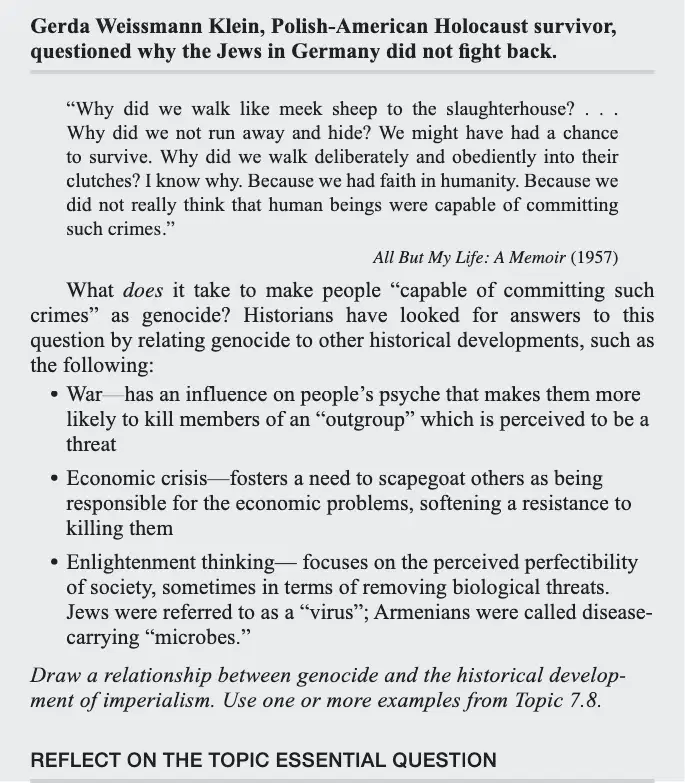
Which explanation connects economic crisis to genocidal behavior as described in the excerpt?
Balanced budgets expand social safety nets protecting minorities
Economic turmoil encourages scapegoating, reducing resistance to killing
Economic growth increases charitable giving to outgroups
Trade liberalization erases national identity conflicts
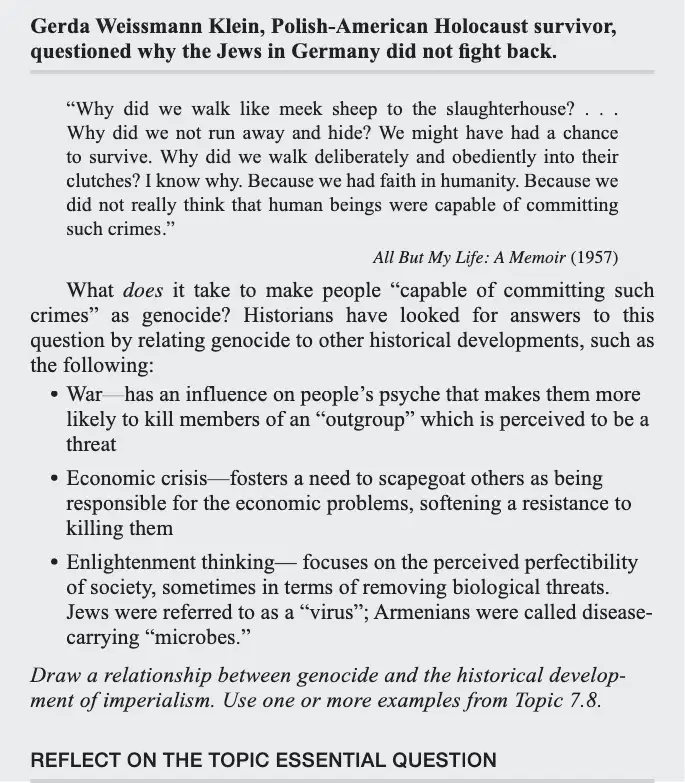
What does the excerpt suggest about Enlightenment thinking and its potential misuse in genocidal contexts?
Belief in social perfectibility can justify removing ‘biological threats’
Empirical skepticism rejects racial hierarchies in all contexts
Natural rights theory protects minority groups from harm
Rational inquiry eliminates dehumanization through universalism
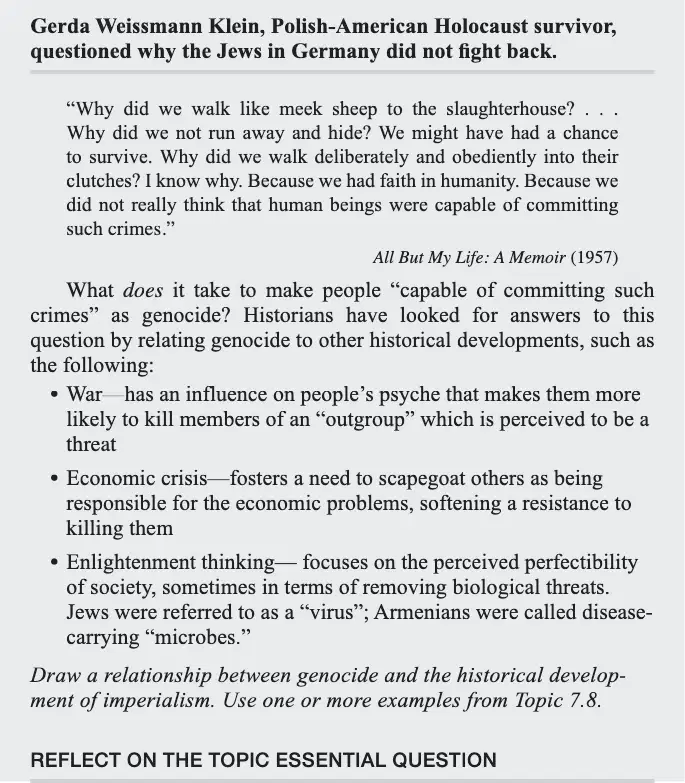
Which statement best reflects the survivor’s reflection on why Jews did not fight back?
They believed escape would guarantee immediate survival
They coordinated successful resistance across all ghettos
They possessed overwhelming military superiority over Nazis
They had faith in humanity and doubted such crimes possible
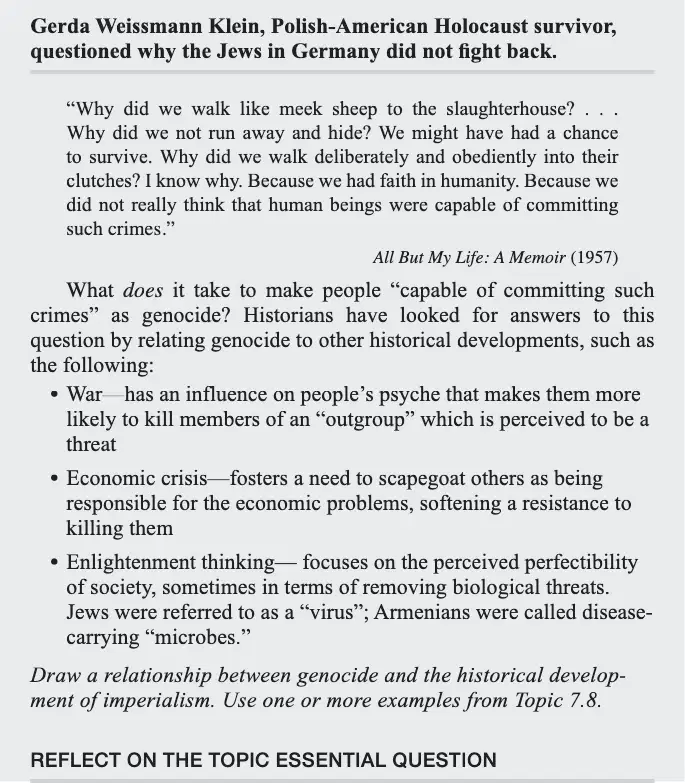
Draw a relationship between genocide and imperialism using examples from Topic 7.8. Which option best captures a valid connection?
Imperial expansion can foster outgroup dehumanization enabling mass killings
Imperialism always spreads democracy preventing ethnic conflicts
Empires consistently reduce warfare through cultural assimilation
Imperial rule eliminates economic crises that trigger scapegoating
What are the various causes and consequences of mass atrocities in the period from 1900 to the present?
Causes: artistic movements and fashion; Consequences: museum attendance growth
Causes: technological innovation only; Consequences: increased trade and literacy
Causes: war, ideology, crises; Consequences: demographic loss, trauma, legal norms
Causes: weather patterns; Consequences: agricultural abundance and peace
Which specific mechanism mentioned in the Holocaust passage facilitated later deportations and killings?
Deployment of peacekeeping forces to occupied areas
Establishment of free trade zones across Europe
Introduction of universal suffrage and civil rights laws
Creation of ghettos, transit camps, forced-labor camps
Between 1941 and 1944, what action was taken by Nazi authorities as described in the passage?
Protection of Jewish citizens through special legal status
Resettlement of Jews into autonomous self-governing regions
Negotiation of armistices with Jewish resistance movements
Deportation of millions of Jews to ghettos and killing centers
Which comparison best distinguishes genocide from ethnic violence at a conceptual level?
Genocide is spontaneous; ethnic violence is strictly preplanned
Genocide always uses gas chambers; ethnic violence never targets civilians
Genocide is any riot involving ethnicity; ethnic violence is only interstate war
Genocide requires intent to destroy a protected group; ethnic violence involves conflict without exterminatory intent
Which example most appropriately parallels the Holocaust’s state-sponsored nature?
Private vigilante actions independent of state policy
Localized riots sparked by sporting events
Intercommunal skirmishes without government involvement
Ottoman state deportations and executions of Armenians

