
 Worksheets
Unit 5: Study Guide
Total questions: 36
Worksheet time: 18mins
Name
Class
Date
1.

This is an example of:
a)
A. bull market
b)
B. A recession
c)
C. Overproduction
d)
D. An uneven distribution of income
2.

These are examples of:
a)
A Wage gaps
b)
B. Trade barriers
c)
C. Innovation
d)
D. Credit
3.
When the Supreme Court ruled that the “National Recovery Administration” was unconstitutional, this was the Court using the Constitutional power of:
a)
A. Vetoing
b)
B. Legislative rule
c)
C. Judicial review
d)
D. Executive review
4.
One lasting impact of the New Deal is the Federal Government has done which of these?
a)
A. Taken control of many corporations.
b)
B. Lessened its role in the economy.
c)
C. Assumed more responsibility for the care of the poor and less fortunate.
d)
D. Worked to discourage the growth of unions.
5.
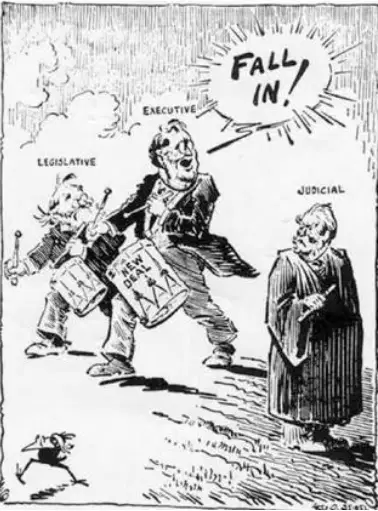
The political cartoon is making reference to:
a)
A. President Hoover’s “Hoovervilles”
b)
B. The Stock Market crash of 1929
c)
C. The creation of tariffs
d)
D. FDR’s “Court Packing” Plan
6.
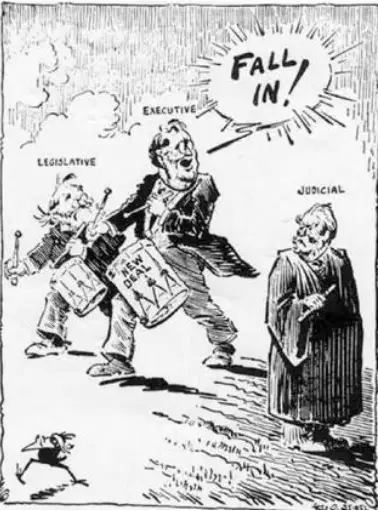
The system which ensures political power is not concentrated into one branch of the government is known as:
a)
A. Checks and Balances
b)
B. Tax Collection
c)
C. Supply and Demand
d)
D. Limited Government
7.
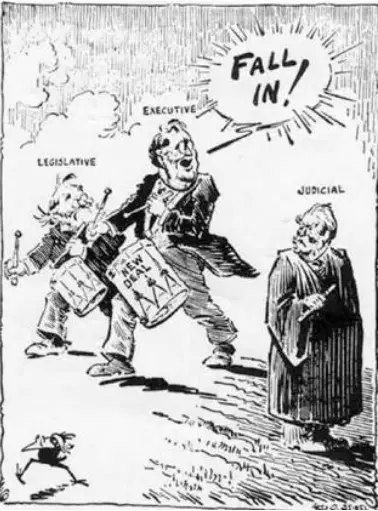
The cartoon suggests the two branches of government that supported the New Deal Programs were:
a)
A. Judicial and Legislative
b)
B. Judicial and Executive
c)
C. Executive and Legislative
d)
D. The President and Speaker
8.
Which of the following is the correct sequence of events during the time known as The Great Depression?
a)
A. Stock market crashes, New Deal begins, Roosevelt elected
b)
B. Stock market crashes, Roosevelt elected, New Deal begins
c)
C. Roosevelt elected, New Deal begins, Stock market crashes
d)
D. Roosevelt elected, Stock market crashes, New Deal begins
9.
Which of the following is NOT a cause of the Great Depression?
a)
A. Uneven distribution of Income
b)
B. Industrialization
c)
C. WWI
d)
D. Stock Market Crash and easy credit
10.
What was one goal or objective of the Social Security Act?
a)
A. To ban child labor.
b)
B. To protect workers’ rights.
c)
C. To supervise union elections.
d)
D. To lessen poverty for retired people.
11.

The description below describes which American leader?
a)
A. Herbert Hoover
b)
B. Franklin Roosevelt
c)
C. Theodore Roosevelt
d)
D. Harry Truman
12.

The description below describes which American leader?
a)
A. Herbert Hoover
b)
B. Franklin Roosevelt
c)
C. Theodore Roosevelt
d)
D. Harry Truman
13.
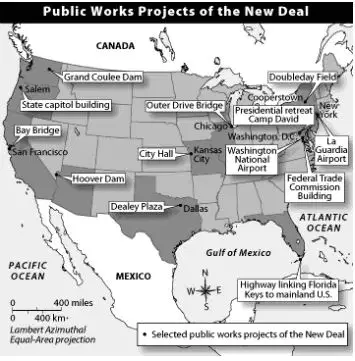
Which of the following conclusions can be reached based on the map?
a)
A. New Deal public works programs failed to reduce unemployment.
b)
B. New Deal public works projects were concentrated in the poorest regions.
c)
C. Under the New Deal, public works projects were limited in scope.
d)
D. Under the New Deal, public works projects stretched from coast to coast.
14.
What weekly photojournalism magazine was introduced in 1936 by TIME magazine publisher Henry Luce to instant success?
a)
America
b)
Life
c)
Newsweek
d)
Guiding Light
15.
Beset by deep anxieties and insecurities, many Americans in the 1930s hungered for heroes. Popular culture offered many. Which of the following was NOT an example of a pop-culture hero in the 1930’s?
a)
Superman
b)
The Lone Ranger
c)
Batman
d)
The Bionic Man
16.

Dorothea Lange’s Migrant Mother photograph:
a)
A. Was sponsored by the American Communist Party.
b)
B. Blamed migrant workers for their own plight.
c)
C. Showed the problems that farmers faced during the Depression.
d)
D. Provoked outrage and resentment against federal welfare recipients
17.
In an attempt to escape their own world for a while, many Americans in the 1930’s turned to the movies. Which of the following movies did not provide entertainment to the people during the 1930’s?
a)
King Kong
b)
Titanic
c)
Gone with the Wind
d)
The Wizard of OZ
18.
In an attempt to reduce the number of people needing assistance, in the early 1930’s the F.B.I. forced over 400,000 Mexican immigrants and Mexican-American citizens into Mexico. This is commonly known as the:
a)
A. Mexican Repatriation
b)
B. Internment Camps
c)
C. Mexican Relocation
d)
D. Interactive Immigration
19.
By the end of President Roosevelt’s first term in office, one of the most dramatic voter shifts in American history occurred. This group of people who had historically voted Republican, voted over 75% Democrat in 1936.
a)
A. Irish-Americans
b)
B. Native-Americans
c)
C. African-Americans
d)
D. Chinese-Americans
20.

The 22nd Amendment to the Constitution was added as a response to which president’s time in office?
a)
A. Herbert Hoover
b)
B. Franklin Roosevelt
c)
C. Theodore Roosevelt
d)
D. Harry Truman
21.
Buying on margin was a method of buying stocks
a)
with mostly borrowed money.
b)
without using a broker.
c)
by pooling money with others.
d)
without any risk.
22.
Stockbrokers who made loans that allowed investors to buy stocks could issue a
___________________ to protect their loans.
a)
collateral call
b)
credit call
c)
margin call
d)
foreclosure call
23.
As a result of the stock market crash, some banks suffered more losses than they could
absorb and
a)
tried to attract more depositors.
b)
had to approve more loans.
c)
increased interest rates.
d)
were forced to close.
24.
At the time of the stock market crash, the government did not insure bank deposits, so
a)
banks kept only a fraction of depositors’ money in reserve.
b)
customers lost their savings if a bank collapsed.
c)
banks had to make money by making loans and investing.
d)
customers turned to their stockbrokers for help.
25.
President Herbert Hoover did not want the government to create as many new jobs as the millions of unemployed people needed because that would require
a)
much lower unemployment
b)
increased government regulation.
c)
reform of federal taxes.
d)
increased government spending.
26.
In 1932, President Hoover asked Congress to set up the Reconstruction Finance Corporation to allow the government to
a)
expand the money supply.
b)
make loans to businesses.
c)
provide relief to the unemployed
d)
create jobs in public works
27.
As creditors foreclosed on nearly one million farms between 1930 and 1934, some farmers destroyed their crops in a desperate attempt to
a)
retaliate against their creditors
b)
raise prices by reducing supply.
c)
call public attention to their plight.
d)
find ways to feed their families.
28.
The stock market crash weakened the nation’s banks because
a)
banks had invested their deposits in the stock market.
b)
investors no longer had money to deposit in banks.
c)
banks depended on their stock for operating funds.
d)
investors could no longer afford to take out loans from banks.
29.
The period between March 9 and June 16, 1933, when Congress passed 15 major acts to meet the economic crisis of the Depression, was called the
a)
First New Deal.
b)
New Nationalism.
c)
Hundred Days.
d)
New Freedom.
30.
President Franklin Roosevelt entered office with no clear agenda or strong political ideology, but his administration favored government
a)
involvement in health care.
b)
intervention in the economy.
c)
promotion of competition.
d)
assistance to small businesses
31.
President Roosevelt’s policies for ending the Depression became known as the
a)
fireside chats.
b)
Glass-Steagall Act.
c)
gold standard.
d)
New Deal.
32.
The Emergency Banking Relief Act helped solve the banking crisis by
a)
putting all banks under government operation.
b)
declaring that the gold standard would not be abandoned.
c)
issuing licenses to financially sound banks.
d)
closing the banks long enough for the Federal Reserve to replenish them.
33.
To regulate the stock market, Congress created the
a)
Federal Trade Commission.
b)
Securities and Exchange Commission.
c)
National Recovery Administration.
d)
Federal Deposit Insurance Corporation
34.
To fight the Depression, the first thing President Roosevelt set out to do was to
a)
provide direct relief to the unemployed.
b)
set up massive public works programs.
c)
restore confidence in the nation’s banking system
d)
provide mortgage assistance to farmers.
35.
President Roosevelt launched the bold new programs that came to be known as the Second
New Deal primarily because
a)
the Supreme Court struck down key elements of New Deal programs.
b)
Roosevelt faced strong criticism from the right over the New Deal.
c)
the first New Deal programs had not generated an economic recovery.
d)
Roosevelt wanted to undermine potential threats to his reelection
36.
President Roosevelt triggered a new economic downturn in 1937 by
a)
launching new programs.
b)
decreasing government spending.
c)
breaking up trusts.
d)
decreasing taxes.
100 %

