
NEW
Font size
 Worksheets
CRM 2.4 Review - Patterns of Earth Systems
Total questions: 15
Worksheet time: 8mins
Anika is learning about Earth's atmosphere in her science class. Her teacher asks, "Which of the following describes how the stratosphere is important to life on Earth?"
It contains ozone which filters out the Sun's harmful rays.
It blocks meteors falling from space and crashing to Earth.
It allows solar heat to pass through and warm the ground below.
It contains conditions that are favorable to jet streams which drive our weather.
Jackson is curious about how the atmosphere helps support and protect life on Earth. Which of the following best explains how the atmosphere does this?
The ozone layer protects the Earth from acid rain and provides the oxygen we need to breathe.
The water vapor in the atmosphere cools the planet and creates wind which helps to form ocean currents and weather.
It cools the land masses by producing carbon dioxide and oxygen while heating the oceans evenly.
It keeps the temperature on Earth balanced by trapping some heat from the Sun while reflecting its harmful radiation.
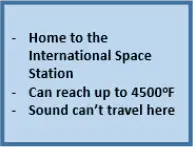
Patrice is working on completing a card sort about the layers of the atmosphere. She does not know how to correctly sort the card shown below:
- Home to the International Space Station
- Can reach up to 4500°F
- Sound can't travel here
Which card should Patrice place this next to?
Thermosphere
Mesosphere
Troposphere
Stratosphere
Elizabeth was enjoying a day at the beach when he noticed storm clouds forming over the ocean. She wondered why this happened at the beach so often. Which of these statements answers Elizabeth's question?
Cool ocean currents cause transpiration forming storm conditions in the atmosphere.
The ocean water is constantly evaporating causing the atmosphere to be humid and storms to form.
Clouds evaporate more quickly over the ocean causing storms to form in the atmosphere.
The land and the ocean are heated evenly causing ocean and air currents to form storms.
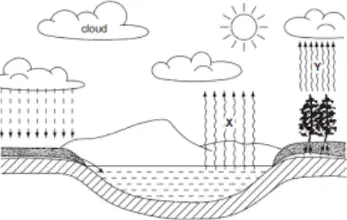
Abigail is spending the day at the beach and notices that the Sun is shining brightly over the ocean. She sees water vapor rising from the ocean at a spot similar to point "X" in the diagram below. How does this process at point "X" affect the weather?
The cooler temperature of the ocean causes the water to evaporate into the atmosphere to later form clouds.
The Sun's rays heat the ocean's water and cause some of it to evaporate into the atmosphere to later form clouds.
The ocean reflects the Sun's rays into the atmosphere and causes the water vapor to condense into a cloud.
The warmer temperature of the ocean causes the water vapor to release into the atmosphere through condensation.
Emma is learning about how the Earth is protected from harmful ultraviolet radiation. She wonders which layer contains most of the protective ozone that absorbs this radiation. Can you help Emma choose the correct layer?
Thermosphere
Mesosphere
Stratosphere
Troposphere
Jackson is curious about how radios and satellites can send signals over long distances in the upper atmosphere. Which condition best explains why this is possible?
Thin air and charged particles allow signals to travel far.
Dense air slows signals and keeps them near Earth.
Thick clouds reflect signals back toward the ground.
Strong winds in jet streams carry signals quickly.

Imagine you are planning a summer vacation and deciding between visiting San Francisco, California or Washington, D.C. Based on the ocean currents near each city shown in the image, which conclusion can you make about their summer temperatures?
San Francisco is warmer than Washington, D.C., because Washington, D.C. is near cool currents and San Francisco is near warm currents.
San Francisco is cooler than Washington, D.C., because Washington, D.C. is near warm currents and San Francisco is near cool currents.
San Francisco is cooler than Washington, D.C., because Washington, D.C. is on the coast and San Francisco is inland.
San Francisco is warmer than Washington, D.C., because Washington, D.C. is farther north than San Francisco.
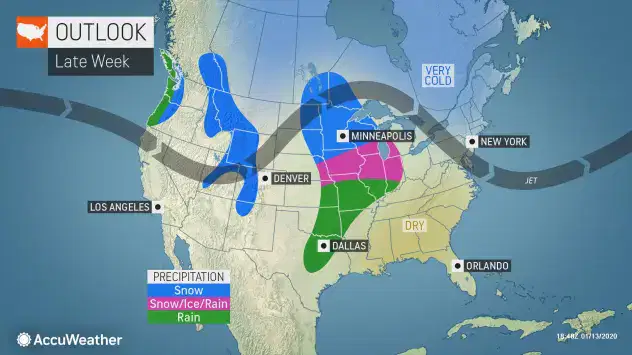
Imagine you are planning a trip across the United States and you notice the polar jet stream curving across the country on a weather map. Which statement best explains temperature differences between two cities?
Orlando is colder than Dallas because Orlando lies south of the jet stream.
Orlando is warmer than Dallas because Orlando lies south of the jet stream.
Eugene is colder than Boston because Eugene lies south of the jet stream.
Eugene is warmer than Boston because Eugene lies north of the jet stream.
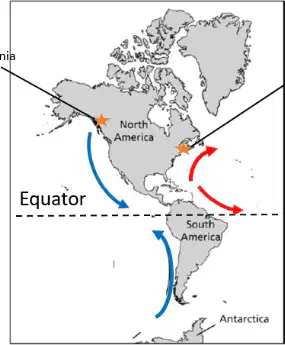
Ava is planning a summer vacation and wants to visit a coastal region with cooler summer temperatures caused by an upwelling cold ocean current. Using the ocean-current map, which coastal region should Ava choose?
East coast of North America near Washington, D.C.
West coast of North America near San Francisco
East coast of South America near Brazil
Gulf Coast of the United States near Houston
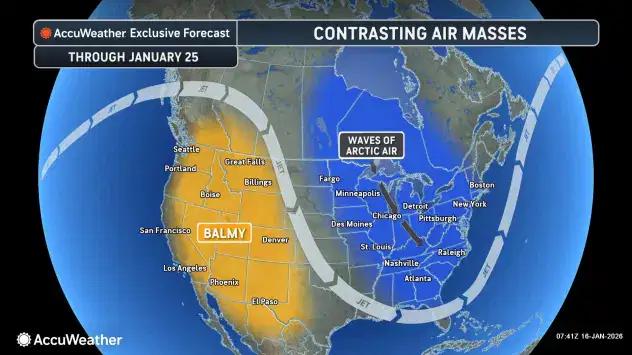
Imagine you are planning a road trip across the United States and want to avoid sudden drops in temperature. Based on the jet stream map, where would a cold front most likely drop south and bring cooler weather to nearby cities?
North of the jet stream over Boston region
South of the jet stream over Orlando region
Along the jet stream over central Texas
Far west of the jet stream over coastal Oregon

The picture shows two Florida cities and their temperatures at the same summer daytime. Which statement best explains why Orlando is much warmer than Merritt Island during the day?
Merritt Island has a smaller population, so total body heat lowers its temperature.
Cool dense air from the ocean moves onshore during the day, replacing warm less dense air in Merritt Island.
The Sun sets in Merritt Island earlier than Orlando, giving more time to cool in shade.
Cool dense air from Orlando moves toward the ocean during the day, replacing warm less dense air in Merritt Island.
On a hot summer day, Jackson notices that the lake near his house seems to lose more water and that it rains more often in his town. Which statement accurately describes how temperature affects the cycling of water?
Warmer temperatures decrease both evaporation and precipitation.
Warmer temperatures increase both evaporation and precipitation.
Cooler temperatures decrease evaporation and increase precipitation.
Cooler temperatures increase evaporation and decrease precipitation.
On a summer afternoon, Charlotte is relaxing at the beach and notices a cool breeze coming from the ocean toward the land. What causes this sea breeze to move from ocean toward land?
Equal heating of land and ocean, causing air to flow randomly.
Mountains far inland deflect winds, sending air toward the beaches.
Ocean heats faster, pushing warm air onto land by strong waves.
Land heats faster, making air rise and drawing cooler ocean air onshore.
Two towns are 40 km apart: one coastal and one inland. By late afternoon, which town is most likely to have higher temperature, and why?
Inland town, because cold ocean air pushes heat farther inland.
Coastal town, because clouds always block sunlight near oceans.
Coastal town, because ocean water warms quickly and heats nearby air.
Inland town, because land warms faster and lacks cooling sea breeze.

