
 Worksheets
Hyperkalemia & Hypercalcemia
Total questions: 8
Worksheet time: 6mins

A 68-year-old man comes to the physician because of constipation and decreased appetite during the past several months. In the past 2 weeks, he has also noticed an increasing frequency of urination. He has not had any dysuria or flank pain. He has a history of hypertension, calcium pyrophosphate crystal arthritis, and alcoholic cirrhosis. Current medications include hydrochlorothiazide, rifaximin, lactulose, and naproxen as needed for his joint pain. He quit drinking 5 years ago. He does not smoke cigarettes. His vital signs are within normal limits. Physical examination shows decreased bowel sounds but is otherwise unremarkable.
Which of the following is the most appropriate next step in diagnosis?
Serum parathyroid-related protein level
Serum 1,25-dihydroxyvitamin D level
Serum parathyroid hormone level
24-hour urine calcium level
A 72-year-old male is brought to the emergency department after being found on the floor, having fallen, and complaining of significant right hip pain. He has a history of chronic kidney disease. On assessment, he is confused, with a BP of 78/60 and a heart rate of 74 bpm. An ABG reveals a serum potassium of 9.0 mEq/L and a blood glucose level of 32 mmol/L. An ECG shows peaked T waves, widening of the QRS complex, and absence of P waves.
Question: What is the priority intervention in this patient?
Administer intravenous calcium gluconate
Start intravenous insulin and glucose infusion
Initiate renal dialysis
Administer calcium polystyrene sulfonate
Which of the following medications is most likely to cause hyperkalemia?
Furosemide
Salbutamol
Enalapril
Hydrochlorothiazide
Insulin

A 67-year-old woman with resistant hypertension and chronic kidney disease stage 4 is admitted with one week of worsening confusion, constipation and generalized weakness following poor oral intake. Her regular medications include amlodipine, perindopril, hydrochlorothiazide and bisoprolol. On examination, she is clinically dehydrated with dry mucous membranes and reduced skin turgor. Her blood pressure is 146/92 mmHg and pulse is 88 bpm.
ECG demonstrates a shortened QT interval. She is commenced on cautious intravenous normal saline. After 24 hours, she remains confused and repeat blood tests show persistent hypercalcaemia with a total calcium of 3.66 mmol/L
What is the MOST appropriate next step in management?
Intravenous insulin and dextrose infusion
Intravenous zoledronic acid
Haemodialysis using a low‑calcium dialysate
Subcutaneous calcitonin
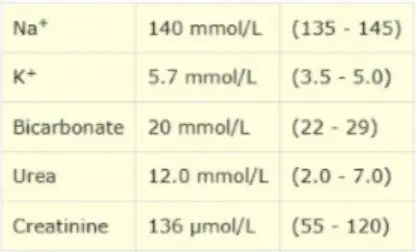
A 63‑year‑old man presents to his GP with persistent back pain. His past medical history includes pneumonia, cellulitis, and pyelonephritis, all of which occurred over the past year. Upon performing a systemic inquiry, he mentions he has noticed that he bruises quite easily, has experienced frequent fatigue, and increased thirst over the past few months. His blood test shows the results listed in the accompanying panel. Based on these results, select the most likely pattern of calcium, phosphate, and ALP.
Hypercalcemia, low phosphate, normal ALP
Hypercalcemia, normal/high phosphate, normal ALP
Hypocalcemia, low phosphate, high ALP
Hypocalcemia, normal/high phosphate, noramal ALP
A 70‑year‑old woman presents with constipation and confusion. Blood tests show corrected calcium 3.2 mmol/L (2.15–2.55 mmol/L). Renal function: normal. She is treated with intravenous normal saline. What is the MOST appropriate next step in management?
Oral calcium supplements
Intravenous zoledronic acid
Observation only
Thiazide diuretic
Which of the following are not possible causes of pseudohyperkalaemia?
fist clenching during blood draw
tourniquet time >1 minute
metabolic acidosis
leucocytosis
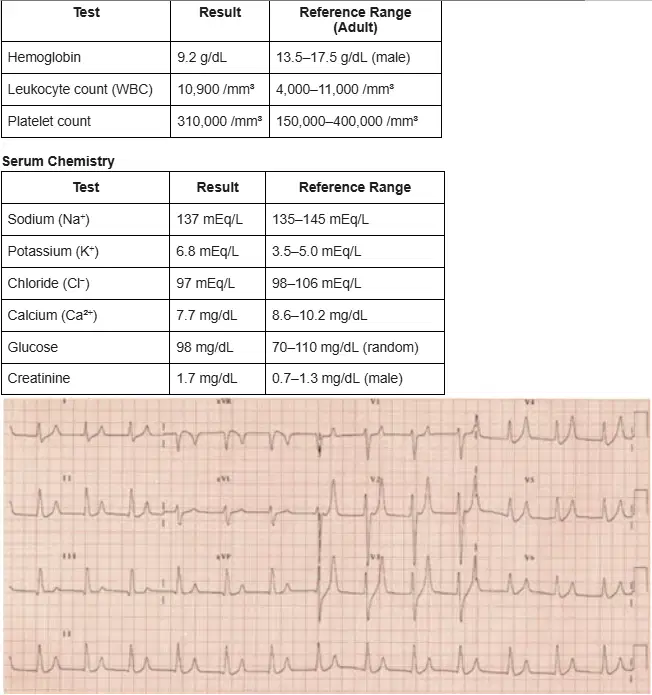
A 32-year-old man is brought to the emergency department after a car accident; he was extricated after 4 hours. He did not lose consciousness and does not have headache or nausea. He is in severe pain. He sustained severe injuries to both arms and the trauma team determines that surgical intervention is needed. Urinary catheterization shows dark-colored urine. His temperature is 38.0°C (100.4°F), pulse is 110/min, and blood pressure is 90/60 mm Hg. The patient is alert and oriented. Examination shows multiple injuries to the upper extremities, contusions on the trunk, and abdominal tenderness.
Arterial blood gas analysis on room air shows a pH of 7.30 and serum bicarbonate of 14 mEq/L. An ECG is shown.
Laboratory studies and ECG are shown
A FAST scan of the abdomen shows no free intra-abdominal fluid. Two large-bore cannulas are inserted and intravenous fluids are administered.
Which of the following is the most appropriate next step in management?
Calcium Gluconate Therapy
Mannitol Therapy
Insulin Therapy
Norepinephrine Therapy

