
 Worksheets
Unit 1: Promotion of Safety Test
Total questions: 36
Worksheet time: 18mins
Health care workers do not have a legal responsibility to protect patients from harm and injury.
True
False
Principles of good body mechanics state that you should avoid bending for long periods of time.
True
False
Ergonomics refers to the way in which the body moves and maintains balance while making the most efficient use of all its parts.
True
False
Good posture is not essential to body alignment and correct body mechanics.
True
False
The major cause of fires is carelessness with matches and smoking.
True
False
The Occupational Exposure to Hazardous Chemicals Standard mandates to protect health care providers from diseases caused by exposure to body fluids.
True
False
All manufacturers must provide Safety Data Sheets (SDSs) with any hazardous product they sell.
True
False
If you find a piece of damaged or malfunctioning equipment, ____.
read the instructions for the equipment
repair the equipment before using it
report it immediately
put the equipment away in storage
Ergonomics includes all of the following except ____.
correct placement of equipment
determining which repetitive movements will be most effective
correct placement of furniture
an awareness of the environment to prevent injuries
Solutions used in health care facilities ____.
can be dangerous, so avoid eye and skin contact
can be mixed together in most cases
do not always need a label
all of the above
If a solution such as acetic acid spills on a counter, ____.
wipe it up immediately
dilute it with water
absorb it into a sponge
report it immediately
You read the labels on solution bottles at least how many times?
one
two
three
four
Most fire emergency plans usually include all of the following except ____.
patients and personnel in immediate danger should be removed from the area
the alarm should be activated as soon as possible
electrical equipment and oxygen should be shut off
doors and windows should be opened to expel the smoke
If a particle gets in your eye, ____.
rub the eye to loosen the particle
report it immediately
flush the eye with large amounts of water
use a sterile gauze pad to remove the particle
While handling any electrical equipment, be sure to ____.
check first for damaged cords or improper grounds
plug the equipment into any socket regardless if the equipment has improper grounding
wear gloves
all of the above
In case of fire in a health care facility, the most important thing to do is ____.
know the fire emergency plan
activate the fire alarm
remove everyone from the building
remain calm
The three things needed in order for a fire to start are ____.
fuel, heat, oxygen
fuel, oxygen, carbon dioxide
carbon dioxide, oxygen, chemical reaction
fuel, flammable material, carbon dioxide
How many inches apart should the feet be to maintain a broad base of support?
2 to 4
4 to 6
6 to 8
8 to 10
Safety glasses ____.
should be worn at all times
are required for some procedures
usually are not needed in health care facilities
must be worn while using electrical equipment
To get close to an object, ____.
twist to the correct angle
bend from the waist and knees
bend from the hips and knees
reach out for the object
When leaving a patient's room you should always remember to,
elevate the side rails
lower the bed to the lowest point
open the privacy curtain
all the above
When using correct body mechanics it is important to _____.
bend from the waist correctly
obtain a narrow base of support
twist while moving a patient
use the strongest muscles
Match the type fire extinguisher(s) with the correct information below. Used on burning plastic
Class A
Class B
Class C
Class D
Match the type fire extinguisher(s) with the correct information below. Used on burning or combustible metals
Class A
Class B
Class C
Class D
Match the type fire extinguisher(s) with the correct information below. Used on paper, cloth, and wood fires
Class A
Class B
Class C
Class D
Match the type fire extinguisher(s) with the correct information below. Used on electrical fires
Class A
Class B
Class C
Class D
Match the type fire extinguisher(s) with the correct information below. Often specific for only one metal
Class A
Class B
Class C
Class D
Match the type fire extinguisher(s) with the correct information below. Used on combustible liquids
Class A
Class B
Class C
Class D
Match the type fire extinguisher(s) with the correct information below. Used on gasoline, oil, and paint fires
Class A
Class B
Class C
Class D
Code used in most health care facilities for an abducted child or infant.
Code Blue
Code Pink
Code Red
Code Silver
Code used in most health care facilities for a patient who has went into cardiac arrest.
Code Blue
Code Pink
Code Red
Code Silver
Code used in most health care facilities for to let patients and employees know there is an active shooter on site.
Code Blue
Code Pink
Code Red
Code Silver
Code used in most health care facilities to let patient and employees know there is a fire.
Code Blue
Code Pink
Code Red
Code Silver
What does the 'R' in the acronym RACE stand for?
Run to the nearest exit
Return to assigned area
Remain Calm
Rescue anyone in immediate danger
The 'E' in the acronym RACE stands for extinguish the fire if safely able to do so or, __________ if the fire is too large.
evacuate the area
exit the fire
evaluate the situation
enter the safe zone
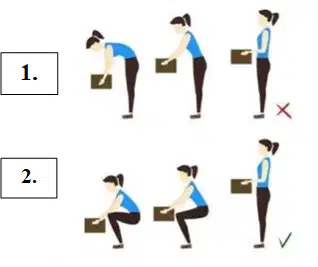
Which diagram above shows the correct use of body mechanics?
Number 1
Number 2

