
NEW
Font size
 Worksheets
Capstone Review ENR
Total questions: 75
Worksheet time: 13hrs 30mins
Solve for x: x + 16 = 31
x = −17
x = −15
x = 15
x = 17
Solve for n: 78 = −2 − 10n
n = −7
n = −9
n = −6
n = −8
Solve for r: (r + 3) / 16 = 1
r = 19
r = 16
r = 13
r = −13
Solve for b: −6b − 7 = 11
b = 2
b = −2
b = 3
b = −3
Solve for n: −7(−6n + 5) − 2 = −373
n = −5
n = −6
n = -8
n = 5
Solve for r: 85 = −3 + 8(r + 4)
r = 3
r = 7
r = 5
r = 6
Solve for x: −7(x + 8) = −91
x = 21
x = −5
x = 5
x = −21
Solve for n: −8(6n − 5) = 136
n = 3
n = 2
n = −2
n = −3
Solve the absolute value equation: |b − 5| = 11
b = 16 or b = −6
b = 6 or b = −16
b = 16 or b = −16
b = 6 or b = −6
Solve the absolute value equation: |k / 7| = 3
k = 10 or k = −10
k = 7 or k = −7
k = 3 or k = −3
k = 21 or k = −21
Solve the absolute value equation: |−7x − 5| = 5
x = 0 or x = −10/7
x = 10/7 or x = 0
x = 5/7 or x = −5/7
x = −10/7 or x = 10/7
Solve the absolute value equation: |4x − 9| = 33
x = 6 or x = −6
x = 21/2 or x = −21/2
x = 6 or x = −21/2
x = −6 or x = 21/2
How would you graph k ≤ 6?
All k to the left of 6, open dot
All k to the right of 6, closed dot
All k to the left of 6, closed dot
All k to the right of 6, open dot
How would you graph k ≤ 18?
All k to the left of 18, open dot
All k to the right of 18, closed dot
All k to the left of 18, closed dot
All k to the right of 18, open dot
How would you graph x > −6?
All x to the right of −6, open dot
All x to the left of −6, closed dot
All x to the right of −6, closed dot
All x to the left of −6, open dot
How would you graph x > 20?
All x to the right of 20, open dot
All x to the left of 20, closed dot
All x to the right of 20, closed dot
All x to the left of 20, open dot
Solve: m / 5 ≥ 20
m ≤ 100
m ≥ 100
m ≥ 20
m ≥ 4
Solve: 9(−3 + a) ≥ −162
a ≤ −12
a ≥ −12
a ≥ −15
a ≤ −15
Solve: −2 ≥ (n − 1) / 10
n ≥ −19
n ≤ −21
n ≥ −21
n ≤ −19
Solve 3(−3 + 5p) + 3p > 135
p > 7
p > 8
p ≥ 8
p ≥ 7
Solve: 88 ≤ 8(a + 4)
a ≥ 11
a ≤ 11
a ≤ 7
a ≥ 7
Solve: x + 4 < −5 or x + 10 ≥ 2
x < −9 or x > −8
x ≤ −9 or x ≥ −8
x ≤ −9 or x > −8
x < −9 or x ≥ −8
How would you graph x < −9 or x ≥ −8?
Closed circle at -9, open circle at -8, arrows pointing outward
Open circle at -9, open circle at -8, arrows pointing inward
Closed circle at -9, closed circle at -8, arrows pointing inward
Open circle at -9, closed circle at -8, arrows pointing outward
Solve: −4 + x > 6 or x − 10 < −13
x ≥ 6 or x ≤ −10
x > 6 or x < −10
x ≥ 10 or x ≤ −3
x > 10 or x < −3
How would you graph x > 10 or x < −3
Open circle at 10, open circle at 3, arrows pointing outward
Open circle at 10, closed circle at -3, arrows pointing outward
Open circle at 10, open circle at -3, arrows pointing outward
Closed circle at 10, open circle at -3, arrows pointing inward
Solve: 8a > −32 and a − 6 ≤ −5
a > −4 and a ≤ 1
a ≥ −4 and a < 1
a > 4 and a ≤ 1
a ≥ 4 and a < 1
How would you graph a > −4 and a ≤ 1?
Open circle at -4, closed circle at 1, arrows pointing inward
Open circle at -4, open circle at 1, arrows pointing outward
Closed circle at -4, open circle at 1, arrows pointing inward
Closed circle at -4, open circle at -1, arrows pointing outward
Solve: −18 < 9n ≤ 18
−10 < n ≤ 10
−8 < n ≤ 8
−1 < n ≤ 1
−3 < n ≤ 3
How would you graph −3 < n ≤ 3?
Closedcircle at -3, open circle at 3, arrows pointing inward
Open circle at -3, closed circle at 3, arrows pointing outward
Closed circle at -3, closed circle at 3, arrows pointing inward
Open circle at -3, closed circle at 3, arrows pointing inward
Solve the inequality |x + 10| ≤ 5. Which solution set is correct?
x ≤ −15 or x ≥ −5
−5 ≤ x ≤ 15
x ≤ 5 or x ≥ −10
−15 ≤ x ≤ −5
Solve the inequality |n − 2| > 6. What is the solution set?
n ≥ −4 and n ≤ 8
n > −8 and n < 4
n < −4 or n > 8
−8 < n < 4
Solve the inequality |−3b| > 3. What is the solution set for b?
b ≥ −1 and b ≤ 1
b ≤ −1 and b ≥ 1
−1 < b < 1
b < −1 or b > 1
Solve the inequality |2x| ≤ 6. Which describes all possible x values?
x ≤ 3 or x ≥ −3
−3 ≤ x ≤ 3
x ≤ −12 or x ≥ 12
−12 ≤ x ≤ 12
Convert to slope-intercept form: 7x − y = −2. What is the equation?
y = −7x + 2
y = 7x + 2
y = 7x − 2
y = −7x − 2
Convert to slope-intercept form: x + y = −7. What is the equation?
y = x + 7
y = −x + 7
y = x − 7
y = −x − 7
Convert to slope-intercept form: 6x + y = −6. What is the equation?
y = 6x + 6
y = −6x + 6
y = 6x − 6
y = −6x − 6
Convert to slope-intercept form: 2x + y = −7. What is the equation?
y = −2x + 7
y = 2x − 7
y = −2x − 7
y = 2x + 7
Convert to slope-intercept form: 6x + y = 2. What is the equation?
y = −6x + 2
y = 6x − 2
y = 6x + 2
y = −6x − 2
Convert to slope-intercept form: x − 13y = 84. What is the equation?
y = −(1/13)x + 84/13
y = −(1/13)x − 84/13
y = (1/13)x + 84/13
y = (1/13)x − 84/13
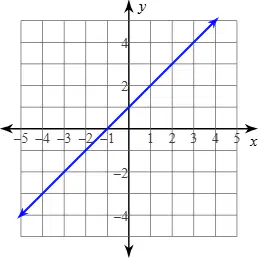
From the graph, identify slope and y-intercept, then write the equation in slope-intercept form.
y = 2x − 1
y = (3/4)x − 1
y = (1/2)x − 1
y = x + 1
Given slope = 3 and y-intercept = −4, what is the line’s equation?
y = 3x − 4
y = 4x + 3
y = −4x − 3
y = −3x + 4
Given slope = −1 and y-intercept = 2, what is the line’s equation?
y = −2x − 1
y = x + 2
y = −x + 2
y = 2x − 1
Write the slope-intercept form of the line through (5, 0) with slope = −5/8.
y = −(5/8)x + 25/8
y = (5/8)x − 25/8
y = (5/8)x + 25/8
y = −(5/8)x − 25/8
Write the slope-intercept form of the line through (2, 3) with slope = −1.
y = −x + 5
y = −x − 1
y = −x + 1
y = −x − 5
Write the slope-intercept form of the line through (1, −5) with slope = −10.
y = 10x + 5
y = 10x − 5
y = −10x − 5
y = −10x + 5
Write the slope-intercept form of the line through (3, −1) with slope = 0.
y = x − 1
y = 0
y = −1
y = 3x − 1
Write the slope-intercept form of the line through (3, 5) and (0, 4). Choose the correct equation.
y = (2/5)x + 4
y = x + 2
y = x + 4
y = (1/3)x + 4
Write the slope-intercept form of the line through (3, −5) and (−3, −3). Choose the correct equation.
y = 1/3 x − 4
y = −1/3 x − 4/3
y = 1/2 x − 4/3
y = −1/3 x − 4
Write the slope-intercept form of the line through (−2, 1) and (5, 3). Choose the correct equation.
y = 1/3 x + 2
y = 2/7 x + 11/7
y = 2/7 x + 15/7
y = 7/2 x − 3
Write the slope-intercept form of the line through (3, −4) and (0, −1). Choose the correct equation.
y = −x + 2
y = x − 4
y = −x − 1
y = x − 1
Find the slope-intercept form of the line through (−4, 5) parallel to y = −5/4 x + 1.
y = 4/5 x + 0
y = −5/4 x
y = −5/4 x + 5
y = −4/5 x + 5
Find the slope-intercept form of the line through (−4, −2) parallel to y = 1/4 x − 4.
y = 1/4 x − 1
y = -4 x − 3
y = 1/4 x − 2
y = 4 x − 2
Find the slope-intercept form of the line through (5, −5) perpendicular to y = 5/7 x + 4.
y = 7/5 x + 2/5
y = 7/5 x +2
y = -7/5 x + 2/5
y = −7/5 x + 2
Find the slope-intercept form of the line through (5, 3) perpendicular to y = 5x − 4.
y = 1/5 x - 4
y = −1/5 x + 4
y = −1/5 x - 4
y = 1/5 x + 4

For y = −3x, what are two points that help sketch the line on the grid?
(1, 3) and (−1, 0)
(0, 3) and (−1, −3)
(0, −3) and (1, 0)
(0, 0) and (1, −3)

For y = −x − 4, which statement correctly identifies the y-intercept and slope?
y-intercept 4, slope 1
y-intercept −1, slope −4
y-intercept 4, slope −1
y-intercept −4, slope −1

Convert x − 5y = 0 to slope-intercept form.
y = 1/5 x + 0
y = x − 5
y = 5x + 0
y = −1/5 x + 0

Convert 2x − y = −2 to slope-intercept form.
y = −2x − 2
y = 2x − 2
y = 2x + 2
y = −2x + 2

Convert x − 2y = −8 to slope-intercept form.
y = 1/2 x − 4
y = 1/2 x + 4
y = 2x + 8
y = −1/2 x + 4

Convert x − 4y = −20 to slope-intercept form.
y = 1/4 x + 5
y = 1/4 x − 5
y = −1/4 x + 5
y = 4x − 20
Which graph represents the equation y = 5?
Curve passing through (0,5) only
Diagonal line slope 5 intercept 0
Vertical line through x = 5
Horizontal line through y = 5
For the inequality y < −(8/3)x + 5, which boundary line style should be used?
Squiggly boundary line
No boundary line at all
Solid boundary line
Dashed boundary line
In the inequality x + 4y < −12, what is the y‑intercept of the boundary line x + 4y = −12?
(0, 3)
(0, −3)
(0, −4)
(0, −12)
For x + y ≤ 1, which point is a solution?
(1,1) is a solution
(2,2) is a solution
(2,0) is a solution
(0,1) is a solution
Solve the system by graphing: y = (2/3)x + 1 and y = −(1/3)x + 4. What is the intersection point?
(3,3)
(4,3)
(3,4)
(2,2)
Solve the system by graphing: y = −5x + 2 and y = −x − 2. What is the solution?
(−1,7)
(−1,−1)
(2,−8)
(1,−3)
Solve the system by graphing: −y − 4 = −3x and 0 = −y + 4 − x. What is the intersection?
(−4,−8)
(2,2)
(0,4)
(−1,−1)
Solve by graphing: −9y + 3x = 36 and −y = 4 − (1/3)x. What is the solution?
(0,−4)
(12,0)
No Solution
Infinite Solutions
Solve by substitution: y = −6x − 13 and 6x − 4y = 22.
(2,6)
(-1,-7)
(6,2)
(-7,-1)
Solve using substitution: y = −3x + 11 and −5x − y = −21
(21, 3)
(-4, 5)
(3, 21)
(5, -4)
Solve the system x − 4y = −19 and −x + 4y = 19. What is the solution?
(−19, 0)
(0, −19/4)
No solution
Infinitely many solutions
Solve by substitution: 4x + 2y = 8 and 2x + y = 1. What is the solution pair?
No Solution
(2,−3)
Infinite Solutions
(−3,7)
Eliminate to solve: 4x − y = 16 and −4x − 5y = −16.
(8, -4)
(4, 0)
(−4, 8)
(0,4)
Eliminate to solve: 3x + y = 3 and −3x + y = −3.
(3,1)
(0,1)
(1,3)
(1, 0)
Use elimination: −6x − 7y = 23 and −12x − 10y = 26. What is the solution type?
Cannot be determined
Infinitely many solutions
One solution, lines intersect
No solution, lines parallel

