
NEW
Font size
 Worksheets
Quarter 2 Review
Total questions: 74
Worksheet time: 37mins
Which step of the Scientific Method involves testing your hypothesis?
Experiment
Conclusion
Observation
Ask Questions
What does the Hypothesis step in the Scientific Method mean?
Using your 5 senses
Educated guess or idea
Summarize info based on data
Write down data and figure out your information
Which of the following is the best hypothesis for testing if plants need sunlight to grow?
I think plants need water to grow tall.
I think if plants get sunlight, they will grow taller because plants need sunlight to grow.
Some plants grow better than others and I was proved.
Plants are living things that need nutrients.
What is the first step of the Scientific Method?
Experiment
Hypothesis
Observation
Conclusion
Which step of the Scientific Method involves asking how and why certain things occur?
Ask Questions
Experiment
Reflect & Repeat
Record and Analyze Data
What do you do in the "Record and Analyze Data" step of the Scientific Method?
Summarize info based on data
Write down data and figure out your information, compare and contrast
Test your hypothesis
Ask how and why certain things occur
What is the purpose of the "Reflect & Repeat" step in the Scientific Method?
Look over work and repeat the steps to check your work
Test your hypothesis
Using your 5 senses
Educated guess or idea
What are the three parts you should include when writing a conclusion for an experiment?
Restate hypothesis, say if you were proved/disproved/inconclusive, explain why using your data
Write your name, list materials, draw a picture
Make a guess, write a story, ask a question
Record data, analyze data, make a graph
What is data in a science experiment?
The answer to a math problem
What is collected and recorded during an experiment, such as numbers (measurements) and observations
The title of your experiment
The materials you use
What does it mean to record and analyze data?
To draw a picture of your experiment
To write down your data and figure out your data by looking for similarities, differences, or patterns
To guess the results
To clean up your workspace
In an experiment, what is it called when you keep many things the same?
Variables
Constants
Hypothesis
Observations
What is a variable in an experiment?
Something you keep the same
Something you test one thing at a time
The result of the experiment
The conclusion
What is the invisible region around a magnet called?
Magnetic field
Electric current
Gravity zone
Light beam
Magnetism is the force of ________ and ________ between two objects.
attraction, repulsion
friction, gravity
heat, light
pressure, volume
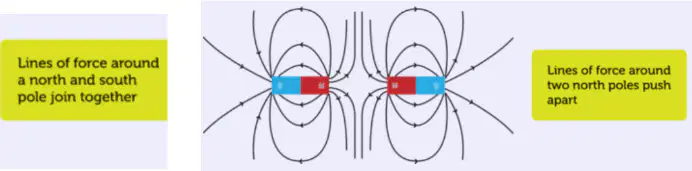
Which diagram represents attraction between two magnets?
The diagram where lines of force join together
The diagram where lines of force push apart
The diagram with no lines of force
The diagram with only one magnet
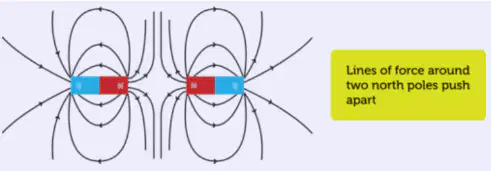
Which diagram represents repulsion between two magnets?
The diagram where lines of force push apart
The diagram where lines of force join together
The diagram with only one magnet
The diagram with no lines of force
In the experiment described, what is the variable?
Liquid spray (lemon juice or water)
Green slime
Shower
4 days of spraying
Which of the following is NOT a constant in the experiment?
Type of liquid spray used
Shower
Green slime
4 days of spraying
What type of material allows electric current to easily flow through it?
Insulator
Conductor
Plastic
Wood
Which material is commonly used for electrical wiring because it conducts electricity well?
Plastic
Wood
Copper
Glass
What do insulators do in an electrical circuit?
Increase the flow of electricity
Prevent or reduce the flow of electrical current
Change electricity into light
Make electricity flow faster
Materials with high resistance are usually:
Conductors
Insulators
Metals
Wires
A series circuit has how many paths for the electric current to flow?
Many
Two
One
Four
If one light goes out in a series circuit, what happens to the other lights?
They all stay on
They all go out
Only one goes out
They get brighter
A parallel circuit is described as:
Simple with one path
Complex with many paths
Simple with no paths
Complex with one path
If one light goes out in a parallel circuit, what happens to the other lights?
They all go out
Only one goes out
The current stops
The current cannot travel
What is created when electricity and magnetism are combined?
Insulator
Electromagnet
Battery
Light bulb
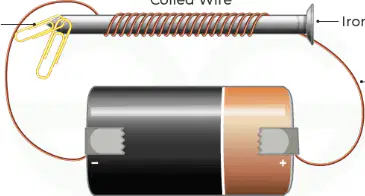
Electromagnetism is the interaction between which two forces?
Electrical and gravitational
Magnetic and electrical
Magnetic and thermal
Electrical and sound
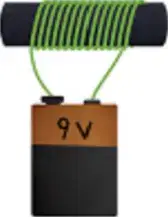
Which electromagnet is the strongest?
1
2
Both are equally strong
Neither is strong
Why is electromagnet 1 stronger than electromagnet 2?
It has more coils.
It has a bigger battery.
It is made of gold.
It is heavier.
Which type of adaptation is described when a poison dart frog produces toxins in its body to protect itself from predators?
Structural
Physiological
Learned
Instinctive
What is an example of a learned behavior in animals?
Lion cubs learning how to hunt from the pride
Owl butterfly mimicking a larger animal
Camel storing water in its hump
Polar bear having large paws
How do camels survive when there is not water available to drink?
They store water in their hump.
They run very fast.
They sleep during the day.
They eat only grass.
What adaptation helps polar bears not slip on ice?
Large paws, sharp claws, stiff hairs on their paws
Long tail
Big ears
Short legs
Which adaptation is described as an animal migrating during a specific season and knowing how to find their way?
Instinctive behavior
Structural adaptation
Learned behavior
Physiological adaptation
Which biome receives less than 10 inches of precipitation each year and can be extremely dry but hot or cold?
Desert
Rainforest
Tundra
Ocean
Which biome receives the most amount of precipitation each year and is located near the equator, being warm year round and very humid?
Grasslands
Rainforest
Tundra
Deciduous Forest
Which biome has only two seasons, winter and summer, and during the winter the sun stays below the horizon for weeks?
Ocean
Coniferous Forest
Tundra
Rainforest
Which biome is the largest on earth and is made up of different zones where light, pressure, and temperature change at each zone?
Ocean
Desert
Deciduous Forest
Grasslands
Which biome is home to many broad leaf trees, has 4 seasons with a mild climate, and the trees drop their leaves to retain water and energy?
Coniferous Forest
Deciduous Forest
Rainforest
Tundra
Which biome receives more rain than a desert but less than a forest, and the dominant vegetation is grass?
Grasslands
Ocean
Rainforest
Tundra
Which biome has trees that remain green with pine needles all year long and is found south of the tundra with cold winters and cool summers?
Deciduous Forest
Coniferous Forest
Rainforest
Desert
What is the term for the impact humans have on the frequency and intensity of natural disasters and changes in the world?
Biodiversity
Precipitation
Climate change
Vegetation
What is happening to biodiversity in many biomes due to human activities?
Increasing
Decreasing
Staying the same
Unknown
What is the process of fertile land turning into desert called?
Deforestation
Poaching
Desertification
Drilling
What is the illegal hunting of animals that can lead to extinction known as?
Drilling
Poaching
Ocean warming
Air pollutants
What is the large removal and destruction of forests called?
Sea
Deforestation
Arid
Desertification
Regions with very little rainfall and water have what type of climate?
Ocean warming
Arid
Poaching
Drilling
What levels are rising due to climate change, affecting coastal areas?
Air pollutants
Sea
Deforestation
Drilling
What is caused by excess heat being absorbed into the ocean from human-caused greenhouse gas emissions?
Poaching
Ocean warming
Desertification
Arid
What activity for oil can cause environmental pollution and disrupt habitats?
Drilling
Poaching
Deforestation
Sea
What do fossil fuels, cars, and wildfires release into the air, causing gases to build up in the atmosphere?
Ocean warming
Air pollutants
Desertification
Arid
What is the definition of climate?
The long term pattern of weather (Average temperature and precipitation over decades)
The current condition of the atmosphere over a short period of time
The layer of gases that surrounds Earth and protects it
The movement of air in the atmosphere
What is the definition of weather?
The long term pattern of weather
The current condition of the atmosphere over a short period of time
The layer of gases that surrounds Earth and protects it
The amount of air pressure in the atmosphere
What is the atmosphere?
The layer of water that covers Earth
The layer of gases that surrounds Earth and protects it
The solid ground beneath Earth's surface
The movement of clouds in the sky
In which layer of the atmosphere does weather occur?
Exosphere
Thermosphere
Mesosphere
Troposphere
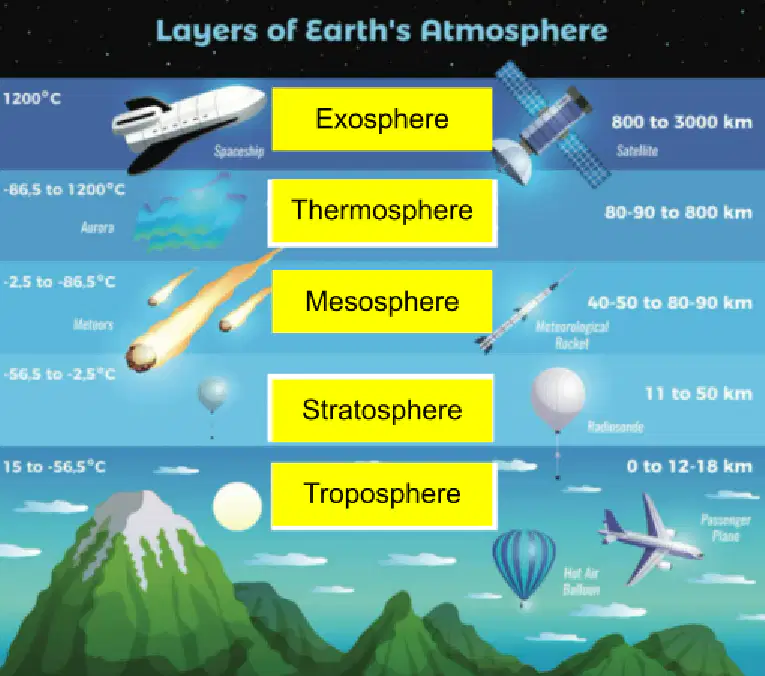
Label the layers of the atmosphere as shown in the diagram.
Troposphere, Stratosphere, Mesosphere, Thermosphere, Exosphere
Troposphere, Mesosphere, Stratosphere, Thermosphere, Exosphere
Exosphere, Thermosphere, Mesosphere, Stratosphere, Troposphere
Stratosphere, Troposphere, Mesosphere, Exosphere, Thermosphere
Why are there different weather patterns around Earth’s surface?
Because the Earth is flat
Because the sun heats the Earth evenly
Because the Earth’s surface is heated unevenly by the sun
Because the moon pulls the air
Which of the following would be an example of climate?
The temperature is currently 75°F.
On Saturday, January 31st we are predicted to receive 2 inches of snow.
The polar regions of Earth have two seasons; summer and winter.
A warm front will pass through Endwell, New York on Sunday, January 26th.
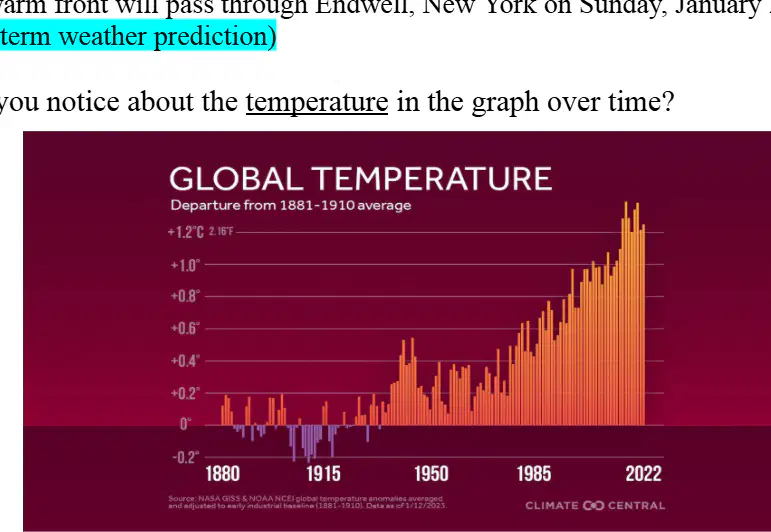
What do you notice about the temperature in the graph over time?
The temperature has stayed the same since 1880.
The temperature has decreased since 1880.
The temperature has increased since 1880.
The temperature has fluctuated but never increased.
What causes convection currents in Earth's atmosphere?
Warm and cool air traveling in a straight path
Uneven heating of the Earth's surface
Ocean currents
Gravitational pull of the moon
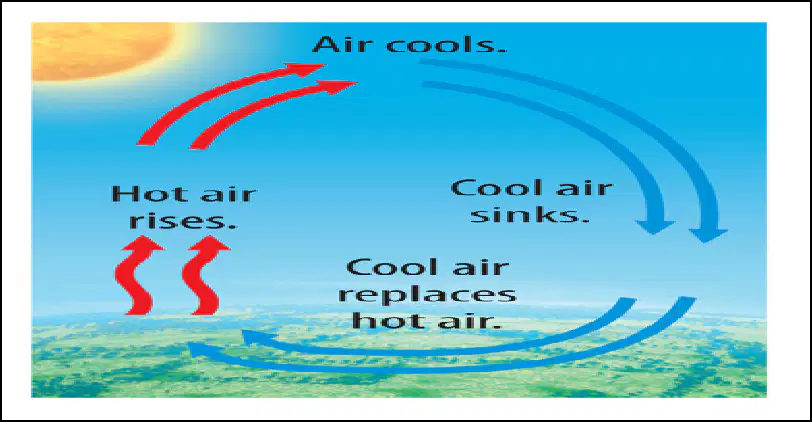
What happens to air in a convection current?
Hot air sinks and cool air rises.
Hot air rises and cool air sinks.
Both hot and cool air rise.
Both hot and cool air sink.
What is the Coriolis effect and how does it impact planetary winds?
It causes winds to move in a straight line.
It causes winds to be deflected and curve due to Earth's rotation.
It only affects ocean currents, not winds.
It causes winds to stop completely at the equator.
At higher altitudes, what happens to air pressure?
Air pressure is higher.
Air pressure is lower.
Air pressure stays the same.
Air pressure disappears.
At lower altitudes (sea level), what happens to air pressure?
Air pressure is higher.
Air pressure is lower.
Air pressure stays the same.
Air pressure disappears.
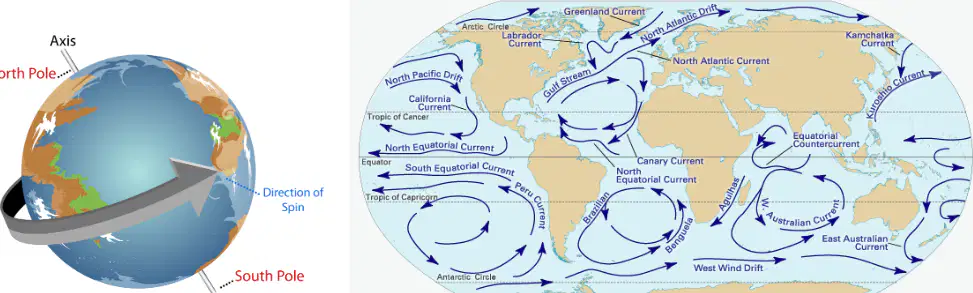
The Coriolis effect causes wind and ocean currents to rotate in what kind of pattern?
Straight pattern
Zigzag pattern
Circular pattern
Random pattern
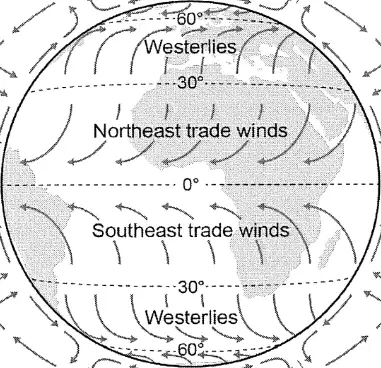
Which of the following claims uses correct evidence from the model of global atmospheric circulation?
The prevailing winds only flow from West to East in the direction that the Earth spins on its axis.
Air flows in the same direction as the prevailing winds. Between 0° North and 30° North you can find the Northeast trade winds that blow from the northeast to the southwest.
The prevailing winds in the northern hemisphere all flow in a straight line but in the southern hemisphere they curve.
Air flows in the same direction as the prevailing winds. Between 30° South and 60° South you can find the Southeast trade winds which flow from the southwest to the northeast.
Which of the following is an example of a phenomenon?
Coriolis Effect
Magnet Pole
Rainforest
Deforestation
Which of the following is NOT a step in the scientific method?
Making a hypothesis
Identifying a variable
Drawing a conclusion
Poaching
Which of the following is a type of biome?
Rainforest
Magnet
Electric Current
Hypothesis
Which of the following is an example of human impact on the environment?
Deforestation
Series Circuit
Atmosphere
Structural Adaptation
Which of the following is related to weather and climate?
Atmosphere
Magnet Poles
Learned Behavior
Coal Mining
Which of the following is a resource you can use to study for science?
Science binder notes
Rainforest
Electric current
Wildfires
Which of the following is a type of adaptation?
Structural
Rainforest
Deforestation
Magnet

