
NEW
Font size
 Worksheets
Introduction to Rectifiers and Filters
Total questions: 30
Worksheet time: 15mins
Which statement best defines a rectifier in electronics?
A component storing energy in electric fields
A circuit converting AC voltage to DC voltage
A sensor measuring alternating current levels
A device changing DC voltage to AC voltage
What is rectification in simple terms?
The shaping of DC waveforms into AC
The filtering of noise from DC
The process of converting AC to DC
The amplification of alternating signals
Which component is the main element used for rectification?
Resistor in series with load
Transformer secondary winding
Semiconductor diode device
Inductor placed across source
In forward bias, how does a diode behave in a rectifier circuit?
It conducts current mainly
It oscillates at high frequency
It blocks current completely
It stores charge indefinitely
What does the ripple factor compare in a rectifier’s output?
AC components to DC components
Input power to output voltage
AC components to total power
DC components to input frequency
Which formula represents rectifier efficiency η?
Input AC power minus DC output voltage
AC input current multiplied by DC load
DC output power divided by AC input power
Output AC power divided by input DC power
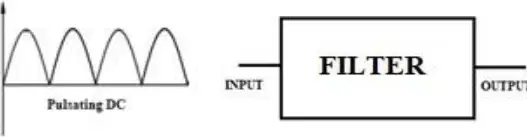
How does a capacitor filter produce a purer DC from a rectifier?
It blocks AC and passes DC to load
It amplifies AC and reduces DC ripple
It stores DC and releases only AC waves
It converts DC to AC using resonance
In a half-wave rectifier without a filter, what happens during the positive half cycle of the input AC?
The diode is reverse biased and blocks current
The diode is forward biased and allows current
The transformer secondary is disconnected from load
The resistor RL stores charge like a capacitor
During the negative half cycle in a half-wave rectifier, the output across RL is best described as:
A steady positive DC level
An increased ripple due to capacitor action
Zero because the diode does not conduct
A steady negative DC level
Which statement explains why this circuit is called a half-wave rectifier?
Only the negative half cycle appears at the output
Both half cycles appear at the output equally
Only the positive half cycle is present at the output
Neither half cycle reaches the load resistor
What is the typical efficiency of a half-wave rectifier converting AC power to DC power?
About 60.0 percent
About 90.0 percent
About 40.6 percent
About 25.0 percent
A filter capacitor is added across RL. When the input AC voltage rises and exceeds the capacitor voltage, what occurs first?
The load disconnects and stops current flow
The diode becomes reverse biased and discharges
The diode becomes forward biased and charges the capacitor
The capacitor immediately discharges through the diode
After the input voltage starts decreasing from its peak in the filtered circuit, why does the capacitor discharge through RL?
Because the capacitor holds more charge than the decreasing input
Because RL becomes an open circuit during decay
Because the input voltage is higher than the capacitor charge
Because the diode shorts the transformer secondary
Which pair lists common disadvantages of a basic half-wave rectifier?
Low ripple and poor efficiency
High ripple and poor efficiency
Low ripple and high efficiency
High efficiency and stable DC
In the waveforms, the time marked 20 ms corresponds to which property of a 50 Hz AC supply?
Two full cycle periods of 50 Hz
Quarter of the cycle period of 50 Hz
Half the cycle period of 50 Hz
One full cycle period of 50 Hz
Which statement best describes a full wave bridge rectifier’s purpose in a circuit?
It amplifies AC to a higher voltage
It stores charge like a capacitor
It converts AC to pulsating DC output
It generates a pure constant DC
How many diodes are used in a typical bridge rectifier configuration?
Four diodes in a bridge
Five diodes with a filter
Two diodes in parallel
Three diodes in series
During the positive half cycle of the AC input, which diode pair conducts in a bridge rectifier?
D3 and D4 conduct together
Only D1 conducts alone
D1 and D2 conduct together
All four diodes conduct
During the negative half cycle of the AC input, what happens to diodes D1 and D2 in a bridge rectifier?
They short the transformer secondary
They are reverse biased and do not conduct
They remain off due to open circuit
They become forward biased and conduct
What is the direction of current through the load in a full wave bridge rectifier across both half cycles?
Reverses only when filtered
Stops during the negative half cycle
Remains unidirectional through the load
Alternates direction each half cycle
Which waveform label correctly matches the output of a bridge rectifier without a filter?
Pulsating DC with both halves positive
Triangular wave increasing over time
Smooth DC with zero ripple
AC sine with negative halves clipped
Why does a bridge rectifier use a transformer secondary connected to a four-diode network?
To route each half cycle for forward conduction
To cancel both half cycles of AC
To store energy during peaks for later use
To create negative DC from positive AC
Which statement best describes the role of the filter capacitor in a bridge rectifier during the rising part of the AC cycle?
It blocks current to keep the output zero
It stays uncharged until the AC cycle ends
It charges up toward the peak input voltage
It discharges quickly through the transformer
When the input AC voltage falls after its peak, what does the charged capacitor do in the bridge rectifier circuit?
It discharges through the load resistor
It increases the input frequency
It reverses the transformer polarity
It stops conduction through all diodes
Which rectifier type has higher efficiency based on the comparison table?
Both rectifiers at 50.0 percent
Half wave rectifier at 81.2 percent
Half wave rectifier at 40.6 percent
Bridge rectifier at 81.2 percent
Which option lists the correct ripple factor values for half wave and bridge rectifiers?
Half 0.50, Bridge 0.50
Half 1.21, Bridge 0.482
Half 0.482, Bridge 1.21
Half 0.10, Bridge 0.20
Why is full-wave (bridge) rectification commonly used for converting AC to DC?
It needs fewer diodes and wires
It offers lower ripple in the output
It removes the need for a transformer
It doubles the input voltage amplitude
In a Zener diode regulator, under reverse bias breakdown, what happens to the voltage across the Zener diode?
It rises without any limit
It drops to nearly zero
It remains essentially constant
It fluctuates with input current
How is the Zener diode connected relative to the load resistor in a basic regulator circuit?
In series with the load resistor
Parallel to the load resistor
Between two forward-biased diodes
Across the transformer primary
What is the immediate effect of placing a Zener diode regulator across a varying DC supply feeding a load?
Output current becomes zero at all times
Output voltage tracks input peaks closely
Output frequency doubles automatically
Output voltage stays near the Zener voltage

