
 Worksheets
First Quiz (Psychiatry. Test Preparation & Review Manual)
Total questions: 15
Worksheet time: 11mins
Blocking the H1 receptor will lead to which of the following?
Weight gain
Dry mouth
Orthostatic hypotension
Elevated prolactin
Urinary retention
Needle electromyographic studies of muscles of patients with myasthenia gravis would be expected to reveal:
Delayed F-responses
Slow nerve conduction velocities
Decrementing response to repetitive stimulation
Incrementing response to repetitive stimulation
Increased motor latencies
While working in the emergency room you evaluate a patient with confusion, myoclonus, diarrhea, hypotension, tachycardia, and a normal creatine phosphokinase (CPK) level. The patient is not speaking. His family tells you that he was recently started on a new medication by his psychiatrist for treatment of bipolar disorder but they don't know what.
Between NMS and Serotonin syndrome, which diagnosis would you pick?
NMS because the patient is confused
NMS because rigidity is more commonly part of serotonin syndrome
Serotonin syndrome because it commonly presents with hypotension
NMS because it usually presents with normal CPK
Serotonin syndrome because it more commonly presents with myoclonus and GI symptoms
Which of the following magnetic resonance imaging (MRI) anomalies is most closely associated with patients diagnosed with Huntington’s disease?
Caudate head atrophy
Cerebellar atrophy
Generalized cortical atrophy
Putamen atrophy
Communicating hydrocephalus
Which of the following must be present to meet Diagnostic and Statistical Manual of Mental Disorders 5 (DSM 5) criteria for somatic symptom disorder?
Preoccupation with acquiring a serious illness
Two sexual symptoms
Three pseudoneurological symptoms
Maladaptive thoughts, feelings, or behaviors in response to the symptoms
The illness must begin after age 30
A 65-year-old woman is brought to the emergency room from a nursing home. She is noted to have cognitive impairment, delusions, masked facies, shuffling gait, cogwheel rigidity of the extremities, visual hallucinations, and agitation. She is medicated by the emergency room physician with 5 mg of intramuscular haloperidol but experiences acute worsening of her muscular rigidity. The most likely diagnosis is:
Frontotemporal dementia
Dementia with Lewy bodies
Alzheimer’s dementia
Normal-pressure hydrocephalus
Vascular dementia
Which one of the following is NOT an inhibitor of cytochrome P450 (CYP) 1A2?
Amiodarone
Tobacco
Cimetidine
Fluvoxamine
Grapefruit juice
Brain metastasis is most commonly due to which of the following?
Lung carcinoma
Breast carcinoma
Melanoma
Prostate carcinoma
Colorectal carcinoma
The metabolite of which one of the following tricyclic antidepressants has potent dopamine-blocking ability that can lead to antipsychotic-like side effects?
Amoxapine
Clomipramine
Desipramine
Trimipramine
Imipramine
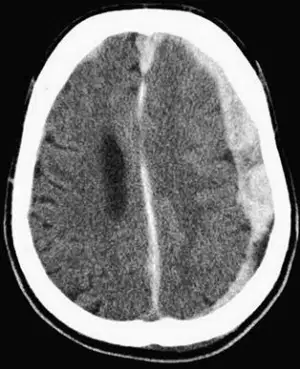
The computed tomography (CT) scan of the brain shown here depicts which one of the following pathologies?
Epidural hematoma
Left middle cerebral artery infarction
Subdural hematoma
Sagittal sinus thrombosis
Uncal herniation
Which one of the following does not pertain to Wilson’s disease?
Dementia
Intention tremor, 4 to 6 Hz
Kayser–Fleischer corneal rings
Chronic hepatic dysfunction, cirrhosis
Early onset, ages 15 to 45 years
Which one of the following central nervous system (CNS) infections is most likely to produce ring-enhancing lesions on brain neuroimaging studies?
Tuberculosis
CNS HIV-related lymphoma
Cryptococcal meningitis
Progressive multifocal leukoencephalopathy
e (AIDS)-related dementia complex
Which one of the following would NOT correlate with the brain imaging finding of thin gyri, wide sulci, and enlarged ventricles (especially the third ventricle)?
Alzheimer’s disease
Chronic alcoholism or drug abuse
A lacunar infarct of the subcortical white matter
Schizophrenia
Trisomy 21 (Down’s syndrome)
A left-sided middle cerebral artery territory stroke is most likely to produce which of the following?
Impaired naming and repetition
Preserved language functioning
Right hemiparesis with leg weakness worse than the face and arm
Receptive, fluent aphasia
Speech paraphasias
You are studying two variables, a binary predictor variable and a continuous outcome variable. You want to know if the relationship between those two variables is due to chance alone. Which of the following tests would you use?
Analysis of variance (ANOVA)
χ2 test
T test
Negative predictive power
Predictive validity

