
 Worksheets
AA. Chapter 1 Test "Classifying and Exploring Life"
Total questions: 81
Worksheet time: 41mins
Name
Class
Date
1.
What Class period are you in?
a)
7-1 (A/C)
b)
7-2 (B/D)
2.
To see something 1500 times larger than its original size, you would use a light/compound microscope. _______________
a)
True
b)
false
3.
All living things have organs that perform specific functions. _______________
a)
True
b)
False
4.
Aristotle lived in Italy. _______________
a)
True
b)
False
5.
For a type of organism to survive, ALL organisms of that type must reproduce. _______________
a)
True
b)
False
6.
The microscopes used today are just like the ones used by Leeuwenhoek and Hooke. _______________
a)
True
b)
False
7.
Linnaeus lived in Sweden in the 1700s. _______________
a)
True
b)
False
8.
A scanning microscope is used to study internal cell structures. _______________
a)
True
b)
False
9.
An organism only grows by increasing its number of cells. _______________
a)
True
b)
False
10.
The first microscope was made in the late 1800s. _______________
a)
True
b)
False
11.
The order in which organisms are classified is Kingdom, Phylum, Order, Class, Genus, Family, and Species._______________
a)
True
b)
False
12.
A scanning microscope is a type of light microscope that has more than one lens. _______________
a)
true
b)
False
13.
Nonliving things can have some characteristics of life. _______________
a)
True
b)
False
14.
How many times does a compound light microscope with an ocular lens of 14 times; and an objective lens of 24 times; magnify objects?
a)
38 times
b)
10 times
c)
336 times
d)
2 times
15.
Photinus pyralis is the scientific name for a firefly in which country
a)
United States
b)
Australia
c)
Germany
d)
All of these
16.
Dichotomous keys are divided into steps with ____ descriptions at each step
a)
two
b)
three
c)
four
d)
five
17.
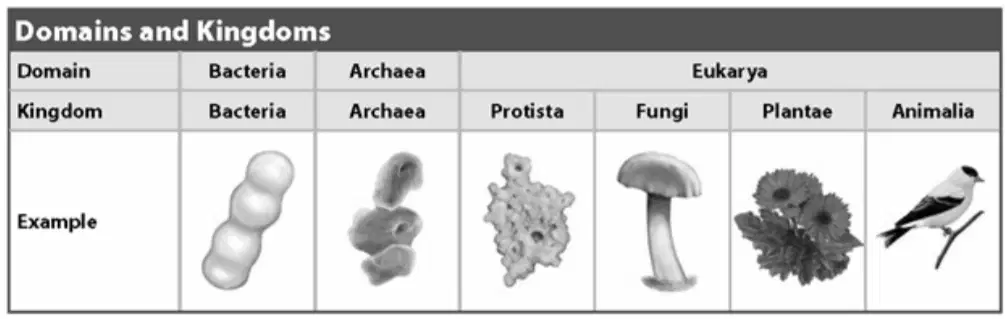
Which of the following is NOT one of the current Kingdoms used for classification of organisms?
a)
Eukarya
b)
Protista
c)
Fungi
d)
Plantae
18.
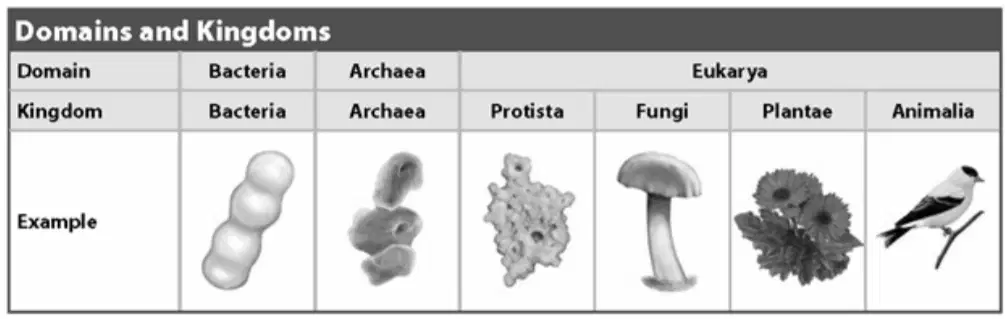
Human beings belong in the which of the following Kingdoms?
a)
Animalia
b)
Protista
c)
Fungi
d)
Plantae
19.
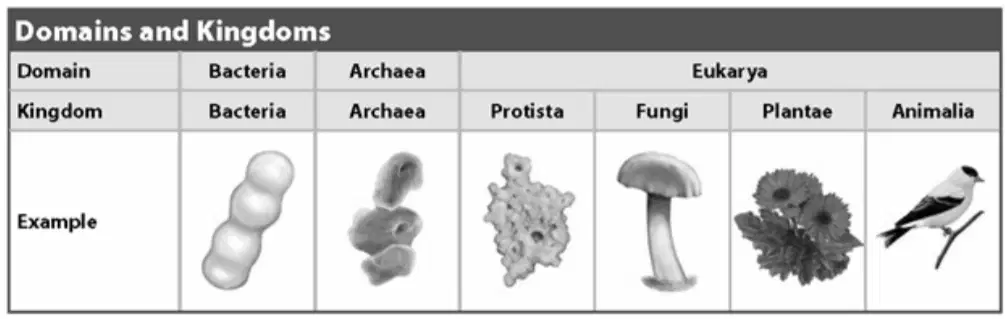
Which of the following Kingdoms contain multicellular organisms?
a)
Bacteria
b)
Protista
c)
Fungi
d)
Archaea
20.
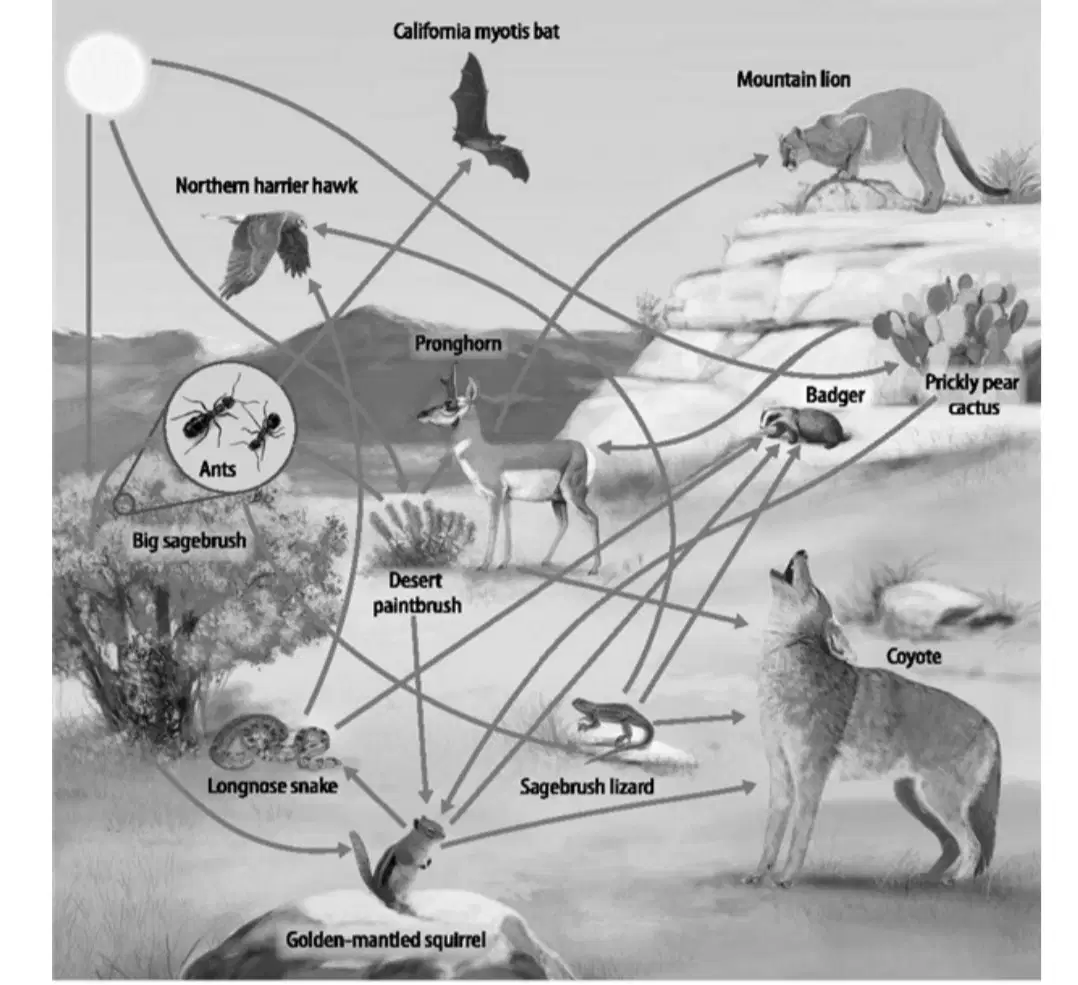
The mountain lion gets its energy from _____.
a)
longnose snake
b)
desert paintbrush
c)
pronghorn
d)
ants
21.
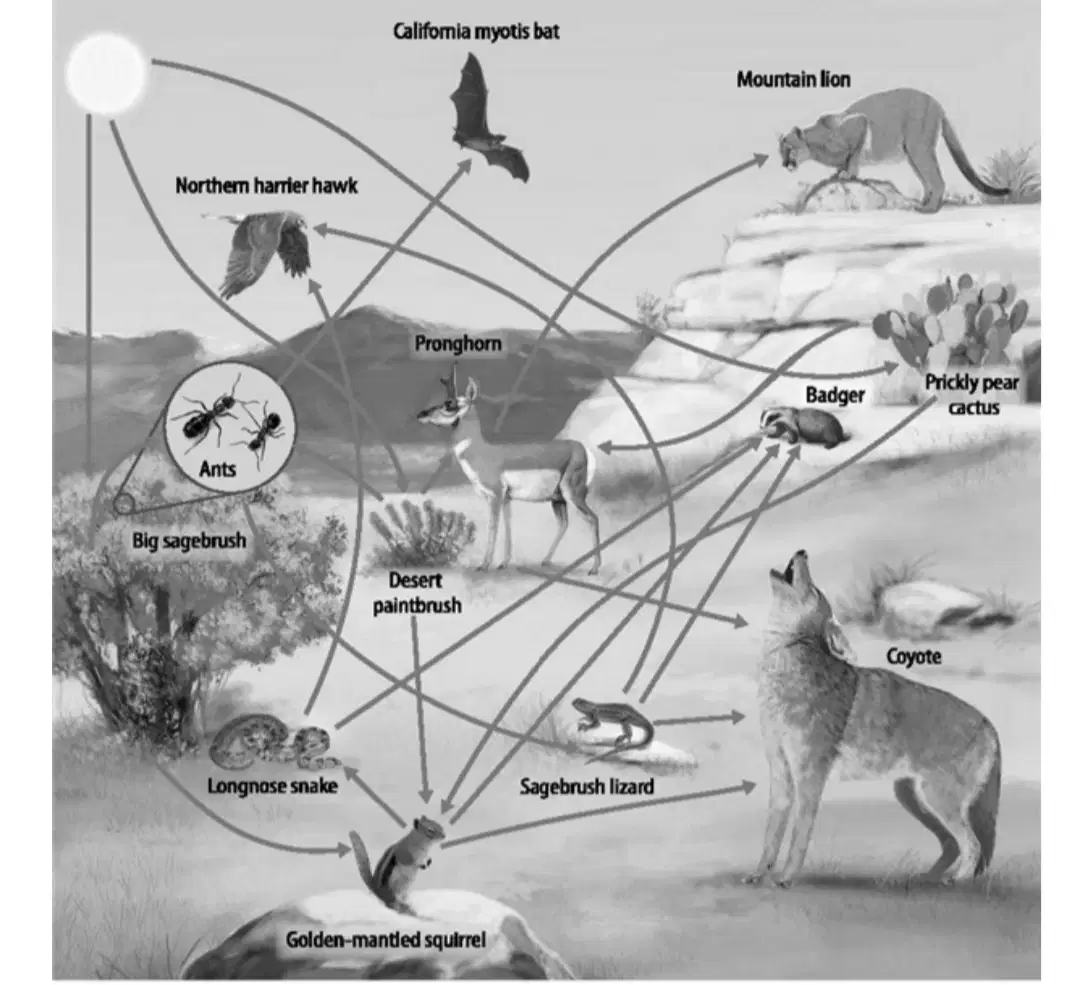
From which food does the California myotis bat get its energy?
a)
ant
b)
desert paintbrush
c)
longnose snake
d)
pronghorn
22.
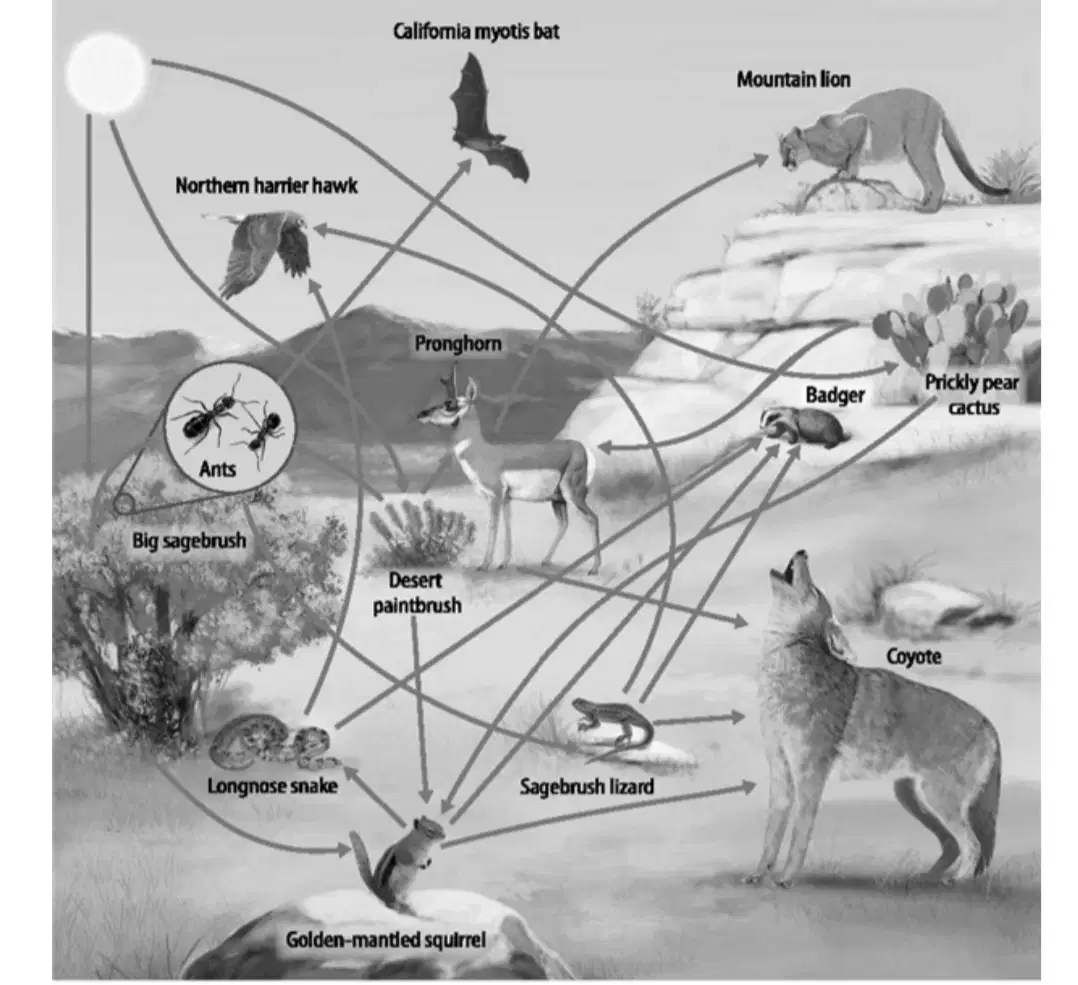
Which organism gets its energy directly from the Sun?
a)
ant
b)
desert paintbrush
c)
longnose snake
d)
pronghorn
23.
Two horses mate and produce a foal. This is an example of _____.
a)
growth
b)
development
c)
homeostasis
d)
reproduction
24.
The classification system most commonly used today separates organisms into ____ kingdoms
a)
six
b)
five
c)
four
d)
three
25.
Which of the following workers would NOT use a microscope?
a)
jeweler
b)
forensic scientist (CSI)
c)
auto mechanic
d)
fossil researcher
26.
Which of the following is NOT a multicellular organism?
a)
worm
b)
amoeba
c)
mosquito
d)
grass
27.
Linnaeus's system gave how many names to each organism
a)
one
b)
two
c)
three
d)
four
28.
Which of the following is an example of a response to stimulus?
a)
you are scared
b)
you are hot
c)
you are tired
d)
you eat food
29.
Early microscopes were invented by Anton van Leeuwenhoek and _____.
a)
Edwin Armstrong
b)
Galileo Galilei
c)
Robert Hooke
d)
Rudolf Hertz
30.
The first name of the organism's scientific name is the ____.
a)
family
b)
order
c)
species
d)
genus
31.
Which of the following is NOT classified like the rest?
a)
couch
b)
tree
c)
grass
d)
rock
32.
Growth of many-celled organisms is mostly due to an increase in the ____ of cells.
a)
number
b)
protons
c)
size
d)
all of the above
33.
If you know an insect is a butterfly but don't know its scientific name, it would be best to use a(n) ____ to find out.
a)
encyclopedia
b)
dictionary
c)
biology textbook
d)
dichotomous key
34.
Which represents the earliest microscope?
a)
compound microscope
b)
transmission electron microscope
c)
scanning electron microscope
d)
light microscope
35.
A tadpole turns into a frog over its lifetime. This is called _____.
a)
development
b)
homeostasis
c)
growth
d)
reproduction
36.
The total magnification of the image in a compound microscope is equal to the magnifications of the ocular lens and the objective lens ______
a)
subtracted
b)
multiplied together
c)
added together
d)
divided
37.
Which of the following is NOT a use of microscopes in the healthcare field?
a)
determine whether tissue is healthy or diseased
b)
locate placement of shots
c)
analyze body fluids
d)
view surgical field
38.
Electrons are found where?
a)
outside cells
b)
outside atoms
c)
inside atoms
d)
inside cells
39.
A plant growing toward light is an example of _____.
a)
reproduction
b)
external stimulus
c)
internal stimulus
d)
homeostasis
40.
Robert Hooke used the microscope to observe and name _____.
a)
blood types
b)
insects
c)
algae
d)
cells
41.
A cladogram is similar to which of the following?
a)
chronology tree
b)
grouping set
c)
concept web
d)
family tree
42.
In a ______ electron microscope, electrons actually pass through the object being viewed
a)
transmission
b)
scanning
c)
compound
d)
passing
43.
How many times does a compound light microscope with an ocular lens of 8 times; and an object lens of 32 times; magnify objects?
a)
256 times
b)
40 times
c)
4 times
d)
24 times
44.
Which of the following is the scientific name for a bear?
a)
Brown bear
b)
Grizzly bear
c)
Ursus arctos
d)
Silvertip bear
45.
What type of field guide would be the easiest and most efficient to use?
a)
encyclopedia with phylum names only
b)
encyclopedia with species names only
c)
Aristotle system
d)
dichotomous key
46.
How many groups did Aristotle use to classify organisms?
a)
two
b)
three
c)
four
d)
five
47.
Of the following, which would NOT be grouped with the others?
a)
sweatshirt
b)
sweat pants
c)
shorts
d)
blue jeans
48.
Things too small to be seen with other microscopes may be viewed with a(n) ____.
a)
compound light microscope
b)
electron microscope
c)
brightfield microscope
d)
simple microscope
49.
Scientific names of organisms consist of ____.
a)
class and order
b)
order and family
c)
genus and specific name
d)
family and genus
50.
Which of the following is more general in terms of classifying an organism?
a)
Class
b)
Species
c)
Order
d)
Family
51.
Which is NOT a function of a dichotomous key?
a)
give descriptive information
b)
more difficult to find and identify species
c)
organisms with similar evolutionary histories are classified together
d)
avoid errors in communication
52.
Which of the following is NOT a method your body uses to regulate homeostasis?
a)
change the flow of blood
b)
sweating
c)
taking a cool shower
d)
shivering
53.
A __________ key uses pairs of descriptions to help the user identify an organism
a)
patriarchal
b)
dichotomous
c)
cladogram
d)
heirarchical
54.
You have a stomach ache and decide to lay down.
a)
internal stimuli
b)
external stimuli
55.
A bird is thirsty and drinks some water
a)
internal stimuli
b)
external stimuli
56.
A squirrel sees a cat and runs up a tree.
a)
internal stimuli
b)
external stimuli
57.
A lion gets hungry and eats a gazelle
a)
internal stimuli
b)
external stimuli
58.
You see a spider and run away.
a)
internal stimuli
b)
external stimuli
59.
A lizard is cold so it moves into the Sun
a)
internal stimuli
b)
external stimuli
60.
You are cold so you put on a jacket
a)
internal stimuli
b)
external stimuli
61.
You are hungry so you eat some food.
a)
internal stimuli
b)
external stimuli
62.
uses light and lenses to enlarge an image of an object
a)
compound microscope
b)
light microscope
c)
scanning electron microscope
d)
transmission electron microscope
63.
used to study extremely small things such as cell structures
a)
compound microscope
b)
light microscope
c)
scanning electron microscope
d)
transmission electron microscope
64.
a light microscope that uses more than one lens to magnify an object
a)
compound microscope
b)
light microscope
c)
scanning electron microscope
d)
transmission electron microscope
65.
used to study an object’s surface
a)
compound microscope
b)
light microscope
c)
scanning electron microscope
d)
transmission electron microscope
66.
things that have all the characteristics of life
a)
organisms
b)
unicellular
c)
multicellular
d)
systematics
e)
molecular analysis
67.
the study of molecules
a)
organisms
b)
unicellular
c)
multicellular
d)
systematics
e)
molecular analysis
68.
uses all evidence about a known organism
a)
organisms
b)
unicellular
c)
multicellular
d)
systematics
e)
molecular analysis
69.
living things that are made up of one cell
a)
organisms
b)
unicellular
c)
multicellular
d)
systematics
e)
molecular analysis
70.
living things that made up of two or more cells
a)
organisms
b)
unicellular
c)
multicellular
d)
systematics
e)
molecular analysis
71.
A Greek philosopher and one of the first people to classify organisms
a)
Aristotle
b)
Carolus Linnaeus
c)
Robert H. Whittaker
72.
an American biologist that proposed five kingdoms for classifying organisms
a)
Aristotle
b)
Carolus Linnaeus
c)
Robert H. Whittaker
73.
a Swedish physician and botanist that classified organisms based on similar structures
a)
Aristotle
b)
Carolus Linnaeus
c)
Robert H. Whittaker
74.
unicellular microorganisms that have a cell wall but lack a nucleus and certain organelles
a)
bacteria
b)
archaea
c)
prokaryote
d)
protista
e)
eukaryotic
75.
no nucleus
a)
prokaryote
b)
bacteria
c)
archaea
d)
protista
e)
eukaryotic
76.
with a nucleus
a)
eukaryotic
b)
bacteria
c)
archaea
d)
prokaryote
e)
protista
77.
organisms that live by absorbing decomposing organic material
a)
fungi
b)
bacteria
c)
archaea
d)
prokaryote
e)
protista
78.
multicellular organisms that take in food
a)
animalia
b)
bacteria
c)
archaea
d)
prokaryote
e)
protista
79.
multicellular organisms that make their own food
a)
plantae
b)
bacteria
c)
archaea
d)
prokaryote
e)
protista
80.
any eukaryotic organism that is not an animalia, plant or fungus
a)
protista
b)
bacteria
c)
archaea
d)
prokaryote
e)
eukaryotic
81.
single-celled microorganisms that live under extreme conditions
a)
archaea
b)
bacteria
c)
prokaryote
d)
protista
e)
eukaryotic
100 %

