
 Worksheets
Large Intestine – Cover Page (No Extractable Questions)
Total questions: 188
Worksheet time: 2hrs 44mins
Almost all nutrient absorption takes place in the
Stomach
Small intestine
Large intestine
Rectum
Anus
The large intestine is mostly concerned with
Protein digestion
Fat emulsification
Reabsorption of water and ions
Enzyme secretion
Bile production
Bacteria in the large intestine may produce significant amounts of
Vitamins A and D
Vitamins K and B12
Vitamin C only
Vitamin E only
Vitamin B1 only
The ileocaecal valve regulates
Bile release into duodenum
Admission of chyme into the large intestine
Gastric emptying into duodenum
Pancreatic enzyme secretion
Water absorption in rectum
The ileocaecal valve also prevents
Entry of bile into colon
Reflux of contents back into the ileum
Stool storage in rectum
Formation of haustra
Vitamin production by bacteria
Correct sequence through the large intestine (as shown) is
Caecum -> ileocaecal valve -> anus -> rectum
Ileoceacal valve -> caecum -> ascending -> transverse -> descending -> sigmoid -> rectum -> anus
Ileum -> descending -> transverse -> ascending -> caecum
Rectum -> sigmoid -> descending -> transverse -> ascending -> caecum
Anus -> rectum -> sigmoid -> caecum
The caecum is described as
Large in humans, small in mammals
Small in humans, large in some mammals
Always large in humans
Absent in humans
Only present in infants
The caecum terminates in the
Appendix (vermiform)
Sigmoid colon
Rectum
Anal canal
Transverse colon
The vermiform appendix is about
2 cm long
4 cm long
6 cm long
10 cm long
20 cm long
The vermiform appendix contains much
Cartilage
Lymphoid tissue
Bone marrow
Fat tissue only
Smooth muscle only
Appendicitis is caused by
Inflamed colon
Inflamed appendix
Inflamed rectum
Inflamed ileocaecal valve
Inflamed anal canal
Appendicitis pain is initially perceived as
Left iliac fossa pain
Central abdominal pain
Right shoulder pain
Lower back pain
Perineal pain
Appendicitis pain typically shifts to the
Left hypochondrium
Right iliac fossa
Epigastrium
Umbilicus only
Suprapubic region
The usual precipitating cause of acute appendicitis is said to be
Excess water intake
Obstruction of the lumen
Vitamin deficiency
Hypersecretion of mucus
Excess bile salts
The colon is about
0.5 m long
1.0 m long
1.5 m long
2.5 m long
4.0 m long
The colon is divided into
Two sections
Three sections
Four sections
Five sections
Six sections
Constricts that form pockets/bulges in the colon walls are called
Villi
Haustra
Lacteals
Rugae
Sphincters
Internally, the colon
Has abundant villi
Lacks villi
Has villi only in sigmoid colon
Has villi only in rectum
Has villi only in caecum
The colon mucosa has
No glands
Closely packed tubular glands
Only gastric pits
Only bile ducts
Only Brunner's glands
The colon mucosa contains lots of
Parietal cells
Chief cells
Goblet cells
Hepatocytes
Pancreatic acinar cells
The muscularis externa of the colon has a thick
Longitudinal muscle layer
Circular muscle layer
Skeletal muscle layer
Cardiac muscle layer
No muscle layer
The longitudinal muscle of the colon is arranged into
One band
Two bands
Three bands
Four bands
Six bands
The three longitudinal muscle bands are called
Haustra
Taeniae coli
Villi
Plicae circulares
Lacteals
The colon terminates at the
Stomach
Duodenum
Rectum
Ileum
Caecum
Compared with colon mucosa, rectum mucosa has
Fewer goblet cells
More numerous goblet cells
No goblet cells
Only parietal cells
Only chief cells
The rectum has a thicker
Serosa only
Submucosa only
Muscularis externa
Mucosa only
Epithelium only
In the rectum, the longitudinal muscle layer is
Absent
In two bands
Complete
Only circular
Only skeletal
The rectum is about
4 cm long
8 cm long
10 cm long
12 cm long
20 cm long
The rectum curves
Upward and backward
Downward and forward
Upward and forward
Downward and left
Straight down only
The rectum and anal canal suddenly turn
45 degrees forward
60 degrees left
90 degrees backwards and down
120 degrees forward
180 degrees upward
After the 90 degrees turn, it becomes the:
Ileocaecal junction
Recto-anal junction
Gastro-oesophageal junction
Hepato-pancreatic junction
Pyloric junction
The anal canal is short, about:
2 cm
3 cm
4 cm
8 cm
12 cm
The anal canal marks the junction between:
Mesoderm and endoderm
Endoderm and ectoderm
Ectoderm and epidermis
Endoderm and myocardium
Ectoderm and bone
The internal anal sphincter is:
Skeletal (striated) muscle
Smooth muscle
Cardiac muscle
No muscle
Bone
The external anal sphincter is:
Smooth muscle
Skeletal (striated) muscle
Cardiac muscle
No muscle
Cartilage
Of the chyme entering the caecum per day, the volume is approximately:
50-100 mL/day
100-200 mL/day
200-400 mL/day
500-1000 mL/day
1500-2000 mL/day
The volume lost in faeces per day is approximately:
10-50 mL
100-200 mL
300-500 mL
500-1000 mL
1500 mL
Most reabsorption in the large intestine occurs in the:
Distal half of colon
Rectum only
Absorbing colon (first/proximal half)
Anal canal only
Caecum only
Approximately what percentage of faeces is water?
25%
50%
60%
75%
90%
Approximately what percentage of faeces is solids?
10%
25%
40%
50%
75%
Of the solids in faeces (approx. 25%), about 1/3 is:
Vitamins only
Bacteria
Enzymes
Bile salts
Water
Of the solids in faeces, about 1/3 is:
Undigested cellulose
Digested glucose
Hemoglobin
Hydrochloric acid
Bile pigments only
Of the solids in faeces, about 1/3 is mostly:
Protein
Minerals
Fat
Vitamins
Water
Faeces are propelled along the colon mainly by:
Fast peristaltic contractions
Slow peristaltic contractions
Ciliary movement
Gravity only
Skeletal muscle pumping
The rectum is usually:
Full of faeces
Empty
Filled with chyme
Filled with bile
Filled with gastric secretions
As faecal matter accumulates, it moves into and distends the:
Ileum
Caecum
Rectum
Stomach
Pancreas
Distension of the rectum stimulates:
Chemoreceptors only
Stretch receptors
Photoreceptors
Thermoreceptors
Pain receptors only
Stretch receptor stimulation may trigger the defaecation reflex in the:
Brainstem
Spinal cord
Cerebellum
Cerebral cortex only
Peripheral ganglia only
Defaecation is controlled by parasympathetic nerves mainly for the:
External sphincter
Internal sphincter
Taeniae coli only
Haustra only
Ileoceacal valve only
Defaecation is controlled by somatic motor nerves mainly for the:
External sphincter
Internal sphincter
Colon mucosa
Goblet cells
Caecum
Defaecation does not normally occur until:
The ileocaecal valve closes
The external anal sphincter relaxes
The internal sphincter contracts
Haustra disappear
Taeniae coli stop contracting
The external anal sphincter is under:
No control
Conscious control
Only hormonal control
Only autonomic control
Only fetal control
Total daily fluid secretions added to the GIT are approximately:
1.5 L
3.0 L
5.0 L
7.2 L
10.0 L
Approximate daily ingested food/fluid added is:
0.5 L
1.0 L
1.5 L
2.5 L
4.0 L
Total fluid (secretions + ingested) is approximately:
5,000 mL
7,210 mL
8,710 mL
9,500 mL
12,000 mL
Daily saliva secretion is approximately:
60 mL
700 mL
1,200 mL
2,000 mL
2,050 mL
Daily gastric secretion is approximately:
700 mL
1,200 mL
2,000 mL
2,050 mL
8,000 mL
Daily pancreatic secretion is approximately:
60 mL
700 mL
1,200 mL
2,000 mL
2,050 mL
Daily bile secretion (listed) is approximately:
60 mL
700 mL
1,200 mL
2,000 mL
2,050 mL
Daily succus entericus secretion is approximately:
60 mL
700 mL
1,200 mL
2,000 mL
2,050 mL
Daily colon secretion is approximately:
60 mL
600 mL
700 mL
1,200 mL
2,000 mL
Total secretions (all listed) per day equal:
5,000 mL
6,000 mL
7,210 mL
8,710 mL
10,000 mL
Amount reabsorbed by the small intestine per day is approximately:
500 mL
2,000 mL
7,210 mL
8,000 mL
8,710 mL
Amount reabsorbed by the large intestine per day is approximately:
60 mL
210 mL
500 mL
1,200 mL
2,050 mL
Faeces volume (approx.) per day is:
60 mL
100 mL
210 mL
500 mL
1,500 mL
The large intestine is mostly concerned with reabsorbing water and ions secreted at:
Later stages only
Earlier stages in digestion
Only in colon
Only in rectum
Only in stomach
Which structure directly regulates admission of chyme into the large intestine?
Pyloric sphincter
Ileocecal valve
Internal anal sphincter
External anal sphincter
Taeniae coli
Which is NOT listed as a primary concern of the large intestine on the slide?
Reabsorption of water
Reabsorption of ions
Vitamin production by bacteria
Most nutrient absorption
Admission regulation of chyme
Colon wall pockets/bulges formed by constriction are:
Taeniae coli
Haustra
Goblet cells
Tubular glands
Villi
The colon mucosa is characterized by closely packed:
Alveoli
Tubular glands
Renal tubules
Bile ducts
Pancreatic acini
The colon mucosa has lots of:
Neurons
Goblet cells
Hepatocytes
Osteocytes
Adipocytes
The muscularis externa thick layer in colon is:
Circular muscle
Longitudinal muscle only
Skeletal muscle only
No muscle
Cardiac muscle
The longitudinal muscle arrangement of the colon is best described as:
Continuous uniform sheet
Three bands
Two rings
No longitudinal muscle
Only circular bundles
Taeniae coli refers to:
Circular muscle thickening
Three longitudinal muscle bands
Rectal curvature
Anal canal junction
Ileoceacal valve reflex
The rectum differs from colon by having:
No goblet cells
More goblet cells in mucosa
Villi internally
No muscularis externa
Only two taeniae
The rectum differs from colon by having:
Thinner muscularis externa
Thicker muscularis externa
No longitudinal muscle
No circular muscle
No mucosa
The rectum differs from colon by having a longitudinal muscle layer that is:
Absent
Discontinuous bands only
Complete
Skeletal only
Cartilaginous
The rectum length is approximately:
4 cm
10 cm
12 cm
20 cm
30 cm
The anal canal length is approximately:
2 cm
4 cm
8 cm
12 cm
15 cm
The anal canal marks a junction between:
Liver and pancreas
Endoderm and ectoderm
Small intestine and large intestine
Colon and caecum
Rectum and ileum
The internal anal sphincter is composed of:
Skeletal muscle
Smooth muscle
Cardiac muscle
Bone
Tendon
The external anal sphincter is composed of:
Smooth muscle
Striated (skeletal) muscle
Cardiac muscle
Bone
Cartilage
Which nerve type controls the internal sphincter (as stated)?
Somatic motor nerves
Parasympathetic nerves
Sympathetic nerves only
Sensory nerves only
No nerves
Which nerve type controls the external sphincter (as stated)?
Parasympathetic nerves
Somatic motor nerves
Sympathetic nerves only
Hormones only
No nerves
The defaecation reflex may be triggered by:
Increased saliva secretion
Rectal distension stimulating stretch receptors
Duodenal fat detection
Gastric acid secretion
Bile release into colon
Rectal distension may stimulate the defaecation reflex in the:
Cerebral cortex
Spinal cord
Cerebellum
Thalamus
Medulla only
Defaecation normally requires relaxation of:
Ileoceacal valve
External anal sphincter
Taeniae coli only
Colon mucosa
Appendix
Faeces move along colon primarily until reaching the:
Ileum
Duodenum
Rectum
Caecum
Stomach
According to the slide, the rectum is usually:
Full
Empty
Filled with chyme
Filled with bile
Filled with mucus only
Of 500-1000 mL/day entering caecum, only ____ is lost in faeces:
10-20 mL
50-80 mL
100-200 mL
300-400 mL
500-700 mL
The first/proximal half of the colon where most reabsorption occurs is called:
Secretory colon
Absorbing colon
Terminal colon
Gastric colon
Anal colon
About 75% of faeces is:
Fat
Protein
Water
Cellulose
Bacteria
About 1/3 of the solid fraction of faeces is:
Glucose
Undigested cellulose
Enzymes
Bile salts
Iron
About 1/3 of the solid fraction of faeces is:
Bacteria
Water
Vitamins
Calcium
Starch
About 1/3 of the solid fraction of faeces is mostly:
Protein
Fat
Minerals
Water
Bile only
Total secretions listed per day are:
6,000 mL
7,210 mL
8,000 mL
8,710 mL
10,000 mL
Total fluid (secretions + ingested) per day is:
7,210 mL
8,000 mL
8,710 mL
9,000 mL
10,210 mL
Amount reabsorbed by the large intestine is:
210 mL/day
500 mL/day
700 mL/day
1,200 mL/day
2,000 mL/day
The daily faeces volume listed is approximately:
60 mL
100 mL
210 mL
500 mL
1,500 mL
Large intestine bacteria may produce vitamin K and:
B1
B6
B12
C
D
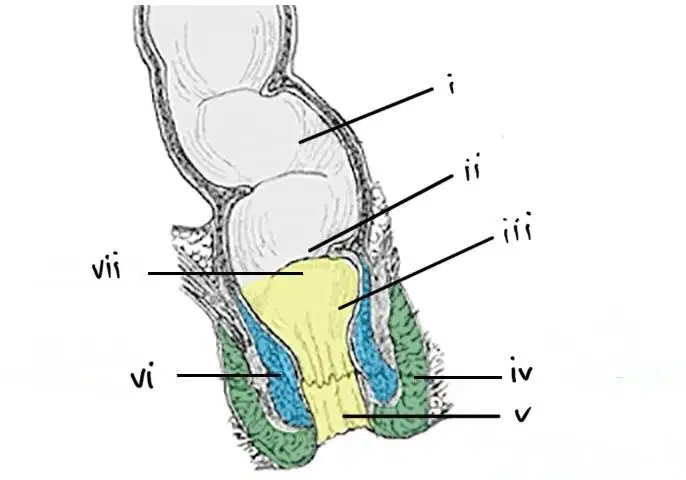
What is "i" ?
(a)
What is "iii" ?
(a)
What is "ii" ?
(a)
What is "v" ?
(a)
What is "iv" ?
(a)
What is "vi" ?
(a)
What is "vii" ?
(a)

What is "i" ?
(a)
What is "ii" ?
(a)
What is "iii" ?
(a)
What is "iv" ?
(a)
What is "v" ?
(a)
What is "vi" ?
(a)
What is "vii" ?
(a)
What is "viii" ?
(a)
What is "ix" ?
(a)
What is "x" ?
(a)
What is "xi" ?
(a)
What is "x" ?
(a)
Which part of the gut is primarily responsible for reabsorption of water and ions?
Large intestine
Stomach
Small intestine
Esophagus
Pancreas
Which valve regulates admission of chyme into the large intestine and prevents reflux into the ileum?
Pyloric valve
Ileocecal valve
Anal sphincter
Cardiac sphincter
Duodenal valve
Which vitamins are produced in significant amounts by bacteria in the large intestine?
Vitamin C and D
Vitamin A and E
Vitamin K and B12
Vitamin B1 and B2
Vitamin D and K
Which part of the colon directly follows the ascending colon?
Transverse colon
Descending colon
Sigmoid colon
Cecum
Rectum
Which term describes the folds visible on the inner surface of the colon that help form haustra?
Villi
Rugae
Vibrissae
Plicae circulares
Semilunar folds
Which of the following is a main function of the large intestine stated on the slides?
Reabsorption of water and ions
Primary absorption of proteins
Digestion of lipids in large amounts
Absorption of most vitamins
Emulsification of fats
Which anatomical feature prevents reflux of colonic contents back into the ileum?
Taenia coli
Haustra
Semilunar folds
Sigmoid colon
Ileocecal valve
How many anatomical sections is the large intestine divided into as listed on the slide?
Four
Five
Seven
Six
Eight
The vermiform appendix is approximately how long?
10 cm
2 cm
25 cm
5 cm
1 cm
What is the usual precipitating cause of acute appendicitis according to the slide?
Viral infection
Autoimmune reaction
Obstruction of the lumen
Ischemia
Allergic reaction
Appendicitis pain classically shifts to which abdominal area?
Left upper quadrant
Right iliac fossa
Epigastrium only
Left iliac fossa
Suprapubic region
What anatomical structure links the descending colon to the rectum?
Ileocecal valve
Appendix
Transverse colon
Sigmoid colon
Anus
Which organ terminates in the vermiform appendix?
Caecum
Ileum
Ascending colon
Sigmoid colon
Rectum
Which is the correct flow of contents through the large intestine starting at the ileocaecal valve?
Caecum → ascending colon → transverse colon → descending colon → sigmoid colon → rectum
Rectum → sigmoid colon → descending colon → transverse colon → ascending colon
Ileum → stomach → caecum → colon
Appendix → caecum → ileum → colon
Ascending colon → caecum → transverse colon → descending colon
Which of the following is TRUE regarding the appendix?
It is 1 metre long
It has no lymphoid tissue
It contains much lymphoid tissue
It is a part of the small intestine
It is part of the rectum
Approximately how long is the colon?
0.5 metres
1.5 metres
3 metres
2.5 metres
4 metres
What are the sacculations or pocket-like constrictions of the colon called?
Haustra
Villi
Rugae
Plicae
Crypts
Which feature is NOT present internally in the colon?
Tubular glands
Goblet cells
Villi
Haustra
Taeniae coli (external)
How is the longitudinal muscle of the colon arranged?
Evenly distributed layer
In four bands
As scattered bundles
In three bands called taeniae coli
Absent
Which layer of the colon's muscularis externa is described as thick?
Longitudinal
Circular
Serosa
Mucosa
Submucosa
Which cell type is abundant in the colon mucosa and is responsible for mucus secretion?
Goblet cells
Enterocytes
Paneth cells
Chief cells
Parietal cells
Which of the following is NOT a labelled surface feature of the colon on the slides?
Taenia coli
Haustra
Villi
Omental appendices
Semilunar folds
Which of these describes the mucosal glands of the colon?
Brunner's glands
Closely packed tubular glands
Peyer's patches
Gastric pits
Villus crypts
Which of the following is true about the colon's mucosa compared to small intestine?
It has longer villi
It has fewer goblet cells
It lacks villi
It has microvilli only in the colon
It contains Paneth cells in abundance
Which structure is visible as three longitudinal bands along the colon surface?
Taeniae coli
Haustra bands
Semilunar folds
Omental appendices
Which of the following statements is correct about the colon's muscular arrangement?
Longitudinal muscle forms a complete layer uniformly
Longitudinal muscle is arranged into three bands (taeniae coli)
There is no circular muscle in the colon
The colon muscle is only skeletal
The colon lacks muscularis externa
Which of the following best explains why the colon has many goblet cells?
To absorb nutrients
To secrete digestive enzymes
To produce bile
To secrete mucus and lubricate faeces
To absorb lipids
Which phrase describes the location of taeniae coli?
In the mucosa
On the external surface as three longitudinal muscle bands
Inside the lumen as mucosal folds
Within the submucosa only
In the anal canal only
Which part of the large intestine is most commonly associated with formation of haustra?
Rectum
Anal canal
Colon
Appendix
Ileocecal valve
Which microscopic feature would you expect to see in a transverse section of colon mucosa?
Villi with enterocytes
Brunner's glands
Tubular glands and many goblet cells
Dense villi cores with lacteals
Keratinized stratified epithelium
Approximately how long is the anal canal according to the slides?
4 cm
6 cm
1.5 m
8 cm
20 cm
Which statement about the rectum's muscularis externa is true?
It lacks longitudinal muscle
It has fewer goblet cells than the colon
It has a thicker muscularis externa with a complete longitudinal muscle layer
It contains villi
It is lined by keratinized epithelium
Which of the following is not true about the rectum on the slides?
It has more goblet cells than the colon
It has a thicker muscularis externa
It has a complete longitudinal muscle layer
It is longer than 50 cm
It is about 12 cm long
Which structure marks the transition between endoderm and ectoderm in the gut?
Rectum
Anal canal
Ileocecal valve
Sigmoid colon
Appendix
How far does the rectum suddenly turn backwards and down through the pelvic diaphragm?
90°
45°
180°
30°
60°
Which muscle type composes the internal anal sphincter?
Skeletal (striated) muscle
Smooth muscle
Cardiac muscle
Pseudo-striated muscle
Voluntary muscle
What composes the external anal sphincter?
Skeletal (striated) muscle
Smooth muscle
Cardiac muscle
Connective tissue only
Smooth and cardiac muscle mix
How long is the anal canal as stated on the slide?
12 cm
6 cm
4 cm
10 cm
2 cm
Which of these is a correct pair: sphincter type — muscle type?
Internal sphincter — skeletal muscle
Internal sphincter — smooth muscle
External sphincter — smooth muscle
External sphincter — cardiac muscle
Internal sphincter — cardiac muscle
Which statement about the anal canal is true?
It is about 12 cm long
It is not guarded by any sphincter
It is lined by simple columnar epithelium throughout
It marks the junction between endoderm and ectoderm and is about 4 cm long
It is part of the small intestine
What is the principal difference between internal and external anal sphincters?
Internal is voluntary, external is involuntary
Internal is smooth muscle (involuntary), external is skeletal (voluntary)
Both are skeletal muscle
Both are smooth muscle
Internal is absent in adults
Of the 500–1000 ml/day of chyme entering the caecum, how much is typically lost in the faeces?
300–400 ml
100–200 ml
0 ml
400–600 ml
250–350 ml
Where does most reabsorption occur within the colon?
Distal half
Rectum
Proximal (absorbing) colon
Sigmoid colon
Anal canal
Approximately what percentage of faeces is water?
75%
50%
25%
90%
10%
The solid portion of faeces is approximately divided into thirds consisting of:
Muscle, fat, and mucus
Proteins, carbohydrates, and salts
Vitamins, bile pigments, and enzymes
1/3 bacteria, 1/3 undigested cellulose, 1/3 mostly fat
1/3 blood, 1/3 bile, 1/3 bacteria
Which mechanism propels faeces along the colon?
Rapid segmentation contractions
Slow peristaltic contractions
Ciliary beating
Gravity only
Smooth muscle tonic contraction only
Which colon segment is typically the site of most fluid reabsorption?
Sigmoid colon only
Rectum only
Proximal (absorbing) colon
Distal colon primarily
Anal canal
Which of the following best describes faecal composition by weight?
50% water, 50% solid
90% water, 10% solid
25% water, 75% solid
75% water, 25% solid
100% solid
Which of the following is not a component of faecal solids as given on the slides?
Undigested cellulose
Villus tips
Bacteria
Which section of the colon is most likely to be empty under normal conditions?
Ascending colon
Transverse colon
Descending colon
Sigmoid colon
Rectum
What stimulates stretch receptors that may trigger the defaecation reflex?
Gastric distension
Small intestine peristalsis
Distension of the rectum by faecal matter
Empty colon
Anal sphincter contraction
Which nervous system component controls the internal anal sphincter during defaecation?
Parasympathetic nerves
Sympathetic nerves
Somatic motor nerves
Enteric nervous system exclusively
Cranial nerves
Which nerves control the external anal sphincter?
Parasympathetic nerves
Somatic motor nerves
Sympathetic nerves
Enteric plexus only
Autonomic sensory nerves
Which requirement must be met for defaecation to normally occur?
Contraction of the external sphincter
Sympathetic activation
Inhibition of parasympathetic fibers
Relaxation of the external anal sphincter (conscious control)
Closure of the ileocecal valve
Which reflex may be initiated by rectal distension?
Defaecation reflex
Gag reflex
Cough reflex
Micturition reflex
Knee-jerk reflex
Total daily fluid secretions added to the GIT are about:
2 litres
5 litres
7.2 litres
10 litres
1 litre
Approximately how much fluid do we ingest (oral intake) per day as shown?
500 ml
1,500 ml
3,000 ml
250 ml
5,000 ml
What is the total fluid volume in the GI tract per day combining secretions and ingested fluid?
5,000 ml
6,710 ml
7,210 ml
8,710 ml
9,500 ml
How much fluid is reabsorbed by the small intestine daily according to the table?
8,000 ml
500 ml
210 ml
1,200 ml
7,210 ml
How much fluid is reabsorbed by the large intestine daily?
8,000 ml
500 ml
210 ml
1,500 ml
60 ml
Approximately how much fluid is excreted in the faeces per day?
500 ml
1,200 ml
210 ml
60 ml
8,000 ml
Which secretion has the highest daily volume according to the table?
Saliva
Pancreatic
Bile
Succus entericus
Colon secretion
Which secretion is approximately 1,200 ml/day?
Saliva and pancreatic (both ~1,200 ml)
Bile
Succus entericus only
Colon secretion
Gastric only
What is the colon secretion volume per day listed in the table?
200 ml
500 ml
1,200 ml
2,050 ml
60 ml
Which item is correctly matched with its approximate daily secretion volume?
Bile — 700 ml/day
Gastric — 700 ml/day
Saliva — 2,050 ml/day
Pancreatic — 700 ml/day
Succus entericus — 60 ml/day
Which of the following contributes about 2,000 ml/day of secretion?
Saliva
Gastric secretions
Pancreatic secretions
Bile
Colon secretions
Which of the following best represents the correct daily total secretions value on the slide?
5,000 ml
8,710 ml
7,210 ml
1,500 ml
210 ml
Which secretion volume is closest to 1,200 ml/day besides saliva?
Bile
Succus entericus
Pancreatic secretions
Colon secretions
Faecal output
Which region of the GI tract reabsorbs the largest single volume of fluid daily?
Small intestine
Large intestine
Stomach
Colon secretions
Esophagus

