
Font size
 Worksheets
LO1.3 Ownership
Total questions: 31
Worksheet time: 16mins
Select all disadvantages of a sole trader listed in the slide.
The sole trader makes all decisions alone.
Working hours are long.
There is no legal protection of limited liability.
Much of the finance is provided by the sole trader personally.
Limited liability shields the owner’s personal assets.
What document is usually signed to form a partnership, setting out profit sharing, responsibilities, and payments to partners, with paperwork supervised by a solicitor?
Deed of Partnership
Memorandum of Association
Share Purchase Agreement
Non-Disclosure Agreement
Select all advantages of partnership listed in the slide.
Easier to raise the capital needed.
Knowledge, skills, and workload can be shared.
If one partner is ill or goes on holiday, the business can cope.
Profits do not need to be shared.
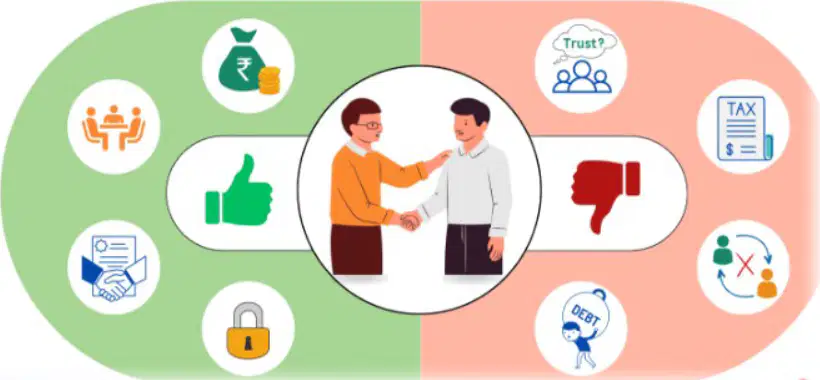
Select all disadvantages of partnerships listed in the slide.
Business decisions can be more difficult and slower because all partners must be consulted.
There may be disagreements about how things should be done.
Profits have to be shared.
Partners enjoy automatic limited liability.

Select the statements that apply to public and private limited companies as described in the slide.
A limited company must be registered before it can operate.
The owners of a limited company are shareholders.
The Board consists of executive directors who make major policy decisions.
Shareholders fund the company by buying shares.
The company is owned by a single proprietor.
According to the slide titled Private Limited Companies, which statement accurately describes private limited companies?
They are typically smaller than public companies and are often family businesses.
They must limit their shareholders to no more than ten individuals.
They cannot raise cash by selling shares.
They are usually owned and operated by the government.
What is the minimum number of shareholders required for a private limited company, as stated on the slide titled Private Limited Companies?
One
Two
Ten
No minimum is specified
Based on the slide titled Public Limited Companies, where are the shares of a public limited company bought and sold?
Privately negotiated markets only
Over-the-counter bulletin boards
The stock exchange
Directly from the board of directors
According to the slide titled Public Limited Companies, which statement is given about raising capital?
Only small amounts of capital can be raised, and it takes a long time.
Large amounts of capital can be raised very quickly.
Capital cannot be raised through selling shares.
Capital is provided solely by government grants.
From the slide titled Public Limited Companies, who is stated to elect the board of the Directors?
The shareholders at the annual meeting
A panel of industry regulators
The Government
The company’s employees
In the Ownership chart, Public Ltd. Co. and Pvt. Ltd. Co. appear as subtypes under which category?
Sole Trader
Partnership
Company
Charitable Trust
Which of the following appears as a category of ownership in the chart?
Worker coop.
Mutual fund
Franchise chain
Joint venture between two firms
According to the slide titled Government Departments and Agencies, which statement best describes a government department such as the Department for Customs and Revenue?
It operates on behalf of the government and is staffed by civil servants.
It is a private firm contracted to provide tax services.
It operates independently of the government and is staffed by volunteers.
It is owned by shareholders who elect a board.
What purpose is stated for setting up government departments and agencies?
To maximize shareholder value across industries
To take responsibility for a particular activity
To replace all private companies in a sector
To provide loans to new businesses
According to the slide titled Worker Co-operatives, who owns a worker co-operative?
External investors who do not work for the organization
The government agency that licenses it
The people who work for it
A single founder who hires employees
What decision-making rule is stated for members of a worker co-operative?
Voting power is proportional to the number of shares held.
Each member has one vote in making decisions.
Only managers vote on operational matters.
Votes are weighted by years of service.
Who are stakeholders?
Individuals or groups who are affected by or can affect an organization’s decisions and performance
Only the owners who hold equity in a company
Any person who buys a company’s products once
External groups that have no influence on a firm
How do stakeholders differ from shareholders?
Shareholders are anyone affected by a business, while stakeholders only own shares
Stakeholders include all parties affected by or influencing the business, while shareholders specifically own equity and are one type of stakeholder
Stakeholders and shareholders are identical terms used interchangeably
Shareholders include customers, suppliers, and regulators but not owners
Why do businesses need to pay attention to stakeholders?
To build credibility, reduce risks, and improve long‑term performance by addressing the interests of those who affect or are affected by the firm
Because laws require firms to treat all groups equally regardless of impact
To focus only on maximizing short‑term profit for owners
To avoid any form of communication with external parties
Select all that apply: Which of the following are stakeholders of Dhiraagu (a telecommunications company)?
Customers using telecom services
Employees working for the company
Suppliers and network vendors
Government and sector regulators
Direct competitors in the telecom market
Why are the selected groups considered stakeholders of a business like Dhiraagu?
They are affected by, or can influence, the company’s decisions, operations, and outcomes
They purchase shares only during public offerings
They have no direct relationship with the company’s performance
They are the only groups legally allowed to contact the business
Refer to the arrow diagram that lists categories feeding into Key Stakeholders. Which of the following appears in that diagram as a key stakeholder category?
Customers
Competitors
Media outlets
Nonprofit donors
Based on the diagram of categories feeding into Key Stakeholders, select all that are listed as stakeholder groups.
Government
Local and national communities
Trade Unions
Marketing agencies
Employee Association
According to the slide, what do customers want from a company?
High‑quality, value‑for‑money products
Maximum profit for shareholders above all else
Low wages and reduced headcount
Minimal government regulation of the firm
According to the slide, what do employees seek from the company?
Security of employment, promotion opportunities, and good rates of reward
Lower product prices, brand identification, and minimal after‑sales support
Deregulation, tax holidays, and reduced compliance costs
Market share growth, higher dividends, and increased firm valuation
According to the slide, what do suppliers want from the business?
Steady orders and prompt payment
Generous return policies to customers
Access to trade union representation
Higher dividends from retained earnings
In a company, who are the owners as described on the slide?
Shareholders
Customers
Government regulators
Trade unions
What outcomes do owners like to see, according to the slide?
Their share of profit increasing and the value of their business rising
Decreasing profits to reduce taxes
Wage bills decreasing regardless of productivity
Supplier prices doubling to signal growth
What do trade unions represent, based on the slide?
The interests of groups of employees
The interests of shareholders
The interests of customers
The interests of suppliers
How are employer associations characterized on the slide?
They are the employer's equivalent of trade unions
They are a government regulatory agency
They are a customer advocacy group
They are a supplier consortium
Match each stakeholder group to the description given on the slides.
Customers
Want high‑quality, value‑for‑money products
Employees
Seek security of employment, promotion opportunities, and good rates of reward
Suppliers
Want steady orders and prompt payment
Trade unions
Represent the interests of groups of employees

