
 Worksheets
Introduction to Ma'rifah and Nakirah
Total questions: 20
Worksheet time: 10mins
Which option best defines Ma'rifah in Arabic grammar?
A verb describing an action or event
A particle connecting two separate clauses
A noun referring to any possible person or thing
A noun referring to a specific person or thing
Which example below is Nakirah rather than Ma'rifah?
رَجُلٌ meaning an unspecified man
دُبَيّ meaning the specific city
الكِتَابُ meaning the specific book
الرَّجُلُ meaning the specific man
Select the option that lists only Ma'rifah nouns.
زَيْدٌ، رَجُلٌ، الكِتَابُ
رَجُلٌ، كِتَابٌ، دَوْلَةٌ
زَيْدٌ، فَاطِمَةُ، الرَّجُلُ
فَاطِمَةُ، كِتَابٌ، الرَّجُلُ
A teacher says, “Bring me الكِتَابُ.” What does this request imply compared with “Bring me كِتَابٌ”?
The first asks for a nearby book, the second for a far book
The first asks for a specific book, the second for any book
The first asks for any book, the second for a heavy book
The first asks for a new book, the second for an old book

Which Arabic item is a Ma'rifah (definite) example?
كِتَابٌ (a book)
وَلَدٌ (a boy)
هٰذَا (this)
رَجُلٌ (a man)

Select the Nakirah (indefinite) noun from the choices.
هُوَ (he)
البِنْتُ (the girl)
الأحْمَرُ (the red thing)
مَدِينَةٌ (a city)
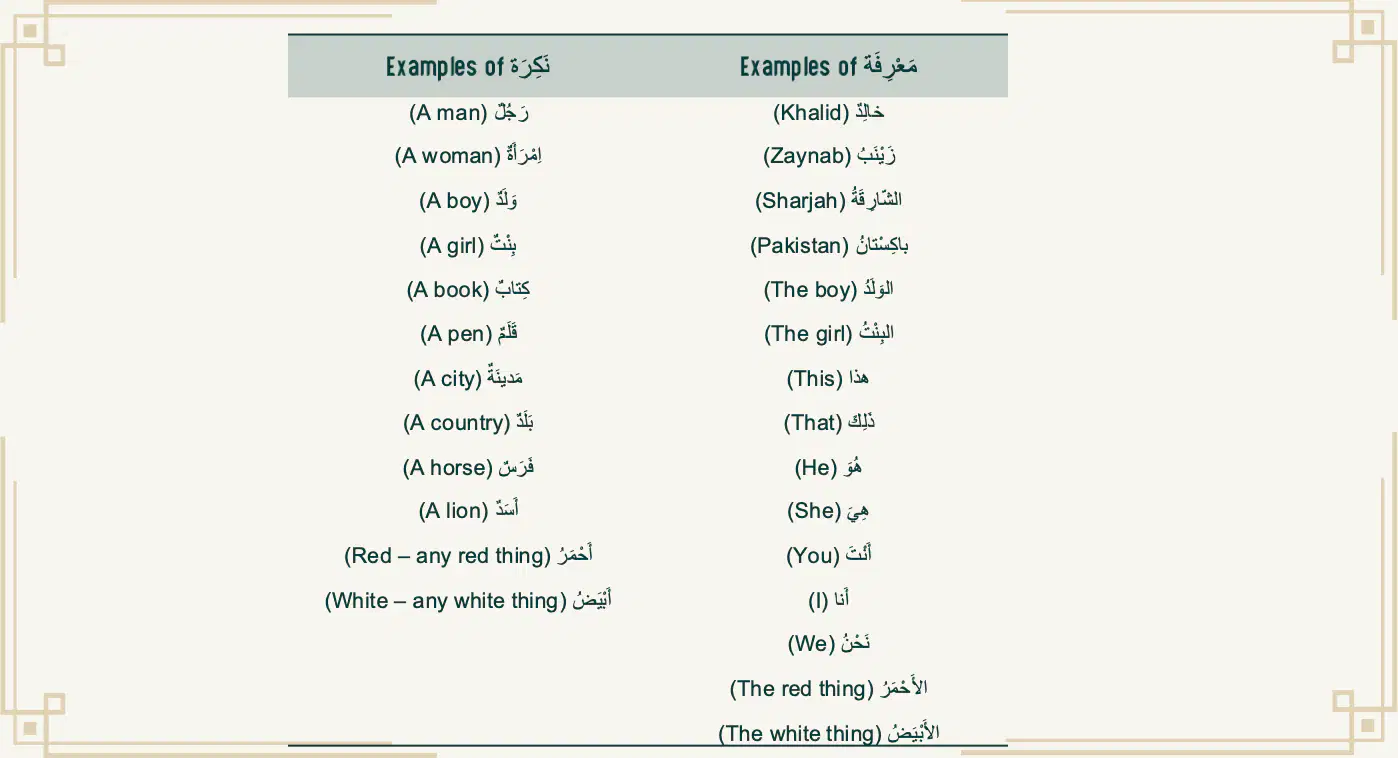
Which pair correctly matches Nakirah to its Ma'rifah counterpart?
فَرَسٌ ↔ الأَبْيَضُ
بِنْتٌ ↔ خَالِدٌ
بَلَدٌ ↔ باكِسْتَانُ
كِتَابٌ ↔ زَيْنَبُ
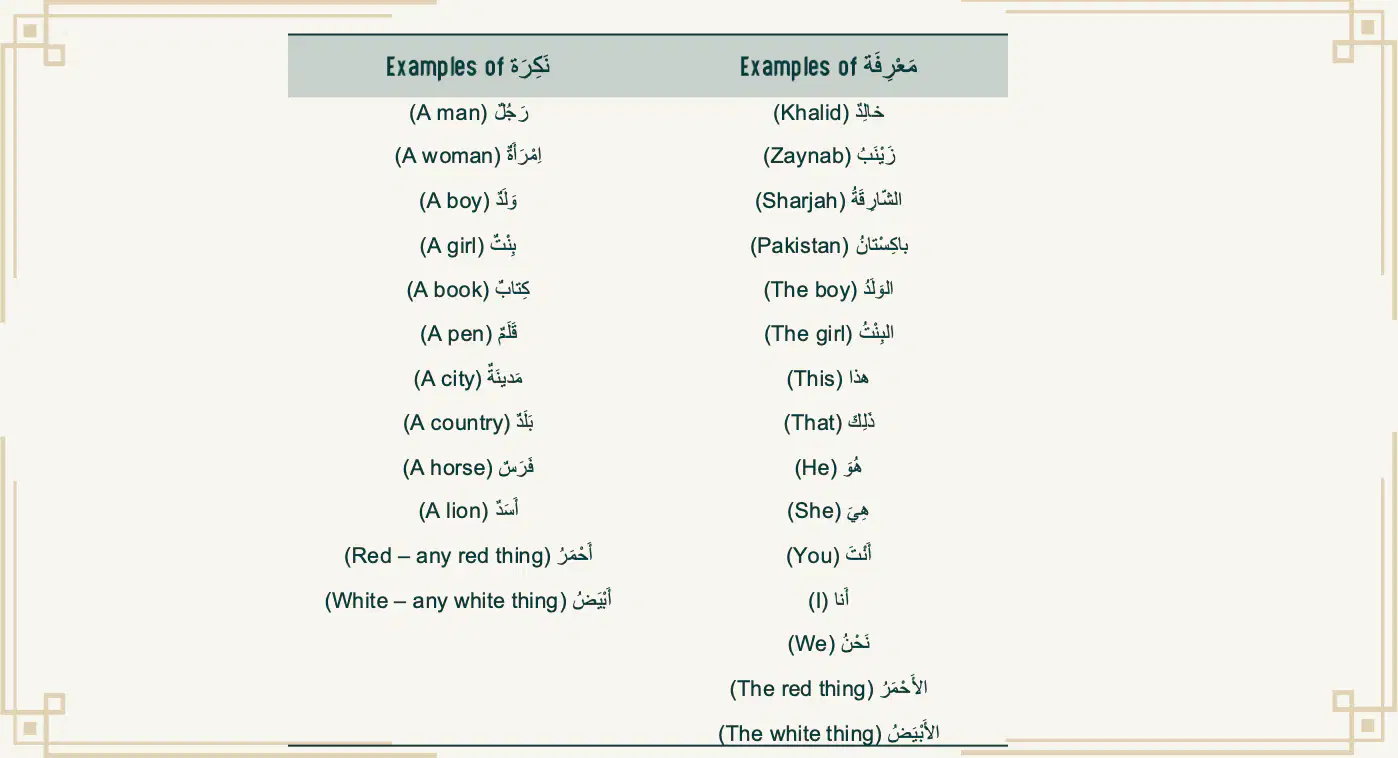
Identify the Ma'rifah form that specifies a particular boy.
الأحْمَرُ (the red thing)
هِيَ (she)
وَلَدٌ (a boy)
الوَلَدُ (the boy)
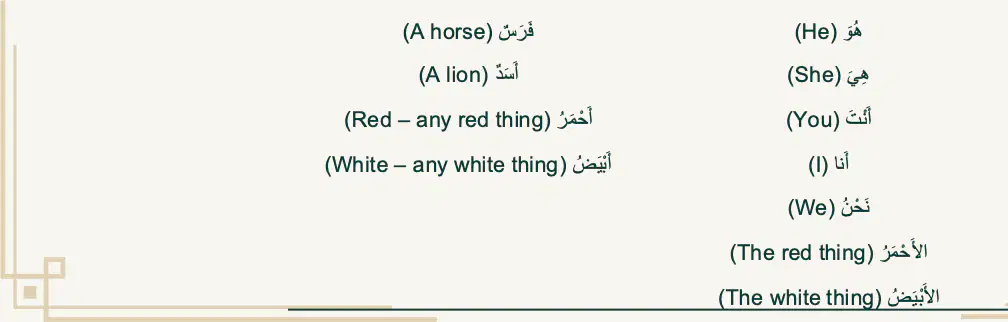
Which choice shows why pronouns belong to Ma'rifah?
They are always proper names
They already point to a specific referent
They refer to any item in general
They always take tanwīn endings
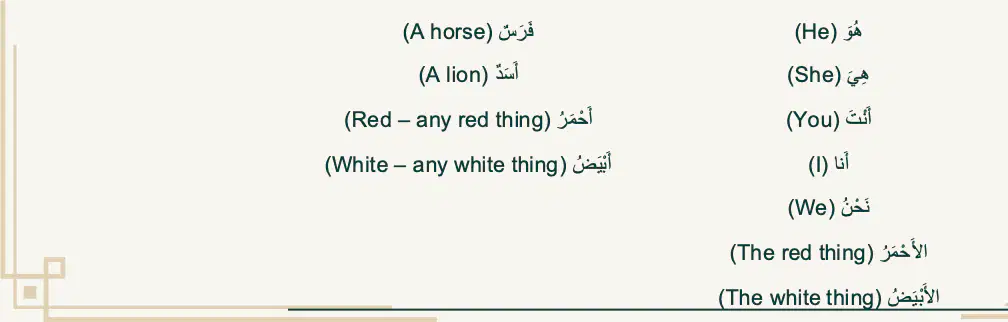
Pick the option that is NOT Ma'rifah.
الأبْيَضُ (the white thing)
الأحْمَرُ (the red thing)
أَبْيَضُ (white, any white thing)
هٰذَا (this)
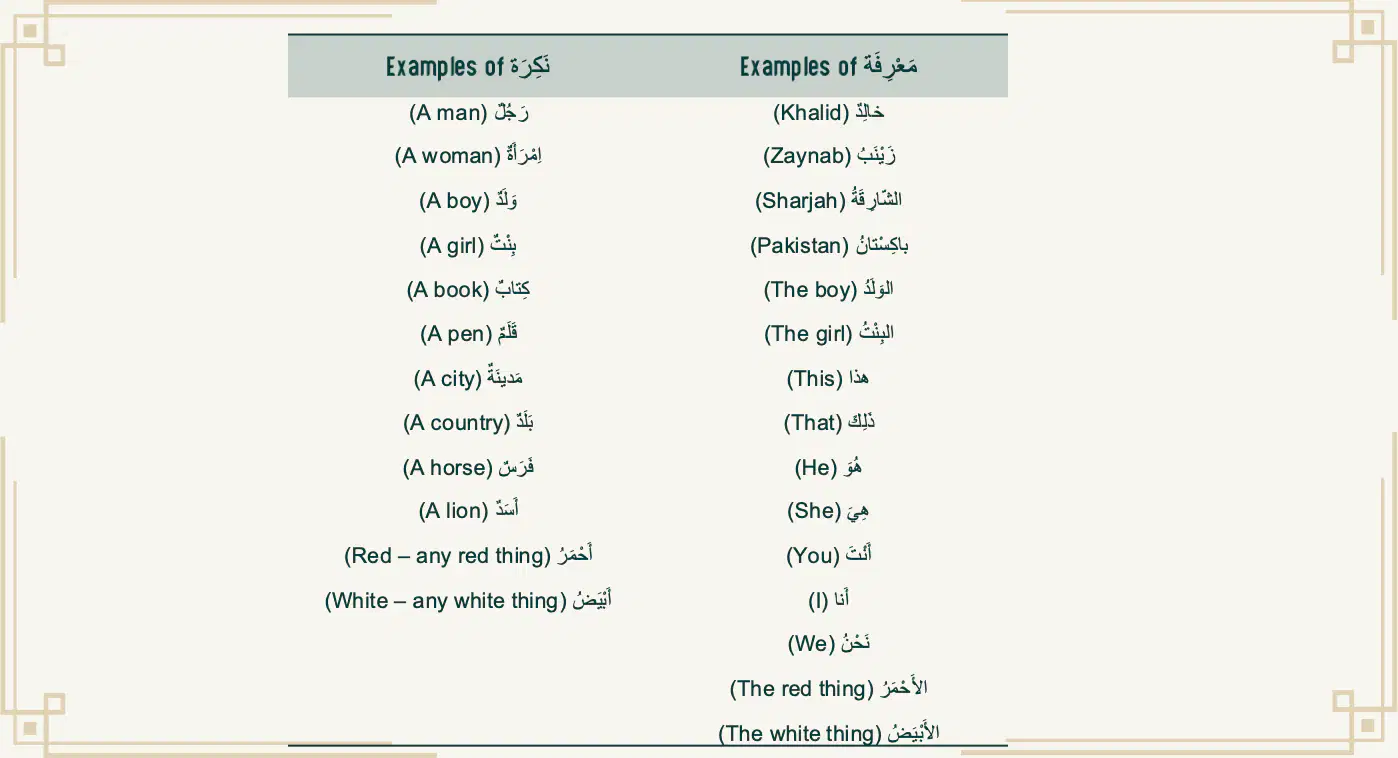
Which best explains the difference between مَدِينَةٌ and الشَّارِقَةُ in the list?
Both are indefinite examples of cities
Both are definite examples of cities
مَدِينَةٌ is indefinite; الشَّارِقَةُ names a specific city
الشَّارِقَةُ is a pronoun; مَدِينَةٌ is a verb

A student changes بِنْتٌ to its definite counterpart. Which is correct?
بِنْتٌ
هٰذَا
البِنْتُ
الأحْمَرُ
Which example best shows a proper noun (ʻalam) as a type of Maʻrifah?
A student reads the new book
Khalid is visiting Cairo today
Which boy finished the homework
This teacher explains the lesson
A noun beginning with ال (al-) qualifies as Maʻrifah because it is made definite. Which sentence shows this correctly?
I bought who’s pen from the shop
I bought the pen from the shop
I bought a pen from the shop
I bought these pens from the shop
Which word set contains only pronouns (ḍamāʼir) that make a noun phrase definite?
hadha, tilka, ulaaʼika
huwa, hiya, ana
ya rajul, ya bint, ya ustadh
alladhi, allati, alladhina
Identify the demonstrative pronoun (ism al-ishārah) indicating pointing to something specific.
Al-kitāb is very interesting
Alladhi won the race today
Khalid is reading quietly
Hādhā on the table is mine
Which sentence correctly uses a relative pronoun (ism mawṣūl) to make a noun definite?
The student who arrived early spoke
The student this arrived early spoke
The student those arrived early spoke
The student a arrived early spoke
Munādā makes a noun definite when calling someone. Which example shows this use?
Yā rajul, listen to the advice
Al-rajul listens to the advice
Tilka rajul listens to the advice
Rajul listens to the advice

A noun does not match any of the seven ma‘rifah types. Using the exclusion rule, how should you classify it?
It is either; classification is impossible
It is ma‘rifah by special exception
It is ma‘rifah if context clarifies
It is nakirah by default rule
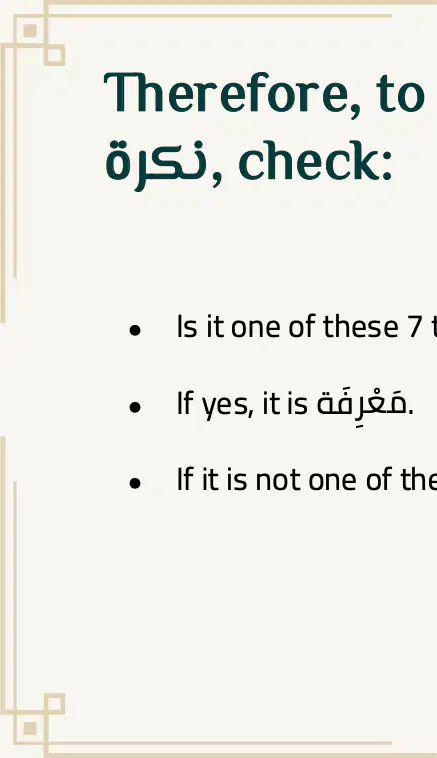
You are checking whether an ism is ma‘rifah. What is the correct decision path to follow?
Assume nakirah, then look for seven types
Check seven types; if yes ma‘rifah, else nakirah
Classify by meaning only, ignore seven types
Ask if it feels specific, then choose ma‘rifah

