

11th Grade Blood Groups Quizzes
Test your knowledge of blood groups with this comprehensive Grade 11 biology quiz designed to assess your understanding of ABO and Rh blood typing systems. Practice identifying blood compatibility, inheritance patterns, and transfusion principles through interactive questions with instant feedback.

20 questions
Blood Quiz

Quiz
•
11th Grade

15 questions
Blood/Serology
Quiz
•
10th - 12th Grade

17 questions
Blood Groups
Quiz
•
9th - 12th Grade
14 questions
Genetics Blood Groups
Quiz
•
10th Grade - University

20 questions
Blood Types & Components of Blood
Quiz
•
9th - 12th Grade

56 questions
Blood Review
Quiz
•
9th - 12th Grade
16 questions
Blood Typing and Transfusion Reactions
Quiz
•
9th - 12th Grade
25 questions
Blood Groups
Quiz
•
9th Grade
15 questions
Blood Groups and Types
Quiz
•
9th Grade
15 questions
Blood Groups
Quiz
•
9th Grade
15 questions
Blood Type Quiz
Quiz
•
9th Grade
Browse by grade
Explore 11th Grade Blood Groups Quizzes
Blood groups represent a fundamental concept in Grade 11 biology that examines the genetic basis of human blood classification systems and their critical role in medical compatibility. Wayground's comprehensive quiz collection provides students with targeted assessment opportunities to master the ABO and Rh blood group systems, including the underlying genetics of allele inheritance, antigen-antibody interactions, and transfusion compatibility principles. These practice questions develop essential analytical skills as students work through Punnett square problems, interpret blood typing results, and understand the molecular mechanisms that determine an individual's blood type. The quizzes offer immediate feedback that reinforces understanding of complex topics such as codominance in ABO genetics, the significance of universal donors and recipients, and the immunological basis for hemolytic disease of the newborn. Wayground supports biology educators through its extensive library of millions of teacher-created blood group quizzes that can be easily discovered through robust search and filtering capabilities aligned with curriculum standards. Teachers can differentiate instruction by selecting quizzes that match varying skill levels, from basic blood type identification to advanced genetic crosses involving multiple generations. The platform's customization tools allow educators to modify existing assessments or combine questions from multiple sources to create targeted practice sessions that address specific learning gaps. These digital-first resources provide flexible delivery options for both classroom instruction and remote learning environments, enabling teachers to use blood group quizzes for diagnostic assessment, concept reinforcement after lessons, exam preparation, and enrichment activities for advanced students ready to explore more complex genetic scenarios.
FAQs
How do I teach the ABO and Rh blood typing systems to students?
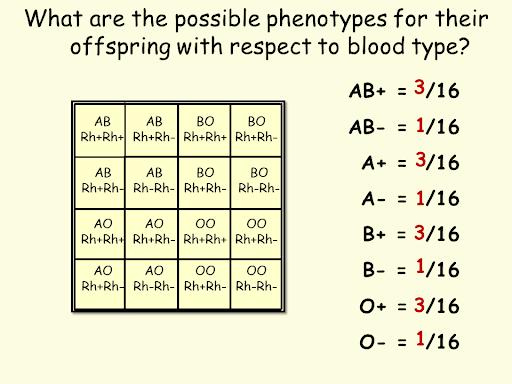
Start by establishing the concept of multiple alleles, explaining that the ABO system is controlled by three alleles (I^A, I^B, and i) rather than the typical two. Introduce codominance by showing how I^A and I^B are both expressed when present together, producing blood type AB. Once students grasp ABO inheritance, layer in the Rh factor as a simpler dominant/recessive trait before connecting both systems to real-world transfusion compatibility. Using Punnett squares alongside clinical scenarios helps students see why these genetic principles matter in medicine.
What are good practice exercises for students learning blood type genetics?
Punnett square problems involving ABO crosses are the most direct way to build procedural fluency, starting with single-trait crosses before combining ABO and Rh factor in the same problem. Pedigree analysis is equally important, as it requires students to work backward from observed phenotypes to determine possible parental genotypes. Adding clinical case scenarios, such as determining which blood types are compatible for a transfusion, pushes students to apply genetics knowledge in a meaningful medical context rather than treating it as an abstract exercise.
What mistakes do students commonly make when solving blood type genetics problems?
The most frequent error is treating the ABO system as a simple dominant/recessive trait, which causes students to incorrectly predict that type AB children cannot have type O parents. Students also confuse codominance with incomplete dominance, misrepresenting blood type AB as a blended phenotype rather than the simultaneous expression of both A and B antigens. A third common mistake is forgetting that type O individuals carry two recessive i alleles and can pass the i allele to children even when crossed with type A or B parents who are heterozygous.
How do blood type pedigree problems differ from standard genetics pedigrees?
Standard pedigrees typically involve one dominant and one recessive allele, but blood type pedigrees require students to track three alleles simultaneously while accounting for codominance. This means a single individual in the pedigree can carry two different information-rich alleles, both of which affect phenotype, making genotype inference more complex. Students must also recognize that a type O phenotype is only possible with the ii genotype, which constrains what alleles parents could have contributed and is a useful anchor point when working backward through a pedigree.
How can I use blood groups quizzes from Wayground in my classroom?
Blood groups quizzes on Wayground are available as printable PDFs for traditional classroom use and in digital formats for technology-integrated environments, giving teachers flexibility in how they assign practice. Teachers can host quizzes directly as a quiz on Wayground, which allows for immediate feedback and progress tracking. Wayground also supports student-level accommodations such as read aloud, extended time, and reduced answer choices, which can be configured individually so that students with different needs receive appropriate support without disrupting the rest of the class.
How do I differentiate blood type genetics instruction for students at different skill levels?
For students still building foundational skills, begin with isolated ABO problems before introducing the Rh factor, and use visual aids like labeled Punnett square templates to reduce cognitive load. Advanced learners can be challenged with multi-generational pedigrees, problems that require ruling out genotypes based on offspring phenotypes, or extensions into blood banking and compatibility testing. On Wayground, teachers can apply individual accommodations such as reduced answer choices or read aloud to specific students, ensuring struggling learners receive targeted support while advanced students work through more demanding problems simultaneously.

Accessibility
Features
Wayground Super
School & District
Wayground for Business
Create a quiz
Create a presentation
Wayground AI
Subjects
Mathematics
Social Studies
Science
Physics
Chemistry
Biology
About
Our Story
Wayground Blog
Media Kit
Careers
Support
F.A.Q.
Help & Support
Privacy Policy
Terms of Service
Teacher Resources
2026 Wayground


Get our app

