

3rd Grade Digestion Quizzes
Test your Grade 3 students' understanding of digestion with this interactive science quiz featuring practice questions and instant feedback. Help young learners assess their knowledge of how the human body processes food through self-paced assessment activities.





Explore 3rd Grade Digestion Quizzes
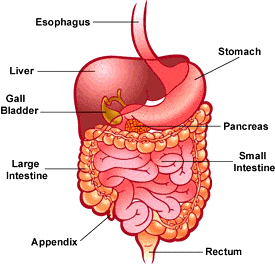
Digestion quizzes for Grade 3 students provide comprehensive assessment tools that help young learners understand how the human body processes food and nutrients. Through Wayground's extensive collection of teacher-created resources, students engage with carefully structured practice questions that cover the digestive system's key organs, the journey food takes through the body, and the basic functions of digestion. These interactive assessments develop critical thinking skills as students analyze how different parts of the digestive system work together, while immediate feedback helps reinforce correct understanding and addresses misconceptions about this fundamental biological process. Wayground's platform empowers educators with access to millions of teacher-created digestion quiz resources, supported by robust search and filtering capabilities that align with curriculum standards and grade-appropriate learning objectives. Teachers can easily customize quiz content to match their students' diverse learning needs, implementing differentiation strategies that support both remediation for struggling learners and enrichment opportunities for advanced students. The platform's flexible digital delivery formats enable seamless integration into classroom instruction, homework assignments, and formative assessment routines, while comprehensive analytics help educators identify knowledge gaps and plan targeted interventions that strengthen students' mastery of digestive system concepts and broader biological literacy skills.
FAQs
How do I teach the digestive system to middle or high school students?
Teaching digestion effectively means tracing the digestive pathway sequentially, from ingestion through elimination, so students can see how each organ hands off to the next. Start with mechanical digestion in the mouth and stomach before introducing chemical digestion through enzymes and bile. Using labeled diagram quizzes alongside process-sequencing activities helps students build both anatomical vocabulary and conceptual understanding of how the system functions as a coordinated whole.
What quizzes help students practice identifying digestive system organs and their functions?
Quizzes that ask students to label diagrams of the digestive tract, match organs to their specific functions, and trace the path of food from ingestion to elimination are particularly effective for building foundational knowledge. Practice problems that require students to analyze the roles of specialized organs like the stomach, liver, and pancreas reinforce both anatomical recall and functional reasoning. Including questions on mechanical versus chemical digestion in the same quiz helps students see how these processes are interdependent.
What common mistakes do students make when learning about digestion?
One of the most common misconceptions is that digestion happens entirely in the stomach. Students often overlook the mouth as the site of both mechanical and chemical digestion, and they frequently underestimate the small intestine's role in nutrient absorption. Another common error is conflating digestion and absorption, treating them as the same process rather than understanding that digestion breaks food down while absorption moves nutrients into the bloodstream through structures like intestinal villi.
How do I explain the difference between mechanical and chemical digestion to students?
Mechanical digestion refers to the physical breakdown of food, such as chewing in the mouth and churning in the stomach, while chemical digestion involves enzymes and substances like bile that break food down at the molecular level. A useful classroom strategy is to have students map which type of digestion occurs at each organ along the digestive tract, reinforcing that both processes often occur simultaneously. Quizzes that present specific scenarios, such as what happens to a piece of bread from mouth to small intestine, help students apply the distinction rather than just memorize it.
How do I use digestion quizzes effectively in my classroom?
Digestion quizzes on Wayground are available as printable PDFs for traditional classroom use and in digital formats for technology-integrated environments, including the option to host them as a quiz directly on the platform. Printable versions work well for guided note-taking, lab reinforcement, or take-home review, while digital formats allow for faster formative assessment and immediate feedback. For students who need additional support, Wayground's accommodation tools, such as read aloud and reduced answer choices, can be applied individually without disrupting the rest of the class.
How do I differentiate digestion instruction for students at different levels?
For students building foundational knowledge, quizzes focused on basic digestive tract anatomy and organ sequencing provide accessible entry points. Advanced learners benefit from tasks that examine enzymatic specificity, nutrient metabolism, and the relationship between digestive health and overall physiological function. On Wayground, teachers can modify quiz complexity and apply student-level accommodations such as extended time or adjustable font sizes, making it practical to run differentiated versions of the same lesson simultaneously.

Accessibility
Features
Wayground Super
School & District
Wayground for Business
Create a quiz
Create a presentation
Wayground AI
Subjects
Mathematics
Social Studies
Science
Physics
Chemistry
Biology
About
Our Story
Wayground Blog
Media Kit
Careers
Support
F.A.Q.
Help & Support
Privacy Policy
Terms of Service
Teacher Resources
2026 Wayground


Get our app

