


10th Grade Dilations Quizzes
Test your understanding of dilations with comprehensive Grade 10 practice questions designed to assess your mastery of scaling transformations on the coordinate plane. These self-paced assessment quizzes provide instant feedback as you work through problems involving scale factors, center of dilation, and the effects of enlargements and reductions on geometric figures.

16 questions
G3.2 Dilations Practice (Quizizz)

Quiz
•
10th Grade

10 questions
Dilations Practice
Quiz
•
10th Grade

14 questions
Dilations
Quiz
•
10th Grade

25 questions
CW: Dilations
Quiz
•
10th Grade
20 questions
Dilations Practice
Quiz
•
10th Grade

20 questions
Dilations
Quiz
•
10th Grade
18 questions
Geometry Dilations & Similar Figures
Quiz
•
10th Grade
18 questions
Dilations and Scale Factor
Quiz
•
10th Grade
14 questions
Dilations TITD
Quiz
•
9th - 12th Grade
22 questions
Dilations
Quiz
•
9th - 12th Grade
20 questions
Dilations Review
Quiz
•
8th Grade
20 questions
Dilations Practice
Quiz
•
8th Grade
Explore 10th Grade Dilations Quizzes
Dilations form a fundamental component of geometric transformations in Grade 10 mathematics, requiring students to understand how shapes change size while maintaining their proportional relationships and angular measures. These comprehensive quiz collections through Wayground provide targeted assessment opportunities that help students master the mathematical concepts behind scaling transformations, including scale factor calculations, center point identification, and coordinate rule applications. The practice questions systematically guide learners through determining whether dilations represent enlargements or reductions, calculating missing measurements in similar figures, and applying dilation rules to coordinate geometry problems, ensuring thorough understanding of how these transformations preserve shape while altering size. Wayground's extensive library contains millions of teacher-created dilation quiz resources that support mathematics educators in delivering standards-aligned instruction tailored to Grade 10 learning objectives. The platform's robust search and filtering capabilities enable teachers to quickly locate quiz materials that match specific curriculum requirements, whether focusing on coordinate plane dilations, similarity ratios, or real-world scaling applications. These digital quiz collections offer flexible delivery formats that accommodate diverse classroom needs, from individual student practice sessions to whole-class review activities, while built-in differentiation tools allow educators to customize difficulty levels and question types for targeted remediation or enrichment, supporting comprehensive skill reinforcement across varying ability levels.
FAQs
How do I teach dilations to Grade 10 students?
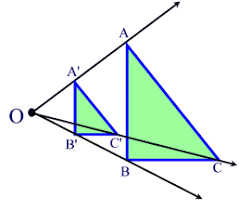
Begin with a fixed center of dilation and trace how points move along rays from that center. Then connect the visual model to coordinate rules: multiply each coordinate by the scale factor when the center is the origin. Have students predict whether a figure will enlarge or shrink before calculating its image.
What exercises help Grade 10 students practice dilations?
Use a progression of problems: identify the scale factor from a diagram, calculate image coordinates on a coordinate plane, and compare corresponding side lengths. Finish with a design or architecture problem in which students create a scale drawing and justify the dilation used.
What mistakes do students commonly make with dilations?
Students often multiply side lengths correctly but apply the scale factor inconsistently to coordinates. They may also assume the center is always the origin or confuse a scale factor between 0 and 1 with a negative value. Asking them to check that corresponding points lie on rays from the center catches many of these errors.
How can I use a Grade 10 dilations quiz from Wayground?
Assign the quiz as a digital quiz on Wayground or download the printable PDF for paper practice. Every quiz includes a complete answer key; for printed submissions, teachers can also scan or capture student work for grading with the Wayground for Teachers app.
How do dilations fit into the Common Core geometry progression?
Dilations support the Common Core progression from proportional relationships and scale drawings toward similarity transformations and geometric proof. Grade 10 students should connect scale factors to corresponding lengths and use dilations to explain why two figures are similar.
How can I differentiate dilation practice for mixed-ability students?
For students who struggle to track coordinates or proportional changes, provide an alternate quiz with wider spacing or a larger font and begin with dilations centered at the origin. In digital sessions, extended time can support multi-step calculations, while reduced answer choices can make scale-factor identification more manageable.
What grade do students learn dilations?
Dilations are commonly introduced in middle school through scale drawings and similarity, then studied more formally in Grade 10 geometry. At this level, students work with centers of dilation, coordinate rules, and the role of scale factors in proving figures similar.

Accessibility
Features
Wayground Super
School & District
Wayground for Business
Create a quiz
Create a presentation
Wayground AI
Subjects
Mathematics
Social Studies
Science
Physics
Chemistry
Biology
About
Our Story
Wayground Blog
Media Kit
Careers
Support
F.A.Q.
Help & Support
Privacy Policy
Terms of Service
Teacher Resources
2026 Wayground


Get our app

