


Estimating Sums Quizzes
Practice estimating sums with this interactive mathematics quiz designed to assess your number sense skills. Work through self-paced assessment questions and receive instant feedback to strengthen your understanding of estimation strategies.

8 questions
Estimating Sums

Quiz
•
3rd Grade

10 questions
4. Estimating Sums
Quiz
•
6th Grade
7 questions
Estimating Sums and Differences
Quiz
•
5th Grade

10 questions
Estimating Sums and Differences
Quiz
•
3rd Grade

10 questions
Estimating Sums and Differences
Quiz
•
3rd - 5th Grade

12 questions
Estimating Sums
Quiz
•
4th Grade
15 questions
Rounding and Estimating Sums
Quiz
•
4th Grade
12 questions
Estimating Sums and Differences
Quiz
•
3rd - 4th Grade
20 questions
Estimating Sums & Differences
Quiz
•
4th Grade
10 questions
Estimating Sums
Quiz
•
3rd - 4th Grade
10 questions
Estimating Sums
Quiz
•
4th Grade
12 questions
Estimating Sums and Differences
Quiz
•
4th - 5th Grade
Explore Estimating Sums Quizzes
Estimating sums represents a fundamental mathematical skill that bridges concrete number understanding with practical problem-solving abilities. Wayground's comprehensive collection of estimating sums quizzes provides students with targeted practice questions designed to strengthen their ability to quickly approximate addition results without performing exact calculations. These assessment tools focus on developing number sense strategies such as rounding to the nearest ten or hundred, using benchmark numbers, and applying front-end estimation techniques. Through systematic practice and immediate feedback, students build confidence in their mathematical reasoning while learning to evaluate the reasonableness of their calculations across various contexts and number ranges. Wayground supports mathematics educators with access to millions of teacher-created quiz resources specifically designed for estimating sums instruction and assessment. The platform's robust search and filtering capabilities allow teachers to locate quizzes aligned with specific curriculum standards and tailored to diverse learning needs within their classrooms. Teachers can customize existing quizzes or create new assessments that match their students' developmental levels, incorporating differentiation strategies that support both struggling learners and advanced students. The flexible digital delivery format enables seamless integration into classroom instruction, homework assignments, and intervention programs, while detailed analytics help educators identify knowledge gaps and plan targeted remediation or enrichment activities that reinforce essential number sense concepts.
FAQs
How do I teach estimating sums effectively?
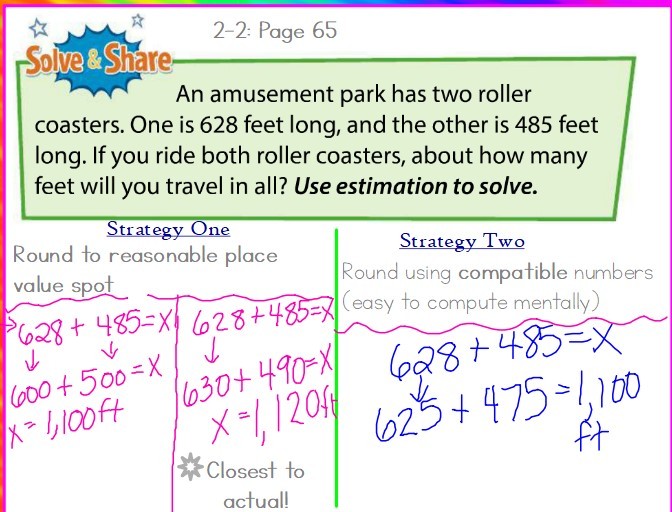
Start by anchoring estimation to a purpose: ask students to predict whether a sum will be closer to 100 or 200 before they calculate anything. From there, introduce rounding to the nearest ten or hundred, then compatible numbers (pairs that add to a round number easily), and finally front-end estimation, where students add the leading digits first and adjust. The key is helping students see estimation as a thinking tool, not a shortcut for when they don't know the real answer.
What exercises help students practice estimating sums?
The most effective practice mixes strategy types rather than drilling one method repeatedly. Good exercise formats include: estimating before solving and then comparing to the exact answer, identifying which of two estimates is more reasonable and explaining why, and applying estimation to word problems where an exact answer isn't needed. Wayground's estimating sums quizzes cover this range, from basic two-digit problems to multi-step scenarios with larger numbers.
What mistakes do students commonly make when estimating sums?
The most common error is rounding each addend independently without checking whether the combined rounding error is pulling the estimate too far in one direction. Students also frequently round to an unnecessarily precise place value, which defeats the purpose of estimating. A subtler issue: students who are strong at exact computation sometimes resist estimation because they don't trust an answer they know isn't exact — they need explicit practice accepting a range as a valid answer.
How do I use Wayground's estimating sums quizzes in my classroom?
Each quiz comes with a complete answer key, so it works well for independent practice or math centers without requiring teacher oversight for every problem. You can run it as a digital quiz hosted on Wayground, or download the printable PDF for paper-and-pencil work — useful for schools managing screen time. If you go the print route, the Wayground for Teachers app lets you scan or capture student submissions for grading without re-entering anything manually.
Is estimating sums aligned to Common Core standards?
Yes. Common Core builds estimation into its number and operations progression starting in second and third grade, where students round to the nearest ten or hundred. By fourth and fifth grade, the expectation expands to rounding multi-digit whole numbers and using that skill to assess the reasonableness of answers — which is exactly what estimating sums practice targets. The underlying goal is that students can look at a computed answer and judge whether it makes sense, not just produce one.
How can I differentiate estimating sums practice for mixed-ability classes?
For students who struggle with the rounding step itself, reducing the number of answer choices on a digital question lowers the cognitive load enough to let them focus on the estimation strategy rather than the mechanics. For students with reading difficulties, Wayground's Read Aloud feature handles word problems so decoding doesn't block math thinking. On the quiz side, you can generate an alternate version with larger font or a dyslexia-friendly font without creating a separate assignment from scratch.
What grade level is estimating sums taught?
Estimating sums is typically introduced in second and third grade using two- and three-digit numbers, deepened in fourth and fifth grade as students work with larger whole numbers and begin applying estimation to check reasonableness, and revisited in sixth grade when decimals and fractions enter the picture. The concept spans a wide range, so the right entry point depends on the number types involved, not just the grade.

Accessibility
Features
Wayground Super
School & District
Wayground for Business
Create a quiz
Create a presentation
Wayground AI
Subjects
Mathematics
Social Studies
Science
Physics
Chemistry
Biology
About
Our Story
Wayground Blog
Media Kit
Careers
Support
F.A.Q.
Help & Support
Privacy Policy
Terms of Service
Teacher Resources
2026 Wayground


Get our app

