


9th Grade Metric Prefixes Quizzes
Test your understanding of metric prefixes with this comprehensive Grade 9 quiz featuring practice questions on unit conversions and measurement scales. Get instant feedback as you work through self-paced assessment problems covering kilo, centi, milli, and other essential metric prefix applications.

10 questions
Helping You Understand Metric Prefixes

Quiz
•
9th Grade
15 questions
Metric Prefixes
Quiz
•
9th Grade

9 questions
metric prefixes
Quiz
•
9th Grade

25 questions
Identifying metric prefixes symbols and multiplication factors
Quiz
•
9th Grade

20 questions
Metric Measurements
Quiz
•
9th Grade

20 questions
SI Units & Prefixes
Quiz
•
9th Grade
6 questions
Metric Prefixes
Quiz
•
9th - 12th Grade
31 questions
Metric Prefixes and Place Value Chart
Quiz
•
9th - 12th Grade
31 questions
Measurement Prefixes
Quiz
•
9th - 12th Grade
10 questions
SI Units and Metric Prefixes
Quiz
•
8th - 12th Grade
Explore 9th Grade Metric Prefixes Quizzes
Metric prefixes form a fundamental component of scientific measurement for Grade 9 students, enabling precise communication of quantities ranging from microscopic to astronomical scales. These comprehensive quiz collections available through Wayground provide targeted assessment opportunities that help students master the conversion between different metric units and understand the mathematical relationships between prefixes like micro, milli, centi, kilo, and mega. Through systematic practice questions and immediate feedback, students develop essential skills in scientific notation, unit conversion, and measurement accuracy that are critical for success in physics, chemistry, and other STEM disciplines. The quizzes emphasize both conceptual understanding of prefix meanings and practical application in real-world scientific contexts, ensuring students can confidently navigate measurement challenges across various scientific domains. Wayground supports educators with millions of teacher-created quiz resources specifically designed for metric prefix instruction, offering robust search and filtering capabilities that allow teachers to locate assessments aligned with specific curriculum standards and learning objectives. The platform's differentiation tools enable instructors to customize quiz difficulty levels, question types, and time limits to accommodate diverse learning needs within Grade 9 classrooms. Digital delivery formats provide flexibility for both synchronous and asynchronous learning environments, while comprehensive analytics help teachers identify knowledge gaps and track student progress through metric conversion concepts. These capabilities streamline lesson planning by providing ready-to-use assessments for initial instruction, targeted remediation for struggling learners, and enrichment opportunities for advanced students, ultimately supporting systematic skill reinforcement in this essential area of scientific measurement.
FAQs
How do I teach metric prefixes to students who struggle with the concept of scale?
Start by anchoring each prefix to a concrete, real-world reference point before introducing numerical values. For example, connect 'kilo-' to kilometers (a familiar distance unit) and 'milli-' to millimeters on a ruler students have already used. Once students can visualize the scale difference between two familiar prefixes, introduce the powers-of-ten structure that connects them. A number line or prefix ladder chart displayed in the classroom helps students internalize the order and relative size of prefixes like micro-, milli-, centi-, deci-, deca-, hecto-, and kilo-.
What exercises help students practice metric prefix conversions?
Effective practice exercises include prefix-to-decimal conversion problems, unit scaling tasks where students rewrite a measurement using a different prefix, and matching activities that pair prefix symbols with their multiplier values. Real-world application problems, such as converting milligrams to grams in a medication dosage context or kilometers to meters in a distance problem, reinforce why these conversions matter. Systematic repetition across multiple prefix ranges, rather than drilling one prefix at a time, builds the flexible thinking students need for science and math coursework.
What mistakes do students commonly make when working with metric prefixes?
The most frequent error is moving the decimal point in the wrong direction when converting between prefixes, often because students confuse whether they are scaling up or down. Students also commonly mix up prefixes with similar-sounding names, such as 'milli-' and 'micro-', or misremember their corresponding powers of ten. Another persistent mistake is treating prefix conversions as addition or subtraction rather than multiplication by powers of ten, which leads to systematic errors across an entire problem set. Targeted practice that requires students to identify the direction of conversion before calculating can reduce these errors significantly.
How do metric prefixes connect to scientific notation?
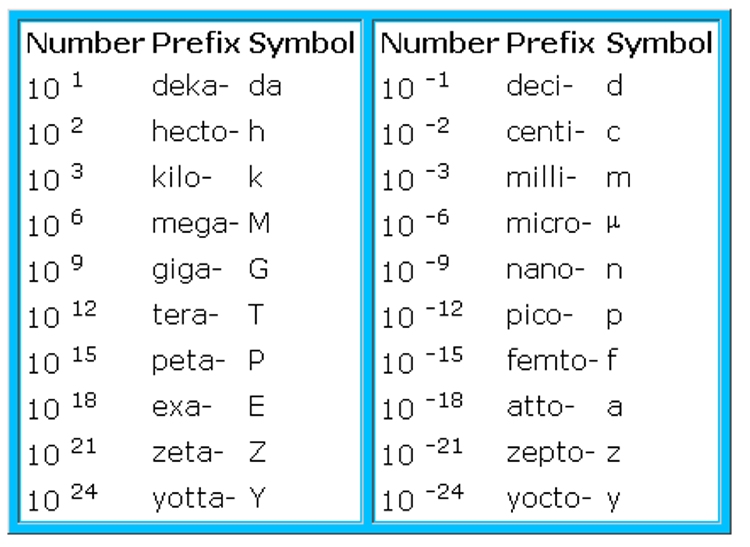
Metric prefixes are directly mapped to powers of ten, making them a natural bridge to scientific notation. For example, 'kilo-' represents 10³, 'milli-' represents 10⁻³, and 'nano-' represents 10⁻⁹, so any measurement written with a prefix can be rewritten in scientific notation using the same exponent. Teaching both concepts together reinforces place value reasoning and helps students move fluidly between unit-based and exponential representations of the same quantity. This connection is especially valuable in chemistry and physics, where measurements span many orders of magnitude.
How can I use Wayground's metric prefixes quizzes in my classroom?
Wayground's metric prefixes quizzes are available as printable PDFs for traditional classroom use and in digital formats for technology-integrated learning environments, giving teachers flexibility depending on their setup. You can assign them as independent practice, use them for small-group review, or host them as a quiz directly on the Wayground platform to collect student responses digitally. For students who need additional support, Wayground's accommodation tools allow teachers to enable read-aloud features, extended time, or reduced answer choices on an individual basis without affecting the rest of the class.
How do I differentiate metric prefix instruction for students at different skill levels?
For students still building foundational understanding, limit practice to the most common prefixes (kilo-, centi-, milli-) before expanding to micro-, nano-, mega-, and giga-. For advanced students, introduce multi-step conversions that require moving across more than one prefix level or apply prefixes in scientific notation problems. On Wayground, teachers can adjust problem complexity and create targeted practice sets for remediation or enrichment, and individual accommodation settings such as reduced answer choices or extended time can be applied to specific students without disrupting the broader class workflow.

Accessibility
Features
Wayground Super
School & District
Wayground for Business
Create a quiz
Create a presentation
Wayground AI
Subjects
Mathematics
Social Studies
Science
Physics
Chemistry
Biology
About
Our Story
Wayground Blog
Media Kit
Careers
Support
F.A.Q.
Help & Support
Privacy Policy
Terms of Service
Teacher Resources
2026 Wayground


Get our app

