
Resource Type


Negative and Fractional Indices Quizzes
Test your mastery of negative and fractional indices with this comprehensive mathematics quiz designed to assess your understanding of advanced exponent rules. Practice challenging problems and receive instant feedback to strengthen your skills in working with negative powers and fractional exponents.

20 questions
Negative and Fractional Indices

Quiz
•
9th - 10th Grade

17 questions
3NA Negative & Fractional Indices
Quiz
•
9th - 10th Grade
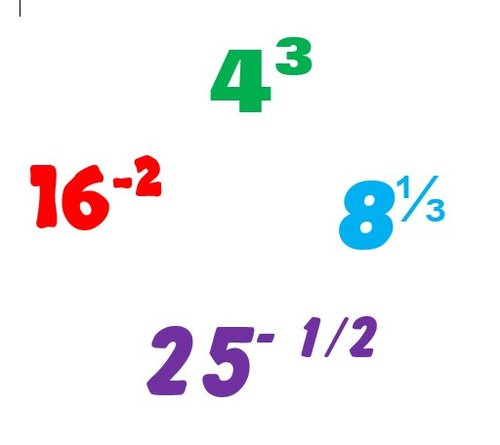
25 questions
Negative and fractional Indices
Quiz
•
10th - 11th Grade
32 questions
Negative and fractional indices
Quiz
•
11th Grade

15 questions
Negative and Fractional Indices
Quiz
•
8th - 10th Grade

19 questions
Higher 1.5 Zero, negative and fractional indices
Quiz
•
9th Grade
15 questions
Negative and Fractional Indices Year 10
Quiz
•
9th - 10th Grade
20 questions
Fractional Indices - Practice.
Quiz
•
9th Grade
20 questions
Fractional Parts and Fractions on a Number Line
Quiz
•
5th Grade
27 questions
Multiplication Law of Indices, The Product of Powers
Quiz
•
9th - 12th Grade
18 questions
Fractional Computation
Quiz
•
5th Grade
20 questions
zero and negative exponents
Quiz
•
9th Grade
Browse by grade
Explore Negative and Fractional Indices Quizzes
Negative and fractional indices represent a crucial extension of exponent rules that challenges students to think beyond whole number powers and develop deeper algebraic reasoning skills. Wayground's comprehensive quiz collection offers targeted assessment opportunities that help students master these complex concepts through carefully structured practice questions that build understanding progressively. These quizzes provide immediate feedback on essential skills including converting between radical and exponential notation, simplifying expressions with negative exponents, and working with fractional powers to evaluate roots. Students receive guided practice in applying the fundamental rule that negative exponents indicate reciprocals while fractional exponents represent roots, enabling them to confidently manipulate algebraic expressions involving these sophisticated mathematical operations. Wayground's platform empowers mathematics educators with access to millions of teacher-created quiz resources specifically designed to address the challenging concepts of negative and fractional indices. The robust search and filtering capabilities allow teachers to quickly locate assessments that align with curriculum standards and match their students' specific learning needs, while built-in differentiation tools enable customization of question difficulty and pacing. These digital-first quiz formats support flexible delivery methods that accommodate diverse classroom environments, from individual practice sessions to whole-class review activities. Teachers can strategically deploy these resources for diagnostic assessment, targeted remediation of misconceptions, and enrichment opportunities that deepen conceptual understanding, ensuring that all students develop the foundational skills necessary for success in advanced algebraic manipulation and higher-level mathematics courses.
FAQs
How do I teach negative and fractional indices?
Introduce negative exponents as reciprocals, not negative numbers. For example, show that 10² is 100, 10¹ is 10, and 10⁰ is 1, so the pattern dictates 10⁻¹ must be 1/10. For fractional exponents, connect them to roots students already know, explaining that x^(1/2) is another way to write the square root of x, and x^(1/3) is the cube root.
What are the most common mistakes students make with exponents?
A frequent error is confusing a negative exponent with a negative result (e.g., writing 3⁻² as -9 instead of 1/9). With fractional exponents, students often multiply the base by the exponent (e.g., calculating 9^(1/2) as 4.5 instead of 3). Consistent practice helps correct these misconceptions.
What exercises help students practice negative and fractional exponents?
Effective practice involves a mix of problem types. Start with simple conversions, like rewriting 5⁻³ as 1/125. Progress to simplifying expressions that combine exponent rules, and then move to converting between radical form (√x) and exponential form (x^(1/2)). This quiz provides a range of such problems.
How does this topic fit into the math curriculum?
This topic directly aligns with Common Core standards for high school algebra, building on middle school work with integer exponents. Mastering negative and fractional exponents is a prerequisite for understanding the behavior of exponential and logarithmic functions, and for manipulating radical expressions in advanced algebra.
How can I use this quiz with my students?
You can assign this resource in multiple ways to fit your classroom. Host it as an interactive digital quiz on Wayground or download the printable PDF for offline practice. Every quiz includes a complete answer key, and for paper assignments, you can use the Wayground for Teachers app to quickly scan and grade student work.
How can I differentiate practice for negative and fractional indices?
For students needing support, you can use Wayground's features to reduce the number of answer choices on multiple-choice questions, which lowers cognitive load. For those who struggle with reading, the Read Aloud feature can vocalize the problems. These accommodations can be set for individual students.

Accessibility
Features
Wayground Super
School & District
Wayground for Business
Create a quiz
Create a presentation
Wayground AI
Subjects
Mathematics
Social Studies
Science
Physics
Chemistry
Biology
About
Our Story
Wayground Blog
Media Kit
Careers
Support
F.A.Q.
Help & Support
Privacy Policy
Terms of Service
Teacher Resources
2026 Wayground


Get our app

