
Filters
Resource Type

1st Grade Rectangular Prisms Quizzes
Help your Grade 1 students master rectangular prisms with our comprehensive collection of interactive quizzes designed to assess their understanding of 3D shapes through engaging practice questions. These self-paced assessments provide instant feedback to support early geometry learning and build confidence in identifying and describing the properties of rectangular prisms.

21 questions
3D Shapes and Attributes | Grade 1

Quiz
•
1st Grade
12 questions
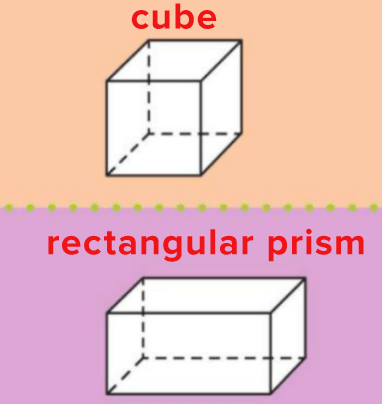
Cubes and rectangular prisms
Quiz
•
1st Grade

10 questions
Cube Prisms
Quiz
•
1st Grade

20 questions
Three Dimensional Shapes
Quiz
•
1st - 2nd Grade

11 questions
2D and 3D Shapes
Quiz
•
1st - 3rd Grade

17 questions
Finding Volume of Rectangular Prisms & Composite Figures
Quiz
•
1st - 5th Grade
Explore 1st Grade Rectangular Prisms Quizzes
Rectangular prisms represent foundational three-dimensional geometric concepts that Grade 1 students encounter as they begin exploring solid shapes in their mathematical journey. Through carefully designed quizzes available on Wayground, young learners engage with interactive practice questions that help them identify, describe, and understand the basic properties of rectangular prisms, including faces, edges, and vertices. These assessment tools provide immediate feedback while developing spatial reasoning skills and visual discrimination abilities essential for geometric understanding. Students build confidence recognizing rectangular prisms in everyday objects like boxes, books, and building blocks, strengthening their connection between abstract mathematical concepts and real-world applications through systematic practice and understanding checks. Wayground supports educators with access to millions of teacher-created quiz collections specifically designed for elementary geometry instruction, featuring robust search capabilities that allow teachers to locate age-appropriate rectangular prism content aligned with Grade 1 mathematics standards. The platform's filtering system enables instructors to customize quiz difficulty levels and question types, ensuring differentiated instruction that meets diverse learning needs within the classroom. Teachers can deliver these digital assessments flexibly during whole-group instruction, small group work, or independent practice sessions, while built-in analytics help identify students requiring additional support or enrichment opportunities. These comprehensive tools streamline lesson planning and provide targeted remediation resources, allowing educators to reinforce spatial concepts and geometric vocabulary through engaging, standards-based quiz experiences that support skill development and mathematical confidence building.
FAQs
What do first graders learn about rectangular prisms?
First graders move beyond simple recognition to identify the defining attributes of rectangular prisms. They learn to count the number of faces, edges, and vertices, understanding that these properties are what make a shape a rectangular prism.
How can I teach the attributes of a rectangular prism?
Use physical models and a 'see, feel, count' method. Have students hold a block or a small box. Ask them to touch and count the flat surfaces (faces), the straight lines where faces meet (edges), and the corners where edges meet (vertices). Using different-sized prisms reinforces that the attributes remain the same.
What are some common mistakes when students count faces, edges, and vertices?
Students often miscount by forgetting the sides they cannot see. For edges, they may double-count where faces meet. A helpful strategy is to have them mark each attribute with a small sticker or a dry-erase marker as they count it to keep track.
What kind of practice is best for Grade 1 students on this topic?
Quizzes that ask students to fill in the number of faces, edges, and vertices for a pictured rectangular prism are ideal. You can also include questions that ask them to distinguish a rectangular prism from other 3D shapes based on its specific attributes.
How does this align with Grade 1 curriculum standards?
This directly supports the Common Core standard 1.G.A.1, which requires students to distinguish between defining attributes (e.g., a triangle has three sides) versus non-defining attributes (e.g., color, size). For rectangular prisms, learning they have 6 faces, 12 edges, and 8 vertices is the core of this standard.
How can I use this Wayground quiz?
This resource is flexible for any first-grade classroom. You can download the printable PDF for a hands-on activity where students can use physical blocks alongside the quiz. Alternatively, you can assign it as a digital activity on Wayground. A complete answer key is included with every quiz for quick assessment.

Accessibility
Features
Wayground Super
School & District
Wayground for Business
Create a quiz
Create a presentation
Wayground AI
Subjects
Mathematics
Social Studies
Science
Physics
Chemistry
Biology
About
Our Story
Wayground Blog
Media Kit
Careers
Support
F.A.Q.
Help & Support
Privacy Policy
Terms of Service
Teacher Resources
2026 Wayground


Get our app

