


8th Grade Refraction Quizzes
Test your Grade 8 understanding of refraction with this comprehensive physics quiz featuring practice questions on light bending, optical phenomena, and wave behavior. Get instant feedback as you assess your knowledge of how light changes direction when passing through different materials and media.

10 questions
refraction and Lenses

Quiz
•
8th Grade

15 questions
Refraction and Lenses
Quiz
•
8th Grade

22 questions
PS (Q4) - Refraction and Lenses
Quiz
•
8th Grade

9 questions
Refraction
Quiz
•
8th Grade
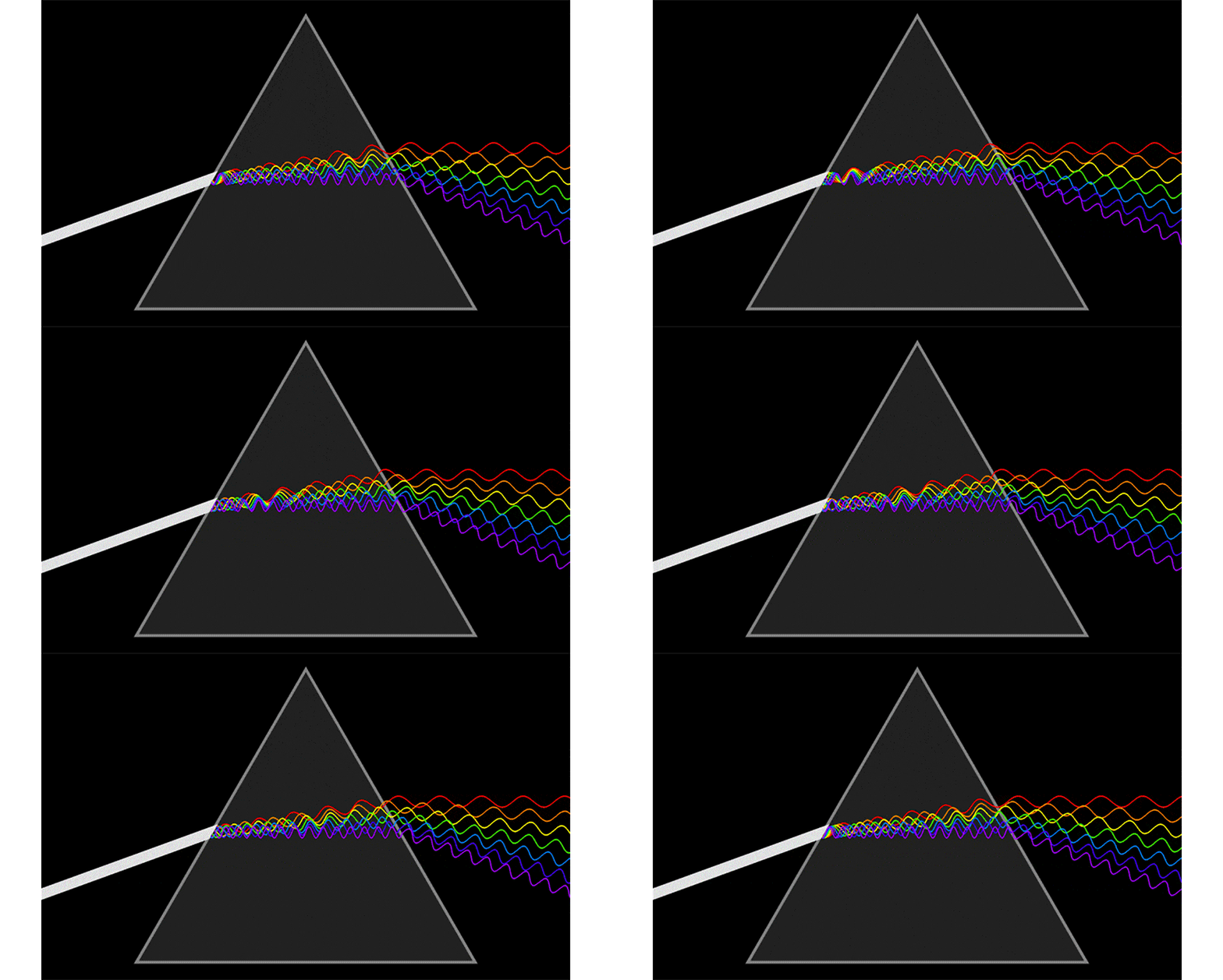
7 questions
Reflection, Refraction, and Diffraction
Quiz
•
8th Grade

15 questions
Light, Reflection, Refraction
Quiz
•
6th - 8th Grade
18 questions
Science Week 29 Refraction
Quiz
•
6th - 8th Grade
22 questions
Concept 3.4 Refraction
Quiz
•
5th - 8th Grade
Explore 8th Grade Refraction Quizzes
Refraction represents a fundamental concept in Grade 8 physics that explains how light and other waves change direction when passing between different materials. These comprehensive quiz collections through Wayground provide targeted assessment opportunities that help students master the principles governing how waves bend at material boundaries, from the familiar phenomenon of objects appearing bent in water to the complex behavior of light in lenses and prisms. The practice questions systematically build understanding of Snell's law, critical angles, and real-world applications, while immediate feedback helps students identify misconceptions and strengthen their grasp of wave behavior across various media. Wayground's extensive library contains millions of teacher-created refraction quizzes that support educators in delivering effective physics instruction for Grade 8 students. The platform's robust search and filtering capabilities enable teachers to locate resources aligned with specific curriculum standards and learning objectives, while customization tools allow for differentiation based on individual student needs and varying skill levels. These digital-first quiz formats provide flexible delivery options for classroom assessment, homework assignments, and review sessions, supporting comprehensive lesson planning that addresses foundational concept reinforcement, targeted remediation for struggling learners, and enrichment opportunities for advanced students ready to explore more complex optical phenomena.
FAQs
How do I teach refraction to physics students?
Start by establishing that light travels at different speeds in different media, which causes it to change direction at the boundary between two substances. Use visual demonstrations like a pencil in a glass of water or a laser pointer passing through a glass block to make the bending tangible before introducing Snell's law mathematically. Once students can predict the direction of bending qualitatively, move into quantitative calculations involving refractive indices and angle relationships. Connecting the math to real-world applications like fiber optics, eyeglass lenses, and mirages helps students see why refraction is worth understanding.
What exercises help students practice Snell's law and refraction calculations?
Students benefit most from scaffolded problem sets that begin with identifying which direction light bends based on the media involved, then progress to calculating angles of refraction using Snell's law, and finally to solving for refractive indices or critical angles. Including diagrams that students must label or complete forces them to connect the geometry to the math, which reduces blind formula application. Practice problems that incorporate real-world contexts, such as calculating how light enters a glass fiber or predicts a mirage, reinforce why the relationships matter beyond the equation itself.
What mistakes do students commonly make when solving refraction problems?
The most common error is measuring angles from the surface of the boundary rather than from the normal, which produces incorrect angle values in every subsequent calculation. Students also frequently confuse which medium has the higher refractive index and therefore bend light in the wrong direction. When working with total internal reflection, many students apply the critical angle formula without first checking whether light is traveling from a denser to a less dense medium, which is a prerequisite condition. Catching these errors early through structured practice with feedback is essential before students tackle multi-step optical problems.
How do I use Wayground's refraction quizzes in my physics class?
Wayground's refraction quizzes are available as printable PDFs for traditional classroom use and in digital formats for technology-integrated environments, giving you flexibility regardless of your setup. You can assign them as guided practice during instruction, independent work, or review before assessments. The digital format also allows you to host the quiz as a quiz on Wayground, making it easy to collect student responses and monitor performance in real time. Answer keys are included with every quiz, so you can use them efficiently for self-checking, peer review, or teacher-led correction.
How can I differentiate refraction instruction for students at different skill levels?
For students who are still building conceptual understanding, prioritize problems that require qualitative reasoning about bending direction before introducing Snell's law calculations. For advanced students, extend practice to include critical angle derivation, total internal reflection scenarios, and multi-media problems involving more than two substances. On Wayground, you can apply accommodations such as reduced answer choices to lower cognitive load for students who need it, or enable Read Aloud so that question text is read to students who benefit from audio support, without other students being affected.
What real-world applications of refraction should I include in physics quizzes?
Effective refraction quizzes connect Snell's law to applications students can observe or interact with, such as how eyeglass and contact lenses correct vision, how optical fibers use total internal reflection to transmit data, and why objects underwater appear displaced from their actual positions. Atmospheric refraction explains phenomena like mirages and the apparent flattening of the sun near the horizon. Including these contexts in practice problems gives students motivation to understand the underlying physics rather than treating refraction as an abstract mathematical exercise.

Accessibility
Features
Wayground Super
School & District
Wayground for Business
Create a quiz
Create a presentation
Wayground AI
Subjects
Mathematics
Social Studies
Science
Physics
Chemistry
Biology
About
Our Story
Wayground Blog
Media Kit
Careers
Support
F.A.Q.
Help & Support
Privacy Policy
Terms of Service
Teacher Resources
2026 Wayground


Get our app

