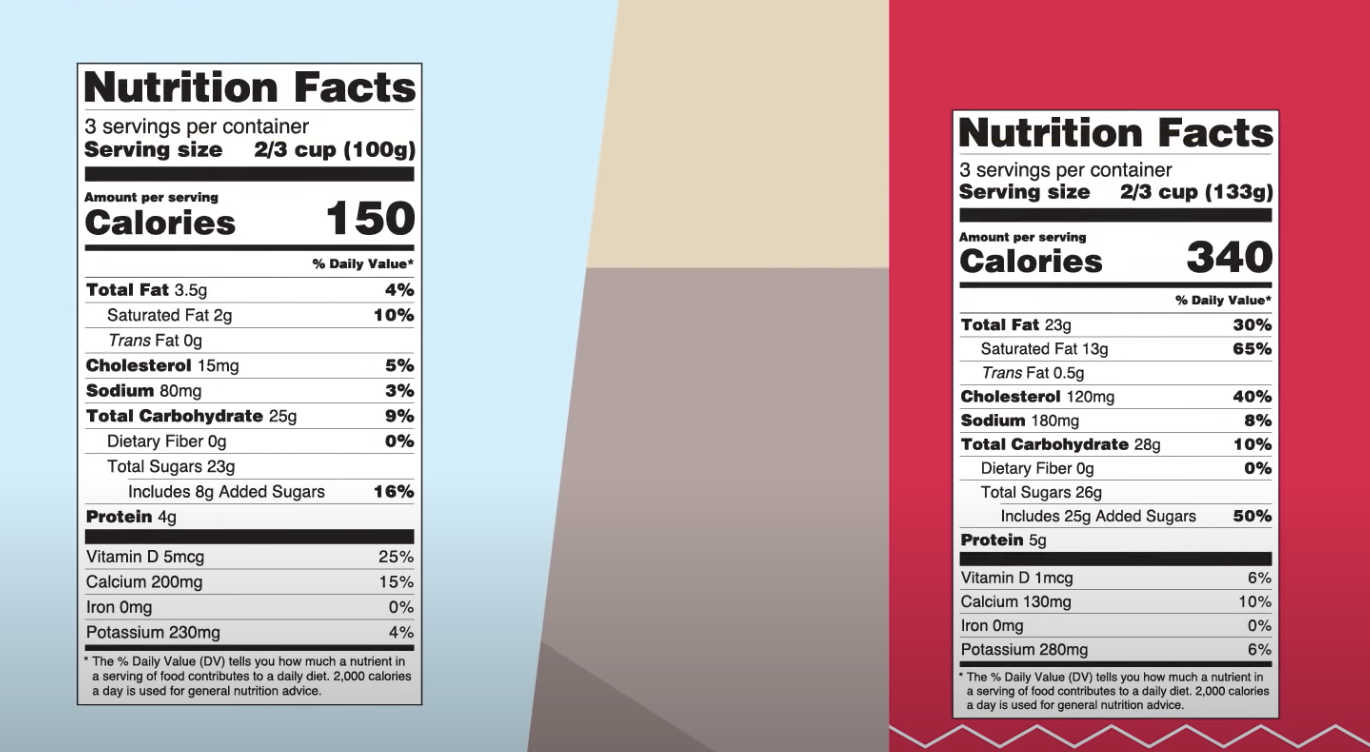
Nutrition Labels

Flashcard
•
Science
•
7th Grade
•
Practice Problem
•
Hard

Wayground Content
FREE Resource
Student preview

10 questions
Show all answers
1.
FLASHCARD QUESTION
Front
The serving size of a food is: El tamaño de la porción de un alimento es:
Back
the amount of food usually eaten at one time la cantidad de comida que normalmente se come de una vez
Answer explanation

The serving size of a food is the amount of food usually eaten at one time.
2.
FLASHCARD QUESTION
Front
Calories provide energy, but eating too many in a day is problematic. ____ calories or more of a food is considered too high (don't eat it!).
Back
400
Answer explanation

400 calories or more of a food is considered too high (don't eat it!). If you eat more calories than you burn through exercise, you could face obesity.
400 calorías o más de un alimento se considera demasiado alto (¡no lo coma!). Si comes más calorías de las que quemas a través del ejercicio, podrías enfrentarte a la obesidad.
3.
FLASHCARD QUESTION
Front
Does this food have a healthy amount of calories per serving? ¿Este alimento tiene una cantidad saludable de calorías por porción?

Back

4.
FLASHCARD QUESTION
Front
The % DV (daily value) section of the label tells you:
Back
how much of each nutrient a food has
Answer explanation

The % DV (daily value) section of the label tells you how much of each nutrient a food has. For example, this food as a 25% DV of fiber.
La sección de % DV (valor diario) de la etiqueta le indica la cantidad de cada nutriente que tiene un alimento. Por ejemplo, este alimento como un 25% DV de fibra.
5.
FLASHCARD QUESTION
Front
The _____ food is higher in cholesterol than the blue food. El alimento _____ tiene más colesterol que el alimento azul.

Back

6.
FLASHCARD QUESTION
Front
If I needed to limit how much fat I eat, I would choose the _____ food to eat. Si tuviera que limitar la cantidad de grasa que como, elegiría el alimento _____ para comer.
Back

7.
FLASHCARD QUESTION
Front
We should "aim to get less than 100% DV" of which nutrients? Options: sodium, added sugar, saturated fat, all of the above.
Back
all of the above


Access all questions and much more by creating a free account
Create resources
Host any resource
Get auto-graded reports

Continue with Google

Continue with Email

Continue with Classlink

Continue with Clever
or continue with

Microsoft
%20(1).png)
Apple

Others
Already have an account?
Similar Resources on Wayground

10 questions
Noun suffixes -ness, -dom, -ship
Flashcard
•
7th - 8th Grade
10 questions
Bahasa Inggris Kelas 4 - I go to school after having breakfast
Flashcard
•
6th Grade
10 questions
Caregiving tools,equipment,and paraphernalia
Flashcard
•
8th Grade
7 questions
Density (Flashcards) (Part 2)
Flashcard
•
7th Grade
7 questions
for zv patho
Flashcard
•
KG
5 questions
Synthesizing Essential Information in Various Sources
Flashcard
•
8th Grade
11 questions
6th Grade Statistics Vocabulary
Flashcard
•
6th Grade
6 questions
Butterfly Flashcards
Flashcard
•
6th - 8th Grade
Popular Resources on Wayground
7 questions
History of Valentine's Day

Interactive video
•
4th Grade
15 questions
Fractions on a Number Line

Quiz
•
3rd Grade
20 questions
Equivalent Fractions
Quiz
•
3rd Grade
25 questions
Multiplication Facts
Quiz
•
5th Grade
22 questions
fractions
Quiz
•
3rd Grade
15 questions
Valentine's Day Trivia
Quiz
•
3rd Grade
20 questions
Main Idea and Details
Quiz
•
5th Grade
20 questions
Context Clues
Quiz
•
6th Grade
Discover more resources for Science
11 questions
Valentines Day
Quiz
•
6th - 8th Grade
20 questions
Cell Organelles and Functions
Quiz
•
6th - 8th Grade
8 questions
Newton's Second Law

Lesson
•
6th - 8th Grade
10 questions
Exploring the Rock Cycle: Types and Formation
Interactive video
•
6th - 8th Grade
10 questions
Carbon Cycle
Lesson
•
6th - 8th Grade
13 questions
Plate Tectonics and Earth's Structure
Lesson
•
6th - 8th Grade
10 questions
Exploring Earth's Seasons and Their Causes
Interactive video
•
6th - 8th Grade
10 questions
Exploring Weathering, Erosion, and Deposition Processes
Interactive video
•
6th - 10th Grade