
Probability - Addition Rule

Flashcard
•
Mathematics
•
9th - 12th Grade
•
Practice Problem
•
Hard

Wayground Content
FREE Resource
Student preview

15 questions
Show all answers
1.
FLASHCARD QUESTION
Front
What is the Addition Rule in probability?
Back
The Addition Rule states that the probability of the occurrence of at least one of two events is equal to the sum of their individual probabilities minus the probability of their intersection. Mathematically, it is expressed as: P(A or B) = P(A) + P(B) - P(A and B).
2.
FLASHCARD QUESTION
Front
If a box contains 18 blue flashlights, 3 red flashlights, 7 silver flashlights, and 2 black flashlights, what is the probability of selecting a blue or black flashlight?
Back
The total number of flashlights is 30. The number of favorable outcomes (blue + black) is 20. Therefore, the probability is P(blue or black) = \frac{20}{30} = \frac{2}{3}.
3.
FLASHCARD QUESTION
Front
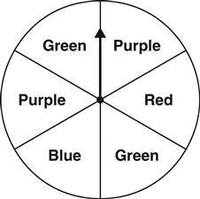
What is the probability of spinning purple or green on a spinner with 6 equal sections?
Back
If the spinner has 6 equal sections and 2 of them are purple or green, the probability is P(purple or green) = \frac{2}{6} = \frac{1}{3}.
4.
FLASHCARD QUESTION
Front
What is the probability of landing on an odd number or a number divisible by 3 when spinning a spinner numbered 1 to 10?
Back
The odd numbers are 1, 3, 5, 7, 9 (5 outcomes) and the numbers divisible by 3 are 3, 6, 9 (3 outcomes). The overlap (3 and 9) counts as 2. Therefore, P(odd or divisible by 3) = \frac{5 + 3 - 2}{10} = \frac{6}{10} = \frac{3}{5}.
5.
FLASHCARD QUESTION
Front
What is the probability of rolling a 4 or an odd number on a seven-sided die?
Back
The odd numbers are 1, 3, 5, 7 (4 outcomes) and the number 4 (1 outcome). The total favorable outcomes are 5. Therefore, P(4 or odd) = \frac{5}{7}.
6.
FLASHCARD QUESTION
Front
If a box contains 18 blue chips, 6 red chips, 4 green chips, and 2 yellow chips, what is the probability of selecting a blue or yellow chip?
Back
The total number of chips is 30. The number of favorable outcomes (blue + yellow) is 20. Therefore, the probability is P(blue or yellow) = \frac{20}{30} = \frac{2}{3}.
7.
FLASHCARD QUESTION
Front
What is the formula for calculating the probability of two mutually exclusive events?
Back
For mutually exclusive events A and B, the probability is calculated as: P(A or B) = P(A) + P(B).
Access all questions and much more by creating a free account
Create resources
Host any resource
Get auto-graded reports

Continue with Google

Continue with Email

Continue with Microsoft
or continue with

%20(1).png)
Apple

Others
Already have an account?


