
DNA structure

Flashcard
•
Biology
•
10th Grade
•
Practice Problem
•
Easy

Wayground Content
Used 1+ times
FREE Resource
Student preview

15 questions
Show all answers
1.
FLASHCARD QUESTION
Front
What is DNA replication?
Back
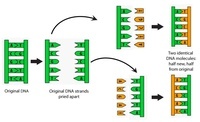
DNA replication is the process by which a DNA molecule makes a copy of itself, ensuring that each new cell receives an identical set of DNA during cell division.
2.
FLASHCARD QUESTION
Front
What role does DNA ligase play in DNA replication?
Back
DNA ligase is an enzyme that repairs the breaks in the sugar-phosphate backbone of DNA, particularly in the Okazaki fragments during replication.
3.
FLASHCARD QUESTION
Front
What are base pairs in DNA?
Back
Base pairs are pairs of nitrogenous bases (adenine-thymine and guanine-cytosine) that connect the two strands of DNA, forming the rungs of the DNA ladder.
4.
FLASHCARD QUESTION
Front
What is the significance of the sugar-phosphate backbone in DNA?
Back
The sugar-phosphate backbone provides structural support to the DNA molecule, holding the nitrogenous bases in place and forming the sides of the DNA ladder.
5.
FLASHCARD QUESTION
Front
What happens to the base pairs during DNA replication?
Back
During DNA replication, the base pairs are separated to allow each strand to serve as a template for the formation of a new complementary strand.
6.
FLASHCARD QUESTION
Front
What is the function of DNA helicase?
Back
DNA helicase is an enzyme that unwinds and separates the two strands of the DNA double helix during replication.
7.
FLASHCARD QUESTION
Front
How do the percentages of guanine and cytosine relate in DNA?
Back
According to Chargaff's rules, the percentage of guanine (G) in a DNA molecule is equal to the percentage of cytosine (C), as they pair together.
Access all questions and much more by creating a free account
Create resources
Host any resource
Get auto-graded reports

Continue with Google

Continue with Email

Continue with Microsoft
or continue with

%20(1).png)
Apple

Others
Already have an account?

