
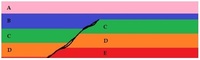
Law of Superposition

Flashcard
•
Science
•
7th Grade
•
Practice Problem
•
Hard

Wayground Content
FREE Resource
Student preview

15 questions
Show all answers
1.
FLASHCARD QUESTION
Front
What is the Law of Superposition?
Back
The Law of Superposition states that in any undisturbed sequence of rocks, the oldest layers are at the bottom and the youngest layers are at the top.
2.
FLASHCARD QUESTION
Front
What does it mean for a rock layer to be 'younger' than another?
Back
A rock layer is considered 'younger' if it was deposited after another layer, meaning it is above that layer in the sequence.
3.
FLASHCARD QUESTION
Front
What is the significance of the Kaibab formation in the context of rock layers?
Back
The Kaibab formation is the youngest rock layer in the given examples, indicating it was deposited last.
4.
FLASHCARD QUESTION
Front
How can you determine the oldest rock layer in a sequence?
Back
The oldest rock layer is found at the bottom of the sequence, according to the Law of Superposition.
5.
FLASHCARD QUESTION
Front
What is an example of a rock layer that is older than the Kaibab formation?
Back
The Zoraster Granite is older than the Kaibab formation.
6.
FLASHCARD QUESTION
Front
In a diagram of rock layers, how do you identify the youngest layer?
Back
The youngest layer is the one at the top of the diagram.
7.
FLASHCARD QUESTION
Front
What does 'deposition' refer to in geology?
Back
Deposition refers to the process by which sediments are laid down in new locations, forming new rock layers.
Access all questions and much more by creating a free account
Create resources
Host any resource
Get auto-graded reports

Continue with Google

Continue with Email

Continue with Microsoft
or continue with

%20(1).png)
Apple

Others
By signing up, you agree to our Terms of Service & Privacy Policy
Already have an account?



