
1st P - Conservation of Mechanical Energy

Flashcard
•
Physics
•
9th - 12th Grade
•
Practice Problem
•
Hard

Wayground Content
FREE Resource
Student preview

15 questions
Show all answers
1.
FLASHCARD QUESTION
Front
What is Mechanical Energy?
Back
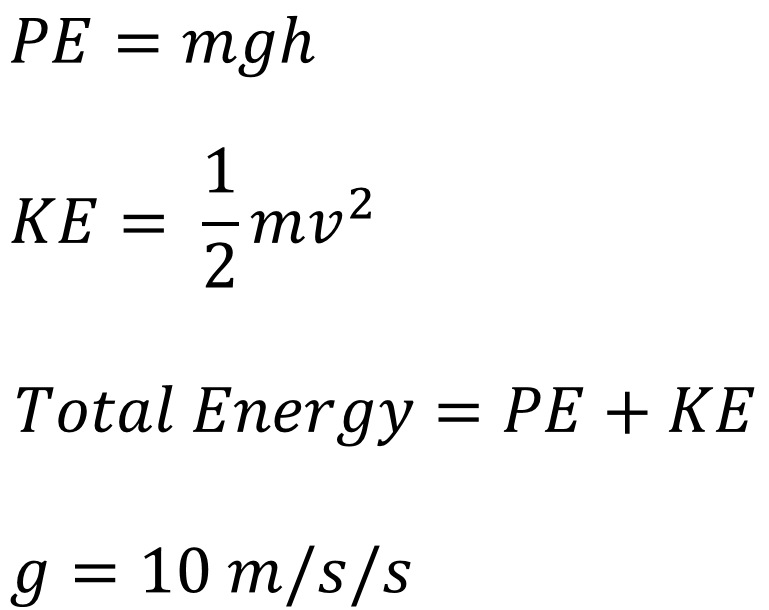
Mechanical Energy is the sum of potential energy and kinetic energy in an object. It is the energy associated with the motion and position of an object.
2.
FLASHCARD QUESTION
Front
Define Gravitational Potential Energy (GPE).
Back
Gravitational Potential Energy is the energy an object possesses due to its position in a gravitational field, typically calculated as GPE = mgh, where m is mass, g is acceleration due to gravity, and h is height.
3.
FLASHCARD QUESTION
Front
What is Kinetic Energy?
Back
Kinetic Energy is the energy an object has due to its motion, calculated using the formula KE = 1/2 mv², where m is mass and v is velocity.
4.
FLASHCARD QUESTION
Front
How does height affect Gravitational Potential Energy?
Back
As the height of an object increases, its gravitational potential energy increases because GPE is directly proportional to height.
5.
FLASHCARD QUESTION
Front
What happens to Kinetic Energy as speed increases?
Back
Kinetic Energy increases with the square of the speed; if the speed doubles, the kinetic energy increases by a factor of four.
6.
FLASHCARD QUESTION
Front
What is the principle of Conservation of Mechanical Energy?
Back
The principle states that in a closed system, the total mechanical energy (potential + kinetic) remains constant if only conservative forces are acting.
7.
FLASHCARD QUESTION
Front
Calculate the GPE of a 10 kg object at a height of 5 m.
Back
GPE = mgh = 10 kg * 9.8 m/s² * 5 m = 490 Joules.
Access all questions and much more by creating a free account
Create resources
Host any resource
Get auto-graded reports

Continue with Google

Continue with Email

Continue with Classlink

Continue with Clever
or continue with

Microsoft
%20(1).png)
Apple

Others
Already have an account?

