
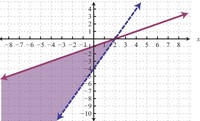
Linear Inequalities and Systems of Linear Inequalities

Flashcard
•
Mathematics
•
9th Grade
•
Practice Problem
•
Hard

Wayground Content
FREE Resource
Student preview

15 questions
Show all answers
1.
FLASHCARD QUESTION
Front
What is a linear inequality?
Back
A linear inequality is a mathematical statement that relates a linear expression to a value using inequality symbols (>, <, ≥, ≤).
2.
FLASHCARD QUESTION
Front
What does the solution set of a linear inequality represent?
Back
The solution set of a linear inequality represents all the points (x, y) that satisfy the inequality.
3.
FLASHCARD QUESTION
Front
How do you graph a linear inequality?
Back
To graph a linear inequality, first graph the corresponding linear equation as a boundary line. Then, shade the region that satisfies the inequality.
4.
FLASHCARD QUESTION
Front
What is the difference between a solid line and a dashed line in graphing inequalities?
Back
A solid line indicates that points on the line are included in the solution set (≥ or ≤), while a dashed line indicates that points on the line are not included (> or <).
5.
FLASHCARD QUESTION
Front
What does the symbol '≥' mean in a linear inequality?
Back
The symbol '≥' means 'greater than or equal to', indicating that the value can be equal to or greater than the specified number.
6.
FLASHCARD QUESTION
Front
What does the symbol '<' mean in a linear inequality?
Back
The symbol '<' means 'less than', indicating that the value must be strictly less than the specified number.
7.
FLASHCARD QUESTION
Front
How can you determine if a point is a solution to a linear inequality?
Back
To determine if a point is a solution, substitute the x and y values into the inequality. If the inequality holds true, the point is a solution.
Access all questions and much more by creating a free account
Create resources
Host any resource
Get auto-graded reports

Continue with Google

Continue with Email

Continue with Classlink

Continue with Clever
or continue with

Microsoft
%20(1).png)
Apple

Others
Already have an account?

