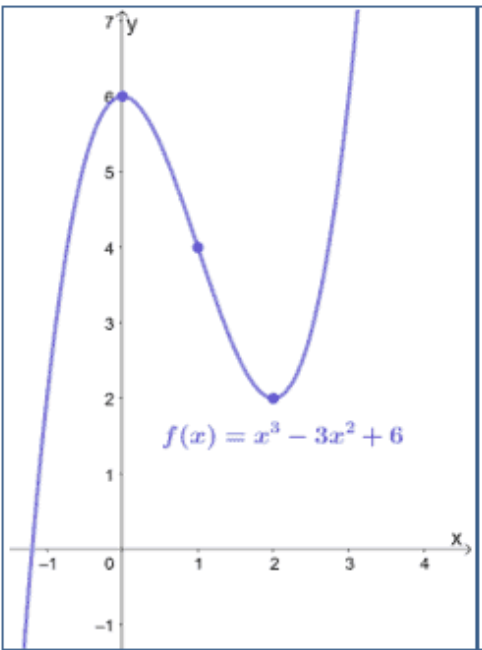
Module 3 Polynomial Functions Review CP

Flashcard
•
Mathematics
•
9th - 12th Grade
•
Practice Problem
•
Hard
Standards-aligned

Wayground Content
FREE Resource
Student preview

15 questions
Show all answers
1.
FLASHCARD QUESTION
Front
What is the end behavior of a polynomial function?
Back
The end behavior of a polynomial function describes how the function behaves as x approaches positive or negative infinity. It is determined by the degree and leading coefficient of the polynomial.
2.
FLASHCARD QUESTION
Front
Define increasing and decreasing intervals in a graph.
Back
Increasing intervals are ranges of x-values where the function's output (y-value) is rising. Decreasing intervals are ranges where the function's output is falling.
3.
FLASHCARD QUESTION
Front
What does it mean if a polynomial function has an odd degree?
Back
A polynomial function with an odd degree will have opposite end behaviors; as x approaches positive infinity, f(x) approaches positive infinity, and as x approaches negative infinity, f(x) approaches negative infinity.
4.
FLASHCARD QUESTION
Front
What does it mean if a polynomial function has a positive leading coefficient?
Back
A polynomial function with a positive leading coefficient will rise to positive infinity as x approaches positive infinity.
5.
FLASHCARD QUESTION
Front
What is factored form of a polynomial?
Back
Factored form expresses a polynomial as a product of its linear factors, which can help identify the roots of the function.
Tags
CCSS.HSF-IF.C.7C
6.
FLASHCARD QUESTION
Front
How do you find the local maximum of a function?
Back
The local maximum of a function is the highest point in a specific interval. It can be found using calculus (derivatives) or by analyzing the graph.
7.
FLASHCARD QUESTION
Front
What is the significance of the roots of a polynomial function?
Back
The roots (or zeros) of a polynomial function are the x-values where the function equals zero. They represent the points where the graph intersects the x-axis.
Tags
CCSS.HSF-IF.C.7C
Access all questions and much more by creating a free account
Create resources
Host any resource
Get auto-graded reports

Continue with Google

Continue with Email

Continue with Classlink

Continue with Clever
or continue with

Microsoft
%20(1).png)
Apple

Others
Already have an account?
Similar Resources on Wayground

16 questions
April Fools Trivia
Flashcard
•
KG - University
10 questions
Present Simple - Negative
Flashcard
•
10th Grade
12 questions
Political Advocacy and Interest Groups
Flashcard
•
9th - 12th Grade
9 questions
Classical and Medieval Art
Flashcard
•
KG
10 questions
Key Principles of Risk Management
Flashcard
•
KG - University
15 questions
paměť + pozornost
Flashcard
•
9th - 12th Grade
7 questions
International Yoga Day Quiz
Flashcard
•
KG - University
Popular Resources on Wayground
15 questions
Fractions on a Number Line

Quiz
•
3rd Grade
20 questions
Equivalent Fractions
Quiz
•
3rd Grade
25 questions
Multiplication Facts
Quiz
•
5th Grade
22 questions
fractions
Quiz
•
3rd Grade
20 questions
Main Idea and Details
Quiz
•
5th Grade
20 questions
Context Clues
Quiz
•
6th Grade
15 questions
Equivalent Fractions
Quiz
•
4th Grade
20 questions
Figurative Language Review
Quiz
•
6th Grade
Discover more resources for Mathematics
20 questions
Graphing Inequalities on a Number Line
Quiz
•
6th - 9th Grade
12 questions
Exponential Growth and Decay
Quiz
•
9th Grade
20 questions
Exponent Rules Review
Quiz
•
8th - 9th Grade
25 questions
Complementary and Supplementary Angles
Quiz
•
7th - 10th Grade
12 questions
Add and Subtract Polynomials
Quiz
•
9th - 12th Grade
13 questions
Model Exponential Growth and Decay Scenarios
Quiz
•
9th - 12th Grade
15 questions
Combine Like Terms and Distributive Property
Quiz
•
8th - 9th Grade
27 questions
7.2.3 Quadrilateral Properties
Quiz
•
9th - 12th Grade