
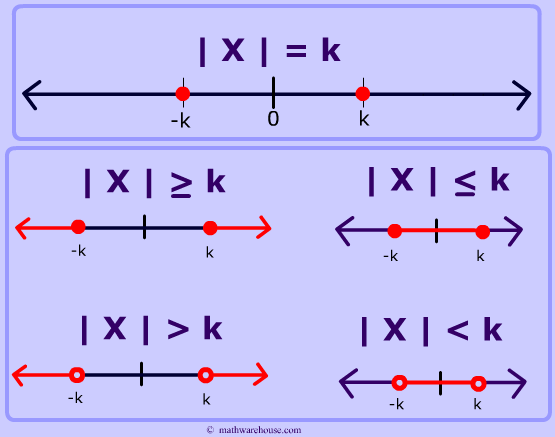
ABSOLUTE VALUE INEQUALITIES

Flashcard
•
Mathematics
•
12th Grade
•
Practice Problem
•
Hard

Wayground Content
FREE Resource
Student preview

15 questions
Show all answers
1.
FLASHCARD QUESTION
Front
What is an absolute value inequality?
Back
An absolute value inequality is an inequality that involves the absolute value of a variable expression, indicating the distance of the expression from zero on a number line.
2.
FLASHCARD QUESTION
Front
How do you solve the inequality |x + 4| < 5?
Back
To solve |x + 4| < 5, split it into two inequalities: -5 < x + 4 < 5. This simplifies to -9 < x < 1.
3.
FLASHCARD QUESTION
Front
What is the solution to the inequality |p + 3| ≥ 10?
Back
The solution is p ≤ -13 or p ≥ 7.
4.
FLASHCARD QUESTION
Front
How do you interpret the inequality |x - 6| ≤ 0.1 in a real-world context?
Back
This inequality indicates that the value of x (the radius of the gears) must be within 0.1 inches of 6 inches, meaning it can range from 5.9 to 6.1 inches.
5.
FLASHCARD QUESTION
Front
What does the inequality |x + 3| ≤ 2 represent?
Back
It represents the range of x values that are within 2 units of -3, which is -5 ≤ x ≤ -1.
6.
FLASHCARD QUESTION
Front
What is the first step in solving an absolute value inequality?
Back
The first step is to isolate the absolute value expression on one side of the inequality.
7.
FLASHCARD QUESTION
Front
What does the solution |x - 4| < 3 look like on a number line?
Back
The solution represents all x values between 1 and 7, which can be shown as an open interval (1, 7) on a number line.
Access all questions and much more by creating a free account
Create resources
Host any resource
Get auto-graded reports

Continue with Google

Continue with Email

Continue with Microsoft
or continue with

%20(1).png)
Apple

Others
By signing up, you agree to our Terms of Service & Privacy Policy
Already have an account?

