
- Resource Library
- Science
- Earth & Space Science
- Relative Dating Fossils
- Relative Dating And The Law Of Superposition
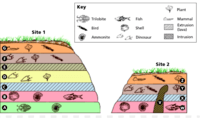
Relative Dating and the Law of Superposition

Flashcard
•
Science
•
6th Grade
•
Practice Problem
•
Hard

Wayground Content
FREE Resource
Student preview

15 questions
Show all answers
1.
FLASHCARD QUESTION
Front
What is relative dating?
Back
Relative dating is any method of determining whether something is older or younger than something else.
2.
FLASHCARD QUESTION
Front
What does the Law of Superposition state?
Back
In undisturbed rock layers, the oldest layers are at the bottom and the youngest layers are at the top.
3.
FLASHCARD QUESTION
Front
What is an intrusion in geology?
Back
An intrusion is a body of igneous rock that forms when magma cools and solidifies beneath the Earth's surface.
4.
FLASHCARD QUESTION
Front
How can fossils be used in relative dating?
Back
Fossils can help determine the relative ages of rock layers by showing which layers contain similar types of organisms.
5.
FLASHCARD QUESTION
Front
What is the significance of layer M in relative dating?
Back
Layer M is considered older than the intrusion P, indicating its position in the geological timeline.
6.
FLASHCARD QUESTION
Front
What is an example of a geological feature that can indicate relative age?
Back
An example is a fault line, which can show that the rock layers on either side are of different ages.
7.
FLASHCARD QUESTION
Front
What is the difference between absolute dating and relative dating?
Back
Absolute dating provides a specific age of a rock or fossil, while relative dating places events in order without exact dates.
Access all questions and much more by creating a free account
Create resources
Host any resource
Get auto-graded reports

Continue with Google

Continue with Email

Continue with Microsoft
or continue with

%20(1).png)
Apple

Others
By signing up, you agree to our Terms of Service & Privacy Policy
Already have an account?



