

Epithelial Tissue

Flashcard
•
Science
•
6th - 8th Grade
•
Hard

Barbara White
FREE Resource
Student preview

15 questions
Show all answers
1.
FLASHCARD QUESTION
Front
Tissues Noun
[tish-oos]
Back
Tissues
A cluster of specialized cells that are grouped together to perform a common function in an organism.
Example: This image displays four types of epithelial tissue, showing how cells group together in different shapes (cubed, flat, column-like) and layers to cover surfaces.

2.
FLASHCARD QUESTION
Front
Epithelium Noun
[ep-i-thee-lee-um]
Back
Epithelium
A type of animal tissue that covers body surfaces, lines body cavities and hollow organs, and also forms glands.
Example: This diagram shows that epithelial tissue, which covers body surfaces, is a category that includes different types based on cell shape and layers.

3.
FLASHCARD QUESTION
Front
Homeostasis Noun
[hoh-mee-oh-stay-sis]
Back
Homeostasis
The ability of an organism or cell to maintain a stable internal environment despite changes in external conditions.
Example: This diagram shows red blood cells delivering a constant supply of oxygen to body cells, a key process for maintaining the body's stable internal environment (homeostasis).

4.
FLASHCARD QUESTION
Front
Cellularity Noun
[sel-yoo-lar-i-tee]
Back
Cellularity
A characteristic of tissue describing the state of being composed of cells that are tightly packed with little intercellular space.
Example: This diagram shows epithelial tissue, which is defined by its high cellularity, meaning it is made of many cells packed very closely together.
5.
FLASHCARD QUESTION
Front
Polarity Noun
[poh-lar-i-tee]
Back
Polarity
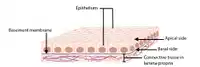
The characteristic of epithelial cells having distinct structural and functional sides, known as an apical and a basal surface.
Example: This diagram shows an epithelial cell has a distinct top (apical membrane) and bottom (basal membrane), which is a feature called polarity.

6.
FLASHCARD QUESTION
Front
Avascularity Noun
[ay-vas-kyoo-lar-i-tee]
Back
Avascularity
The characteristic of a tissue lacking blood vessels, requiring it to receive nutrients through diffusion from adjacent tissues.
Example: This image illustrates four components of alternative education; it does not explain avascularity, which is the lack of blood vessels in a tissue.

7.
FLASHCARD QUESTION
Front
Regeneration Noun
[ri-jen-uh-rey-shuhn]
Back
Regeneration
The natural process of replacing or restoring damaged or missing cells and tissues to restore their full function.
Example: This image shows how a lost limb can regrow in stages, starting with wound healing, which involves epithelial tissue covering the injury.


Access all questions and much more by creating a free account
Create resources
Host any resource
Get auto-graded reports

Continue with Google

Continue with Email

Continue with Microsoft
or continue with

%20(1).png)
Apple

Others
Already have an account?

