

Search Header Logo
Week 5 Lesson 3

Week 5 Lesson 3

Assessment

Presentation

Biology

6th Grade

Hard

Created by

Kyle Oakes

Used 8+ times

FREE Resource

14 Slides • 10 Questions

1

Week 5 Lesson 3

Use 2 devices or open 2 browsers

lesson is taken from textbook pages 62-67

first up a video on circulatory systems
Slide image

2

What is Circulation?

digestion assist by providing glucose to cells,and respiration provides O2, which converts O2 into energy.

multi-cellular organisms circulation is the movement of material such as O2, glucose and waste throughout the body

inverterbrates either have an open or closed circulatory system.

open system blood is not entirely closed within blood vessels, instead blood is released directly into into the tissue.closed system blood remains in vessel, materials diffuse in and out of the thin vessel walls. valves keep blood flowing in one direction


3

organisms and their circulation

  • different organisms use different ways to circulate O2 and glucose

  • Waste material gets circulated too in the circulatory system, CO2

Slide image

4

Multiple Select

select the correct boxes

1

The movement of important materials throughout the

body is called

circulation

2

valves prevent blood flowing backward, and keeps blood flowing in one direction

3

circulation is the digestion of food

4

In a single-loop circulatory system, blood travels from

the heart to the

gills , then to the

body cells. Then the blood goes back to the heart

5

Video time

body temperature warm blooded and cold blooded

6

Body temperature

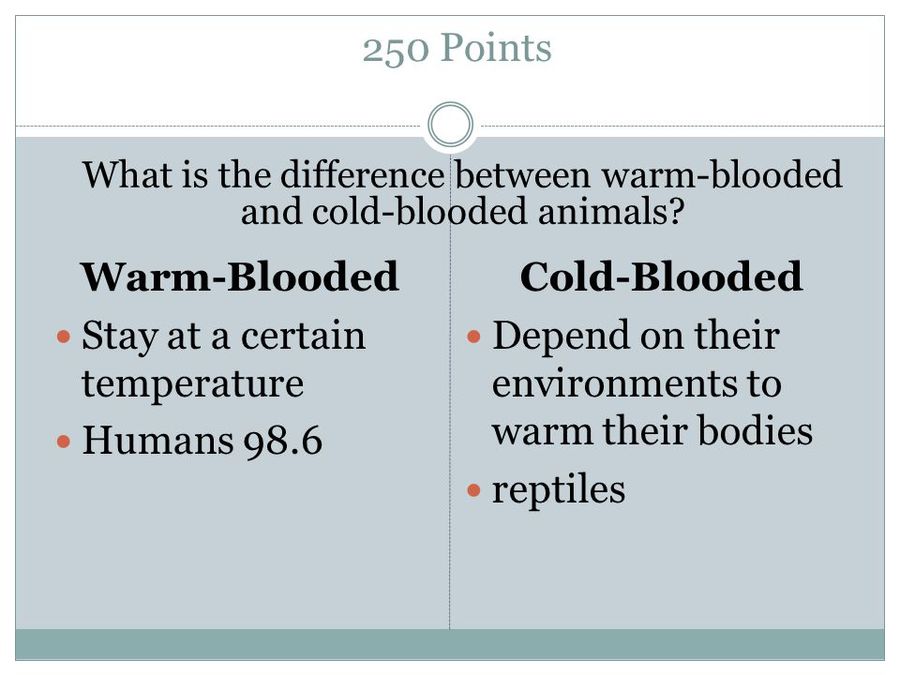
Activities in the body require a certain temperature to carry it out.some animals temperature changes with their surroundings.snakes seek the sun for warmth and burrow under rocks to cool down.amphibians, reptiles and most fish are cold blooded.Mammals are warm blooded surroundings do not influence their temperature. various body mechanisms, If they get hot they give of heat by perspiring. insulation in the body , a layer of fat called blubber. to prevent heat leaving their bodies in whales
Slide image

7

Multiple Select

select the correct boxes

1

Amphibians, reptiles, and

most fish are cold-blooded animals.

2

animals can change from being warm blooded to a cold blooded animal/organism

3

Mammals and birds are warm-blooded. Their

body temperature stays the same, even when the

temperature of the air changes.

4

warm-blooded animals can perspire to reduce the heat in the their body and cool it down (perspiration)

8

Time for a video

Types of skeletons

9

what are support and movement

animals need to move to survive.the animal kingdom has 3 systems of movement.Cnidarians , Mollusks, roundworms and som flat-worms have hydrostatic skeletons.it has no bones, a fluid filled cavity with muscle fibers.Muscles contract, cavity wall pushes against the fluid and produces motion

Slide image

10

Exoskeleton

exoskeleton- a hard coating on the outside of the body.Arthropods and many mollusks have an exo. muscles attached on the inside of the skeleton help the arthropods move their joints

Slide image

11

Multiple Select

Select the correct boxes

1

Cnidarians, some flatworms,

roundworms, and some mollusks

have hydrostatic skeletons.

2

birds have an exoskeleton

3

An exoskeleton is a hard coating on

the outside of the body.

4

arthropods have an endoskeleton

12

endoskeleton

some sponges, echinoderms and vertebrtes, have endoskeletons. Made of a hard structure within the body.Except sponges which have no muscles.animals with endoskeletons have muscles attached to individual bones. skeletons help with movement and protection. Arthropods covering protects their internal organs.Internal ribs protect vital organs such as lungsand heart. the backbone brotects the nerve of the spinal cord

Slide image

13

Multiple Select

select the correct boxes

1

Skeletons also provide protection.

2

A vertebrate’s backbone

protects the nerves of its spinal cord

3

endo-skeleton is made of chitin

4

vertebrates have endoskeletons

14

Lesson review on page 65

Students can do this on their own after the lesson

15

Multiple Select

select the correct boxes

1

The process by which

organisms break down ingested food

into a usable form is called ingestion

2

Respiration releases

energy from food

molecules in the

presence of oxygen.

3

The movement of materials

throughout the body is called digestion.

4

Excretion

removes wastes from

the body.

5

Insects have an exo-skeleton

16

video time

Quick lab on vein valves page 63

17

Multiple Select

select the correct answers

1

valves are important

2

valves allow for blood to flow in two directions

3

valves are not needed in the body

4

valves allow blood to flow in 1 direction

5

blood is needed to transport oxygen and glucose and take waste throughout the body

18

video time

Quick lab/ video on vessels and bell jar pages66-67

19

different blood vessels

  • consider, what would happen if I increase or decrease the diameter of the pipes
  • Will the blood/water flow faster or slower
Slide image

20

Open Ended

write your hypothesis, If the diameter of a blood vessel is made smaller,

then the flow of blood will....

21

Multiple Select

select the correct boxes

1

Amphibians, reptiles, and

most fish are cold-blooded animals.

2

animals can change from being warm blooded to a cold blooded animal/organism

3

Mammals and birds are warm-blooded. Their

body temperature stays the same, even when the

temperature of the air changes.

4

w

22

from the bell jar experiment

possible hypothesis : Student speaks

Slide image

23

Open Ended

hypothesis : if humans have lungs,

then the human body must also have the

following parts for the lungs to work:

24

Open Ended

what experiment would you use to test your hypothesis? explain what is needed and the steps

Week 5 Lesson 3

Use 2 devices or open 2 browsers

lesson is taken from textbook pages 62-67

first up a video on circulatory systems

Slide image

Show answer

Auto Play

Slide 1 / 24

SLIDE