


Newton's 1st Law
Presentation
•
Science
•
8th Grade
•
Medium
Standards-aligned
Dondria Smith
Used 32+ times
FREE Resource
9 Slides • 22 Questions
1
Newton's 1st Law
2
Inertia
We will define inertia and describe it as Newton’s first law of motion.
I will identify a scenario as Newton’s First Law (law of inertia) and explain why it is that law.
3
Sir Isaac Newton
Sir Isaac Newton (1643-1727) an English scientist and mathematician famous for his discovery of the law of gravity also discovered the three laws of motion. Today these laws are known as Newton’s Laws of Motion and describe the motion of all objects on the scale we experience in our everyday lives.
4
Because of Inertia, if it is still it will not move unless…..*
INERTIA!
The tendency of objects to resist a change in motion.
If it is moving – it will keep moving. If it is still – it will not move.
UNLESS….. An unbalanced force acts on it!
5
Why do moving object continue to keep on moving?
INERTIA!
The tendency of objects to resist a change in motion.
If it is moving – it will keep moving. If it is still – it will not move.
UNLESS….. an unbalance force acts on it!
6
Fill in the Blanks
Use the information to complete the statement about Newton’s 1st law of Inertia:
An object at rest will remain at
Type answer...
7
Fill in the Blanks
Use the information to complete the statement about Newton’s 1st law of Inertia:
An object at rest will remain at
rest…..
Unless acted on by an
Type answer...
8
Fill in the Blanks
Use the information to complete the statement about Newton’s 1st law of Inertia:
An object in _____________ will continue with the same speed and direction.
Unless acted upon on by an ________force.
Type answer...
9
Fill in the Blanks
Use the information to complete the statement about Newton’s 1st law of Inertia:
An object in motion will continue with the same speed and direction.
Unless acted upon on by an
Type answer...
10
Multiple Choice
11
Multiple Choice
12
Multiple Choice
13
Mass and Inertia
- All objects have inertia
- Inertia is based on MASS
-More Mass-More Inertia
-Less Mass-Less Inertia
14
Multiple Choice
Which has more inertia?
15
Multiple Choice
Which has more inertia?
16
Multiple Choice
Which has more inertia?
17
Multiple Choice
18
How are balanced forces related to inertia?
If an object is at rest, all of the forces on it are balanced.
If an object is moving at a constant velocity all of the forces are balanced.
19
Multiple Choice
20
Multiple Choice
21
Multiple Choice
22
Open Ended
How are unbalanced forces related to inertia?
What do you think will happen next ?What will happen to the coin when the cardboard is pulled quickly?
23
The coin has inertia, meaning it really wants to stay in one place.
The coin has inertia, meaning it really wants to stay in one place. The coin does not move with the card the coin, falls due to the unbalanced force of gravity.
24
Multiple Choice
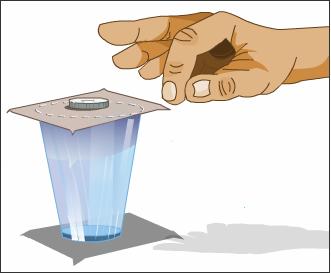
This illustration explains inertia because the object stays at rest until an unbalanced force is applied. What is the unbalanced forced that changed the coin?
coffee
motion
inertia
gravity
25
Open Ended
When the car stops, what happens to the driver? Why it is important to wear a seat belt ?How does this relate to Newton’s first law/ Inertia??
26
Inertia is the reason that people in cars need to wear seat belts
A moving car has inertia, and so do the riders inside it.
When the driver applies the brakes, an unbalanced force is applied to the car
The seatbelt applies an unbalanced force to the driver.
27
Multiple Choice
Which of the following is the best example of Newton's First Law of Motion?
Jessica's body flies forward after she hits the brakes
Jessica drives a car
Jessica is at a road crossing
Jessica is sleeping
28
Multiple Choice
A person is pedaling their bike and suddenly hits the front brakes and their body continues to move and they fly over the handlebars. The body was an object in motion. When the bicycle stops the body resists changing motion and keeps moving. Gravity overcomes the inertia and the person falls to the ground.
Which part of the scenario describes the Inertia ?
When the bicycle stops the body resists changing motion and keeps moving
Gravity overcomes the inertia and the person falls to the ground.
29
Multiple Choice
A person is pedaling their bike and suddenly hits the front brakes and their body continues to move and they fly over the handlebars. The body was an object in motion. When the bicycle stops the body resists changing motion and keeps moving. Gravity overcomes the inertia and the person falls to the ground.
Which part of the scenario describes the unbalanced force acted upon the object?
When the bicycle stops the body resists changing motion and keeps moving
Gravity overcomes the inertia and the person falls to the ground.
30
Multiple Choice
The inertia in the puck keeps it at rest until the inertia is overcome by the force of the stick hitting it. Which part of the scenario describes the Inertia?
The inertia in the puck keeps it at rest
inertia is overcome by the force of the stick hitting it.
31
Multiple Choice
The inertia in the puck keeps it at rest until the inertia is overcome by the force of the stick hitting it. Which part of the scenario describes the unbalanced force acted upon the object?
The inertia in the puck keeps it at rest
inertia is overcome by the force of the stick hitting it.
Newton's 1st Law

Show answer
Auto Play
Slide 1 / 31
SLIDE

Similar Resources on Wayground
24 questions
Atoms
Presentation
•
8th Grade
23 questions
Electromagnetic Spectrum Review
Presentation
•
8th Grade
22 questions
Earth/Space Review 2-Stars & Sun
Presentation
•
8th Grade
22 questions
Exploring Earth's Surface
Presentation
•
8th Grade
27 questions
Weather Maps Lesson and Practice
Presentation
•
8th Grade
27 questions
Electromagnetic Spectrum
Presentation
•
8th Grade
25 questions
Law of Superposition
Presentation
•
7th - 8th Grade
21 questions
Graphing Motion
Presentation
•
8th Grade
Popular Resources on Wayground
10 questions
How much do you know about our Portrait of an Eagle?
Quiz
•
10th Grade
10 questions
Fast Food Slogans
Quiz
•
6th - 8th Grade
21 questions
Continents and Oceans
Quiz
•
6th Grade
20 questions
Parts of Speech
Quiz
•
5th Grade
16 questions
Subject & Predicate
Quiz
•
5th Grade
25 questions
Multiplication Facts
Quiz
•
5th Grade
12 questions
Map Skills
Quiz
•
3rd Grade
22 questions
Continents and Oceans
Quiz
•
5th Grade
Discover more resources for Science
20 questions
Scientific Method and Variables
Quiz
•
8th Grade
20 questions
Scientific method and variables
Quiz
•
8th Grade
27 questions
Counting Atoms - Subscripts
Quiz
•
8th Grade
20 questions
Claim, Evidence and Reasoning (CER)
Quiz
•
6th - 8th Grade
18 questions
Counting Atoms
Quiz
•
7th - 8th Grade
20 questions
Elements, Compounds and Mixtures
Quiz
•
8th Grade
10 questions
Exploring Chemical and Physical Changes
Interactive video
•
6th - 10th Grade
10 questions
Decoding the Periodic Table of Elements
Interactive video
•
6th - 10th Grade