

Law of Superposition

Presentation
•
Science
•
7th - 8th Grade
•
Medium
Standards-aligned

Grace Breazeale
Used 145+ times
FREE Resource
17 Slides • 8 Questions
1
The Law of Superposition
Jan. 29, 2021
2
3
Multiple Choice

Someone took the last cookie in the cookie jar last night. The last person to leave the scene is the culprit. Who was it?
Clues:
Person A walks to work.
Person B rides a bike.
Person C rides a motorcycle.
Person D drives a car.
Person E travels with a guide dog.
4
Let's talk about it!
Who is the culprit?
What evidence did you see that led you to your answer?

5
Answer
Person E is the culprit.
We know that Person E and the dog left most recently because their footprints were on top of all the others.

6
7
Law of Superposition
Recall that fossils are present in layers of sedimentary rock.
The Law of Superposition tells us that in a series of undisturbed rock layers, the oldest layer is at the bottom, and the youngest layer is at the top.

8
Open Ended

According to the Law of Superposition, layer 1 was the first layer deposited, so it is the oldest layer. The last layer deposited was layer 12, so it is the youngest layer.
What can this tell us about the age of the fossils that we find in these layers?
9
Answer
The Law of Superposition gives us information about the relative age of different fossils.
Relative age does not tell the exact age of something, but it tells us which object is oldest and which is youngest.

10
Multiple Choice
11
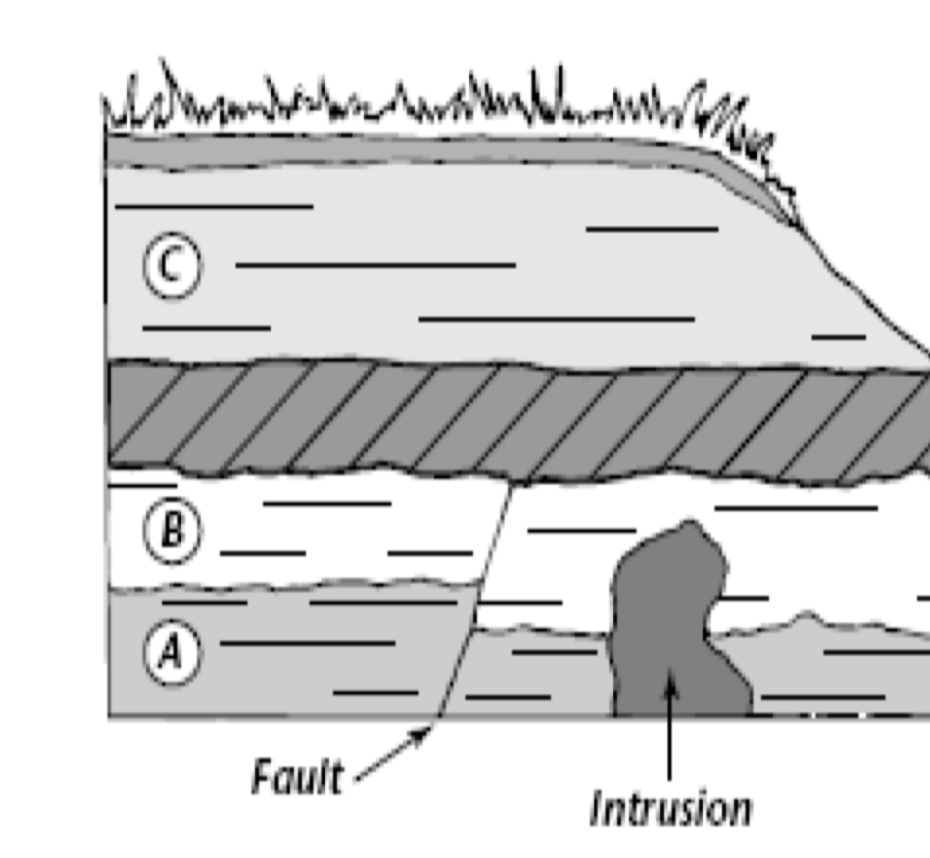
Faults and Intrusions
Sometimes, rock layers are disturbed by natural events, creating faults or intrusions.
In these cases, determining relative age can be more difficult.
12
Faults
Faults occur when rocks break due to the forces acting on them

13
Intrusions
Intrusions: when magma (lava) penetrates existing rock, crystallizes, and solidifies, forming igneous rock.

14
Faults and Intrusions
The Law of Crosscutting Relationships tells us that a fault or intrusion is always younger than all the rocks it cuts through.

15
Multiple Choice

Which letter represents the fault?
16
Multiple Choice

Which letter represents the intrusion?
17
Multiple Choice

Which layer is oldest?
18
Multiple Select

Which layer is the youngest?
19
Answers
"E" represents the fault
"D" represents the intrusion
"C" is oldest because it is the lowest layer
"E" is youngest because it cuts through all of the layers.

20
Open Ended

Let's pull it all together! Based on what we just discussed, put the layers in the correct order, starting with the oldest layer.
21
Let's talk about it!
What order did you put the layers in?
What evidence did you use to put the layers in this order?

22
Answer
K youngest
J
I
H
P
L
M
N
O
Q oldest

23
Independent Practice
Click on the link in the chat box to go to the Google Form.
Follow the instructions given in the form.
If you have any questions, raise your hand or put them in the chat.
I will pull you back together when it's almost time to go.

24
Exit Ticket
Please complete your Exit Ticket in Canvas.
When you are finished, you are free to go.
Have a great rest of your day!

25
Review
A fossil is the preserved remains or impressions of an organism such as a plant, animal, or insect.
Almost all fossils are preserved in sedimentary rock.
Studying fossils helps scientists to learn about the past history of life on Earth.

The Law of Superposition
Jan. 29, 2021
Show answer
Auto Play
Slide 1 / 25
SLIDE


