

States of Matter

Presentation
•
Science
•
5th - 10th Grade
•
Practice Problem
•
Medium
Standards-aligned

Kyle Sheahon
Used 1K+ times
FREE Resource
13 Slides • 15 Questions
1

2
Matter is anything that has mass, or takes up space.
All matter is comprised of particles.
Particles are constantly moving.
Every substance can be a solid, liquid or gas, but at different temperatures.

3
Remember that the state of matter is a Physical Property because the actual substance doesn't change what it is, only the form changes.
For example, water and ice are made up of the exact same molecules, it just changes form.

4
1How close the molecules are to one another, and 2how quickly they move determine what state of matter a substance is in.
5
solid
liquid
gas
plasma

6
Draw
Draw an example of a solid.
7
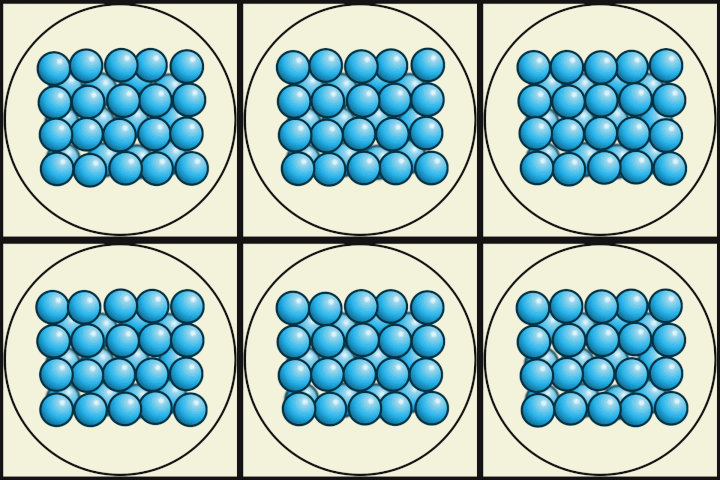
In a solid, particles are packed tightly together so they don't move much, but are dense. The electrons of each particle are constantly in motion, giving the atoms a small vibration, but they are fixed in their position.
Solids have a definite shape, as well as mass and volume, and do not conform to the shape of the container in which they are placed.
8
Draw
Circle the solid.
9
Open Ended
Give an example of a liquid.
10
In a liquid, the particles are more loosely packed than in a solid, but closely enough that it is not easily compressible.
The particles are able to flow around each other, giving the liquid an indefinite shape. Therefore, the liquid will conform to the shape of its container.

11
Draw
Circle the liquid.
12
Open Ended
Give an example of a gas.
13
In a gas, the particles have a great deal of space between them, so they move easily, and have high kinetic energy (energy of movement).

14
Draw
Circle the gas.
15

When a gas is put under pressure by reducing the volume of the container, the space between particles is reduced and the gas is compressed.
16
In a liquid, the particles are already close together, so it is not easily compressed.

17
A gas has no definite shape or volume. If unconfined, the particles of a gas will spread out indefinitely (forever). However, if confined, the gas will expand to fill its container.

18
Plasma is not a common state of matter here on Earth, but it may be the most common state of matter in the universe. Stars are essentially superheated balls of plasma.
Plasma consists of highly charged gas particles with extremely high kinetic energy (energy in motion).
Think of plasma as gas, with an electrical charge.

19
Multiple Choice
Which state of matter contains particles that flow freely past one another?
Solid
Liquid
Gas
Plasma
20
Multiple Choice
Which state of matter has a fixed volume and mass?
Solid
Liquid
Gas
Plasma
21
Multiple Choice
Which state of matter fills a container?
Solid
Liquid
Gas
Plasma
22
Multiple Choice
Which state of matter contains particles that slowly vibrate, but in a fixed position?
Solid
Liquid
Gas
Plasma
23
Multiple Choice
Which state of matter does not contain easily flowing particles?
Solid
Liquid
Gas
Plasma
24
Multiple Choice
Which state of matter has the ability for its particles to be easily compressed?
Solid
Liquid
Gas
Plasma
25
Multiple Choice
Which state of matter is much like a gas, but with particles that are charged?
Solid
Liquid
Gas
Plasma
26
Multiple Choice
Which state of matter has a definite shape?
Solid
Liquid
Gas
Plasma
27
Reorder
Reorder the following in order from MOST energy to LEAST energy.
28
Draw the graphic organizer template located in Google Classroom in this assignment (2. States of Matter).
Fill it out.
Using your chromebook, take a picture of the graphic organizer.
Upload the picture to this assignment in Google Classroom.
Don't forget the google form assignment as well!
Show answer
Auto Play
Slide 1 / 28
SLIDE
Similar Resources on Wayground

22 questions
Layers of the Atmosphere Virginia Grade 6 2023
Presentation
•
6th - 8th Grade
19 questions
Changing States
Presentation
•
5th - 9th Grade
21 questions
Chapter 24: Section One: Boom Times
Presentation
•
KG
23 questions
Plastic Pollution Awareness
Presentation
•
KG - 12th Grade
19 questions
5 Dispozitive de stocare
Presentation
•
5th - 9th Grade
19 questions
prop of matter and motion of molecules summative review
Presentation
•
6th - 10th Grade
22 questions
Physical and Chemical Changes
Presentation
•
6th - 8th Grade
22 questions
Chemistry of Materials Review
Presentation
•
6th - 8th Grade
Popular Resources on Wayground
10 questions
How much do you know about our Portrait of an Eagle?

Quiz
•
10th Grade
10 questions
Fast Food Slogans
Quiz
•
6th - 8th Grade
21 questions
Continents and Oceans
Quiz
•
6th Grade
20 questions
Parts of Speech
Quiz
•
5th Grade
16 questions
Subject & Predicate
Quiz
•
5th Grade
25 questions
Multiplication Facts
Quiz
•
5th Grade
12 questions
Map Skills
Quiz
•
3rd Grade
22 questions
Continents and Oceans
Quiz
•
5th Grade
Discover more resources for Science
9 questions
Properties of matter and Mixtures
Quiz
•
5th Grade
20 questions
Mixtures and Solutions Practice
Quiz
•
5th Grade
17 questions
7.6D Aqueous Solutions
Quiz
•
7th Grade
20 questions
Scientific Method and Variables
Quiz
•
8th Grade
20 questions
Scientific method and variables
Quiz
•
8th Grade
27 questions
Counting Atoms - Subscripts
Quiz
•
8th Grade
10 questions
6.6D - Relative Density Review
Quiz
•
6th Grade
20 questions
Claim, Evidence and Reasoning (CER)
Quiz
•
6th - 8th Grade