Search Header Logo
Review for Unit 3 Summative Assessment

Review for Unit 3 Summative Assessment

Assessment

Presentation

Chemistry

9th - 12th Grade

Easy

Created by

Janeen Miklowski

Used 2+ times

FREE Resource

3 Slides • 49 Questions

1

Review for Unit 3 Summative Assessment

Slide image

2

What should you know? Unit 3a:

  • Types of matter (atom, element, mixtures, compound)

  • Homogeneous vs. heterogeneous mixtures and techniques of separation

  • States of matter: solid, liquid, gas

  • Physical and chemical changes and properties

  • Indicators of chemical reaction

  • Parts of a chemical equation

  • Express elements and compounds with symbols and formulas, respectively

Slide image

3

Multiple Choice

Name the part in red:


H2 + O2 -> H2O

1

Coefficient

2

Product

3

Yield

4

Subscript

4

Multiple Choice

How many atoms of aluminum are on each side of the following equation: 4Al + 3O2 --> 2Al2 O3

1

2

2

6

3

1

4

4

5

Multiple Choice

Which side of a chemical equation is the product side?

1

Left (before the yields sign)

2

Right (after the yields sign)

6

Multiple Choice

In the chemical equation H2O2(ag) → H2O(l) + O2(g), the O2 is a

1

reactant

2

yield

3

product

4

solid

7

Multiple Choice

Chemical reactions

1

create and destoy atoms

2

only occurs outside living organisms

3

occurs only in living organisms

4

produce new substances

8

Multiple Choice

The products of a reaction have the same ________as the reactants.

1

molecule

2

atoms

3

subscripts

4

coefficients

9

Multiple Choice

Question image

Which scientific observation, shown in the chart, indicates that a chemical reaction has NOT occurred?

1

Number 1

2

Number 2

3

Number 3

4

Number 4

10

Multiple Choice

A scientist spilled a few drops of dilute hydrochloric acid (HCl) on a lab table. For safety purposes, the scientist sprinkled some baking soda ( NaHCO3NaHCO_3  ) onto the spill. Which observation would provide the best evidence that a chemical reaction occured?

1

The baking soda and hydrochloric acid combined, and bubbles formed. 

2

The baking soda absorbed the hydrochloric acid. 

3

Some of the baking soda dissolved in the hydochloric acid.

4

The hydrochloric acid evaporated, leaving only the baking soda. 

11

Multiple Select

Which lab experiments below describe a situation where a chemical change has occurred? Check all that apply.

1

After adding zinc (Zn) to hydrochloric acid (HCl), a student observes bubbles forming in the solution and a thermometer registers a  10°10\degree  change in temperature.

2

A student uses a mortar and pestle (a grinding stone) to break up large pieces of ammonium thiocyanate ( NH4SCNNH_4SCN  ) into smaller pieces.

3

After combining Unknown A (a solid, white crystal) with Unknown B (a clear, odorless liquid), there is a strong smell produced and a thermometer registers a  15°15\degree  change in temperature.

4

A student dissolves sugar ( C6H6O6C_6H_6O_6  ) into water ( H2OH_2O  ). The sugar crystals seem to disappear.

12

Multiple Choice

Pb is the element symbol for....

1

lead

2

gold

3

peanutbutter

4

nitrogen

13

Multiple Choice

What's the symbol for copper?

1

C

2

Co

3

Cu

4

CP

14

Multiple Choice

What is the process of separating products with densities?

1

centrifugation

2

chromatography

3

heating

4

decantation

15

Multiple Choice

To separate a mixture of soil and water what separation method is used?

1

Filtration

2

Distillation

3

Chromatography

4

Evaporation

16

Multiple Choice

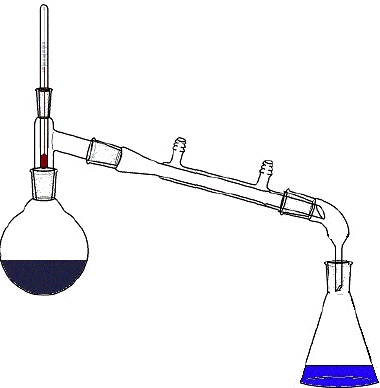
Question image

Water and alcohol are easily separated by distillation because of their

1

different melting points

2

different colors

3

different densities

4

different boiling points

17

Multiple Choice

Which one of the following would you use to separate sand from iron filings?

1

a bar magnet

2

filter paper

3

chromatography paper

4

alum

18

Multiple Choice

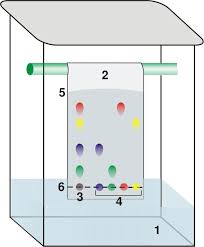
Question image

Dyes in water soluble markers may be separated by means of..

1

crystallization

2

sublimation

3

chromatography

4

sedimentation

19

Multiple Select

Which of the following is the correct set-up of filtration?

1
2
3
4

20

Multiple Choice

Question image

Which state of matter has molecules that move fastest and spread to fill the space they are in? They do not form any pattern.

1

solid

2

liquid

3

gas

21

Multiple Choice

If you had two different substances that looked exactly the same, which properties would you use to tell them apart?

1

Sound

2

Size

3

Color

4

Density

22

Multiple Select

Choose the 3 that are physical properties of aluminum foil

1

Malleable

2

Luster

3

Oxidation

4

High melting point

23

Multiple Choice

Electrical conductivity is an example of what kind of property?

1

Chemical

2

Large

3

Physical

4

Boiling

24

Multiple Choice

Choose the one that is a chemical property

1

Magnetism

2

Size

3

Color

4

Reactivity with water

25

Multiple Choice

Choose which one is a physical property

1

Flammability

2

Solubility

3

Water Reaction

4

Magic

26

Fill in the Blank

There is a lot of copper in the statue of liberty. Copper is a metallic brown in the pure state, but the statue is that famous shade of green. This is because the copper reacts with the oxygen in the air. That means the statue has gone through a _______ change.

27

Multiple Select

Mark all examples of a chemical change occurring

1

liquid water evaporates

2

a 12V current passes through water, breaking is down from

H2O (l)H_2O\ \left(l\right) into H2 (g)H_2\ \left(g\right) and O2 (g)O_2\ \left(g\right) (electrolysis)

3

Iron rusts

4

Coffee cools down to a drinkable temperature

28

Multiple Choice

When ice melts to water at 0 degrees C, that is an example of what type of change?

1

chemical

2

physical

3

intensive

4

property

29

Multiple Choice

I give one student 1 gallon of coffee and a second student 1,000 gallons of coffee and ask them to find the density of coffee. Will the students have the same answer?

1

yes because density is an intensive property

2

yes because density is an extensive property

3

no because density is an extensive property

4

no because density is an intensive property

30

What should you know? Unit 3b:

  • Explain the contributions of 4 major scientists/philosopher: Democritus, Dalton, Thomson, Rutherford

  • Define the points of Dalton's atomic theory and know which points were modified

  • Be able to identify the evolution of the atomic model (Dalton's, Thomson's, Rutherford's)

  • Be able to identify subatomic particles, their role in the atom, location, charge, mass contribution to the atom

  • Identify and interpret mass and atomic numbers

  • Define what an isotope is and some of their uses as radioisotopes

  • Calculate the average atomic mass and distinguish it from mass number

Slide image

31

Multiple Choice

On the periodic table, how is atomic mass represented?

1

weighted average of all the element's isotopes based on their natural abundance.

2

as the exact mass of every atom

3

as the mass of the most common isotopes

4

As the masses of all protons added together

32

Multiple Choice

An element has two naturally occurring isotopes. One is 10.013 amu and is 19.9% abundant. The other is 11.01 amu and is 80.1% abundant. What is the average atomic mass? What element is it?

1

9.012, Beryllium

2

12.011, Carbon

3

6.941, Lithium

4

10.812, Boron

33

Multiple Choice

If a sulfur atom has 16 protons, 16 electrons, and 16 neutrons, its mass number is:

1

16

2

32

3

48

4

64

34

Multiple Choice

Isotopes are atoms of the same element that have the same number of __________ but different number of __________ . Therefore, isotopes of the same element have different masses.

1

protons, neutrons

2

protons, electrons

3

neutrons, protons

4

electrons, protons

35

Multiple Choice

Question image

How many protons would be present in this atom?

1

35.453

2

17

3

18

4

35

36

Multiple Choice

Question image

Using this element, how many electrons would be present?

1

108

2

47

3

61

4

107.87

37

Multiple Choice

Where is most of the mass in an atom?

1

electron cloud

2

nucleus

3

it's equally distributed among the whole atom

4

there is no mass in an atom

38

Multiple Choice

Question image

Which number identifies the number of protons?

1

12

2

24.305

3

24

4

24-12

39

Multiple Choice

Question image

How many neutrons does a Calcium-48 isotope have?

1

16

2

20

3

28

4

12

40

Multiple Choice

How many neutrons in C-14?

1

6

2

7

3

14

4

8

41

Multiple Choice

Question image

How many neutrons does this isotope of lithium have?

1

8

2

3

3

4

4

5

42

Multiple Choice

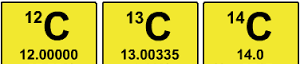
Question image

What do these isotopes of carbon all have in common?

1

same number of neutrons & same mass number

2

same atomic number and same number of neutrons

3

same atomic number and same number of electrons

4

same number of protons, same atomic number, and same mass number

43

Multiple Choice

Question image

When you add the number of protons and neutrons together, you are calculating...

1

Atomic Number

2

Atomic Mass

3

Mass Number

4

Pythagorean's Theorem

44

Multiple Choice

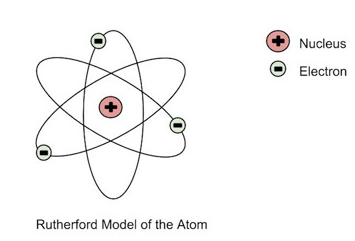
Question image

How did Rutherford describe the nucleus?

1

Tiny

2

Dense

3

Positively Charged

4

all of the above

45

Multiple Choice

Question image

What two particles are part of the nucleus of an atom?

1

Protons and Electrons

2

Electrons and Neutrons

3

Protons and Neutrons

4

Alpha and Beta

46

Multiple Choice

Question image

What was the name of the model?

1

Oatmeal Model

2

Rutherford Model

3

Bohr Model

4

Plum Pudding Model

47

Multiple Choice

Question image

Which of the following are parts of Dalton's theory?

1

All substances are made of atoms.

2

Atoms join with other atoms to make new substances.

3

Atoms of different elements are different

4

All of these are part of his theory

48

Multiple Choice

Question image

Whose model is this?

1

Millikan

2

Rutherford

3

Thomson

4

Bohr

49

Multiple Choice

How did Thomson build upon Dalton's model?

1

His model was the same.

2

He put electrons in orbitals.

3

He discovered the nucleus.

4

He discovered subatomic particles (electron).

50

Multiple Choice

The first person to propose a theory about an atom called the Atomos Theory was

1

Democritus

2

Rutherford

3

Dalton

4

Aristotle

51

Multiple Choice

Question image

Rutherford's gold foil experiment provided evidence that...

1

negative and positive charges are spread evenly throughout the atom.

2

alpha particles have a positive charge.

3

gold is not a dense as previously thought.

4

there is a dense positively charged nucleus at the center of an atom.

52

Multiple Choice

Question image

What contribution did John Dalton make to atomic theory?

1

He discovered that every atom was positively charged.

2

He discovered that every element consisted of one type of atom that couldn't be divided.

3

He discovered that atoms had nuclei.

4

He discovered that atoms could be divided into smaller parts.

Review for Unit 3 Summative Assessment

Slide image

Show answer

Auto Play

Slide 1 / 52

SLIDE