Search Header Logo
Understanding Earth's History Part 1

Understanding Earth's History Part 1

Assessment

Presentation

•

Science

•

8th Grade

•

Practice Problem

•

Medium

•
NGSS
MS-ESS1-4, MS-LS4-1, HS-ESS1-6

+2

Standards-aligned

Created by

Joseph Beshara

Used 23+ times

FREE Resource

16 Slides • 21 Questions

1

Understanding Earth's History
Slide image

2

Slide image

3

Slide image

4

Multiple Choice

These types of fossils include bones, teeth, and shells

1

Body Fossils

2

Trace Fossils

3

Both

5

Multiple Choice

These types of fossils include footprints, burrows, or waste from ancient organisms

1

Body

2

Trace

3

Both

6

Slide image

7

Multiple Choice

Which is the correct order for typical fossilization?

1

1.Dead specimen is buried.

2.Layers of sediment build up

3.The fossil, under pressure, turns to rock

4.The remains are replaced by minerals

2

1.Dead specimen is buried.

2.The fossil, under pressure, turns to rock

3.Layers of sediment build up

4.The remains are replaced by minerals

3

1.Dead specimen is buried.

2.The remains are replaced by minerals

3.Layers of sediment build up

4.The fossil, under pressure, turns to rock

8

Multiple Choice

What is permineralization?

1

The pressure from above layers of rock form casts of previously living things

2

The process of fossilization where the organic matter of a previously living creature is replaced with minerals through the formation of sedimentary rock

3

The process of fossilization where an insect gets trapped in hardened tree sap

9

Slide image

10

Multiple Choice

What is Amber?

1

The process of fossilization where the organic matter of a previously living creature is replaced with minerals through the formation of sedimentary rock

2

The pressure from above layers of rock form casts of previously living things

3

The process of fossilization where an insect gets trapped in hardened tree sap

11

Multiple Choice

The product of a mold being formed is called a......

1

compression

2

cast

3

amber

4

compression

12

Multiple Choice

A fossil that is the product of heavy pressure leaving dark marks as a fossil is called...

1

amber

2

cast

3

mold

4

compression

13

Slide image

14

Multiple Choice

Which is NOT a reason fossils are so rare?

1

Organisms, like jellyfish, with soft parts are least likely to become fossilized

2

Many organic materials, included bones, may be broken down through other naturally occurring processes.

3

The remains of many organisms are consumed

4

All of the above

15

Slide image

16

Multiple Choice

Question image

A paleontologist just discovered a Flower fossil. In which layer do you think the fossil was found in?

1

Cenozoic Layer

2

Mesozoic Layer

3

Paleozoic Layer

4

Late Proterozoic Layer

17

Multiple Choice

Question image
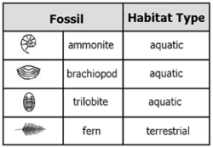
Geologists studied fossils taken from the top of a mountain. The chart lists several fossils taken from this location as well as their original habitat.What can be concluded based on the fossil evidence?
1
The mountain climate was once much warmer than it is today.
2
The mountain climate was once much colder than it is today.
3
The mountain was covered by water at some point in the past.
4
The elevation in the area was much higher at some point in the past.

18

Multiple Choice

Which statement is true?

1

The oldest layers of rock and soil are closest to the surface of the earth

2

The youngest layers of rock and soil are farther away from the surface of the earth.

3

inclusions are younger than the layers they are found in

4

Absolute dating and relative dating are two methods used by scientists to determine the age and sequence of geologic events.

19

Slide image

20

Multiple Choice

Question image

According to the law of superposition, the oldest fossils are found

1

At the top of the rock layers

2

Near the bottom of the rock layers

3

In the middle of the rock layers

4

Somewhat near the surface

21

Multiple Choice

Which statement best describes the Law of Superposition?

1

Each sedimentary layer of rock represents 1,000 years of Earth's age, much like the rings of a tree.

2

In undisturbed layers of sedimentary rocks, the upper rock layers are older than the lower rock layers.

3

In undisturbed layers of sedimentary rock, the lowest layers contain the older rocks.

4

Rocks that form near volcanoes are older than surrounding rock.

22

Multiple Choice

What role do faults play in the Law of Superposition?

1

Faults create new types of rock.

2

Faults are younger than the layers they cut through.

3

Faults are the same age as the layers they cut through.

4

Faults are older than the layers they cut through.

23

Multiple Choice

Question image

The diagram shows different layers of sedimentary rock. Each layer is labeled with a letter.

1

The left part of Layer B is younger than the right part.

2

The left part of Layer F is the same age as Layer M.

3

Layer R is older than Layer M

4

Layer I is older than Layer B

24

Slide image

25

Slide image

26

Multiple Choice

The moon formed during this eon, this eon occured before life and before the crust had solidified. Lava and magma was everywhere, and lots of comets bombarded the earth, giving the earth the large amounts of water you see today. Which eon is this?

1

Hadean

2

Archean

3

Proterozoic

4

Phanerozoic

27

Multiple Choice

What are the 4 Eons in order?

1

Hadean, Proterozoic, Archean, Phanerozoic

2

Hadean, Archean, Proterozoic, Phanerozoic

3

Archean, Hadean, Proterozoic, Present

4

Hadean, Archean, Proterozoic, Mealrozoic

28

Multiple Choice

What was the effect of "The Great Dying"?

1

If allowed plants to thrive.

2

Almost all organisms perished, which started the evolution of dinosaurs.

3

All organisms could now walk on land and swim in water.

4

Water was now more affordable for organisms in any area.

29

Multiple Select

What 2 pieces of evidence is most helpful in understanding events that occurred in Earth’s past?

1

Layers of Rock

2

Fossils

3

The Geologic Time Scale

4

Scientific Tools

30

Multiple Choice

How are periods, eras, and eons related?

1

Periods are the building blocks of all time. Two or more periods form an era. Two or more eras form a eon.

2

Eras are the building blocks of all time. Two or more eras form an eon. Two or more eons form a period.

3

Eons are the building blocks of all time. Two or more eons form a era. Two or more eras form an period.

31

Multiple Choice

Question image

The most present eon continues to this day starting back about 540 million years ago. During this eon, organisms evolved and died in mass numbers, but also includes the start of human life. What is the name of this eon?

1

Hadean

2

Archean

3

Phanerozoic

4

Proterozoic

32

Slide image

33

Slide image

34

Slide image

35

Slide image

36

Slide image

37

Slide image

Understanding Earth's History

Slide image

Show answer

Auto Play

Slide 1 / 37

SLIDE