Search Header Logo
Day 4 - Plate Motion Engineering Internship

Day 4 - Plate Motion Engineering Internship

Assessment

Presentation

Science

6th - 8th Grade

Practice Problem

Medium

NGSS
MS-ESS3-2, MS-ESS2-3, MS-ETS1-1

+1

Standards-aligned

Created by

Caitlin Stiegler

Used 29+ times

FREE Resource

30 Slides • 12 Questions

1

Day 4 - Plate Motion Engineering Internship
Slide image

2

Poll

Question image

Would you rather...

Live on the beach

Live in the mountains

3

Slide image

4

Slide image

5

Slide image

6

Slide image

7

Slide image

8

Slide image

9

Multiple Choice

Question image

Mountains and ocean trenches are found at ________ boundaries.

1

convergent

2

divergent

10

Multiple Choice

Question image

Mid-ocean ridges are found at ________ boundaries.

1

convergent

2

divergent

11

Multiple Choice

Question image

Which areas are more likely to have earthquakes that can cause tsunamis? Why?

1

convergent boundaries

2

divergent boundaries

12

Slide image

13

Slide image

14

Slide image

15

Slide image

16

As we read: Answer and discuss slide 4

1) How do tsunamis work?

2) What boundary type should we put sensors near?

Slide image

17

Slide image

18

Slide image

19

Slide image

20

Slide image

21

Slide image

22

Slide image

23

Slide image

24

Slide image

25

Multiple Choice

Why are tsunamis more likely to happen at convergent plate boundaries?

1

Because the plates are moving apart, there is no where else for the water to go but up.

2

The sideways movement of the plates causes the water to displace upward.

3

When the plates move together and one subducts, it causes an upward displacement of water.

26

Multiple Choice

True or False: You will find a lot of tsunamis near divergent plate boundaries.

1

True

2

False

27

Multiple Choice

What is the purpose of your engineering project?
1
To help warn us of when a tsunami hits California.
2
To design a tsunami warning system to help the citizens of Sri Lanka.
3
To build a shelter for people to go to after a tsunami hits.
4
To let us know when earthquakes are going to hit the west coast.

28

Slide image

29

Slide image

30

Slide image

31

Slide image

32

Multiple Choice

Question image

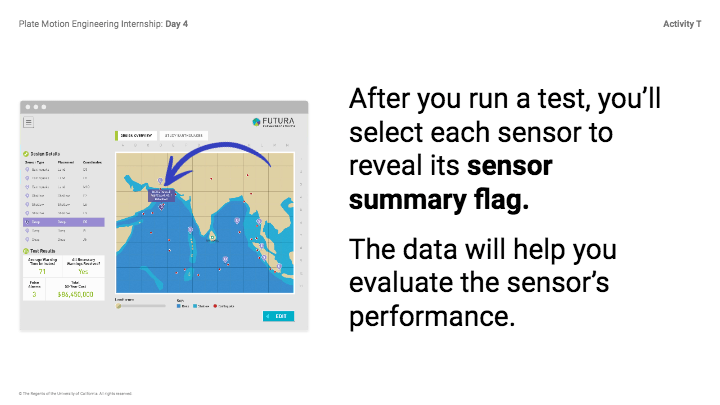
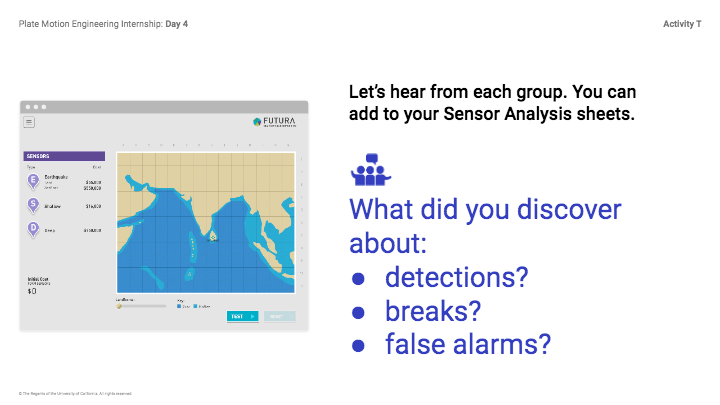
How could you interpret the data in the summary flag for this sensor?

1

This sensor isn’t working, (not helping detect any earthquakes or tsunamis)

2

There aren't any earthquakes or tsunamis at that sensor

33

Multiple Choice

Question image

Did this sensor detect tsunamis?

1

YES, it detected five tsunamis (1 was a false alarm)

2

NO, because it broke

34

Multiple Choice

Which of the following is NOT one of the criteria for your TsunamiAlert design?

1

Maximize average warning time.

2

Minimize false alarms.

3

Creating a safe location for people.

4

Minimize costs.

35

Poll

Question image

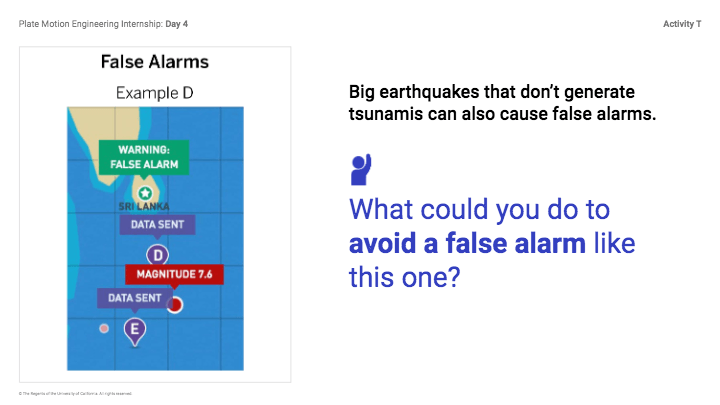
How could you change the sensor placement to avoid a false alarm like this one?

Move the shallow sensor farther away beyond where the local tsunami wave reaches

Remove one or more of the sensors

Something else (write in google chat)

36

Slide image

37

Poll

Question image

How could you interpret the data for this earthquake?

This is an ocean-wide tsunami. The earthquake that caused it was strong—8.2—and on a convergent plate boundary.

The earthquake sensor doesn’t have a flag, so it didn’t detect anything. It’s probably too far from the earthquake.

Sri Lanka did not receive any warning for this tsunami that reached its shores. 0 minutes warning won’t help people get to safety.

The shallow sensor broke because it was too close to the earthquake. It might have helped give a warning if it didn’t break.

38

Slide image

39

Slide image

40

Slide image

41

Slide image

42

Slide image

Day 4 - Plate Motion Engineering Internship

Slide image

Show answer

Auto Play

Slide 1 / 42

SLIDE