

Periodic Table Basics

Presentation
•
Chemistry
•
6th - 8th Grade
•
Medium
Standards-aligned

Michael Stange
Used 353+ times
FREE Resource
10 Slides • 12 Questions
1
Periodic Table Basics
How the Table is Organized
and
What the Patterns Can Tell You

2
Patterns
The periodic table is FULL of patterns.
If you know the patterns, you can use it to find information quickly about the elements.
The two patterns we are going to review are the periods and the group numbers

3
Let's start with the periods
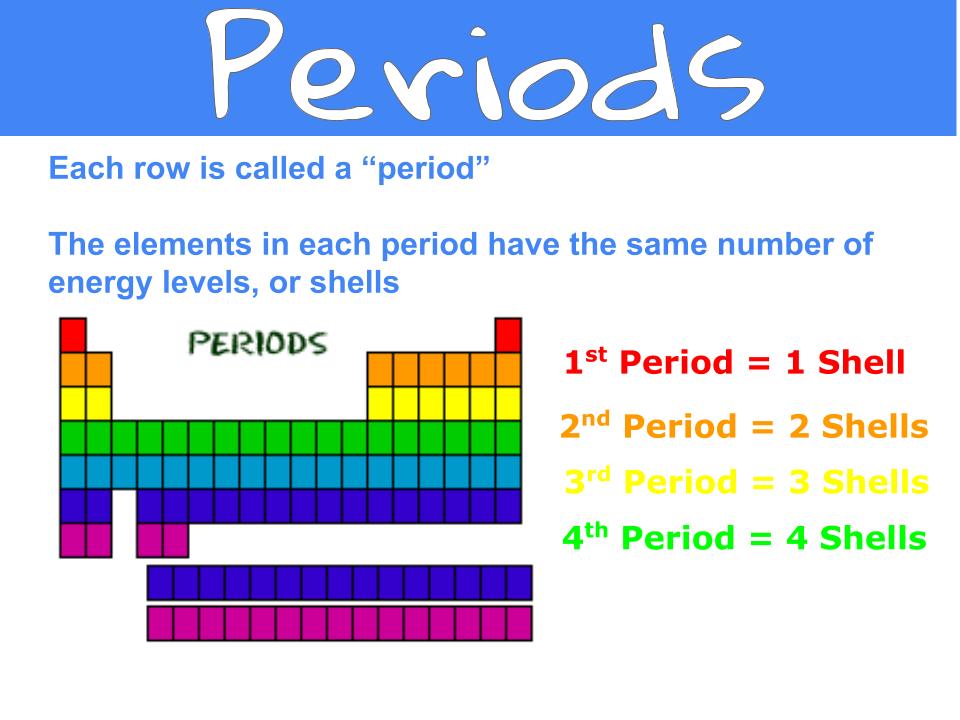
Periods are the horizontal rows that go across the table.
Each new period is a new electron shell. All of the elements in a period have the same number of electron shells.
Moving from left to right, each element has more electrons, & the elements need more space for those electrons.

4
5

6
Electron Shells
Each element in each period have the same number of electron shells.
Hydrogen (1e-) and Helium (2e-) are in period 1 and have 1 electron shell.
Lithium (3e-), Carbon (6e-), Oxygen (8e-), and Neon (10e-) are all in period 2 and have 2 electron shells.

7
Multiple Choice
8
Multiple Choice

How many energy levels (e- shells) does Calcium have in period 4?
9
Multiple Choice

How many energy levels (e- shells) does sodium (Na) have in period 3?
10
Multiple Choice

How many electron shells does Neon have in period 2?
11
Multiple Choice
Helium's atomic number is 2. How many valence electrons does Neon have in its outermost electron shell?
12
Multiple Choice
Neon's atomic number is 10. How many valence electrons does Neon have in its outermost electron shell?
13
Okay!
So the period number tells us the number of electron shells an element has.
The atomic number tells us the number of protons or electrons.
The higher the number of electrons, the more electron shells it needs.
As you go down the periodic table, each row of elements has more electron shells.

14
Now let's talk groups!
Groups (also called families) are the vertical (up and down) columns on the periodic table
There are 18 groups on the periodic table BUT only groups 1 and 2 and 13-18 follow any sort of pattern.
The group number can help you quickly figure out the number of valence electrons.

15
The Group Pattern
The bolded number at the top of the group tell the number of valence electrons the group has.
Group 1 has 1 valence electron
Group 2 has 2 valence electrons
Group 13 has 3 valence electrons
Group 14 = 4, 15 = 5, 16 = 6, 17 = 7
Group 18 has 8 valence electrons (a full outer shell, except for Helium)
16
The Group Pattern
Group 13 has 3 valence electrons
Group 14 has 4 valence electrons
Group 15 has 5 valence electrons
Group 16 has 6 valence electrons
Group 17 has 7 valence electrons
Group 18 has 8, except for Helium, which has 2 (but all have a full outer shell)
17
Multiple Choice

What are the vertical columns on the Periodic Table called?
18
Multiple Choice

What do the vertical columns on the periodic table tell us?
19
Multiple Choice

Which elements have properties in common (also why they are also called families)?
20
Multiple Choice

Which elements have 5 valence electrons?
21
Multiple Choice
Which elements have 7 valence electrons?
22
Multiple Choice
Which elements have a full set of valence electrons?
Periodic Table Basics
How the Table is Organized
and
What the Patterns Can Tell You
Show answer
Auto Play
Slide 1 / 22
SLIDE


