

Mcas cells structure and function

Presentation
•
Biology
•
9th Grade
•
Practice Problem
•
Medium
+5
Standards-aligned

Silvana Konda
Used 18+ times
FREE Resource
8 Slides • 24 Questions
1
Mcas cells structure and function

2
Multiple Choice
What are synthesized by the ribosomes?
A. carbohydrates
B. lipids
C. nucleic acids
D. proteins
3

4
Multiple Choice
The diagram below represents Trichodina. Trichodina is a eukaryotic organism that attaches itself to fish and eats bacteria. Which of the following distinguishes Trichodina from all prokaryotes?
A. Trichodina is unicellular.
B. Trichodina has a nucleus.
C. Trichodina has cytoplasm.
D. Trichodina is heterotrophic.
5
Multiple Choice
Some diseases decrease the activity of certain enzymes in the mitochondria of cells. Which of the following is the most direct result of this decreased enzyme activity?
A.The cells are not able to divide by mitosis.
A.The cells are not able to move water by diffusion.
A.The cells produce less ATP by cellular respiration.
A.The cells produce fewer sugars by photosynthesis.
6
Multiple Choice
Which of the following organisms is a prokaryote?
A. Agaricus arvensis, horse mushroom
B. Rhizopus stolonifer, bread mold fungus
C. Saccharomyces cerevisiae, baker’s yeast
D. Thiopedia rosea, purple sulfur bacterium
7
Multiple Choice
A student views cells from several different prokaryotic and eukaryotic organisms under a high-powered microscope. Which of the following statements describes how the prokaryotic cells appear different from the eukaryotic cells?
A. The prokaryotic cells are much larger.
B. The prokaryotic cells do not have nuclei.
C. The prokaryotic cells have mitochondria.
D. The prokaryotic cells have a less distinct shape.
8

9
Multiple Choice
Which of the following statements best describe this organism?
A. The organism is eukaryotic because it has a plasma membrane.
B. The organism is prokaryotic because it can reproduce asexually.
C. The organism is prokaryotic because it can synthesize its own food.
D. The organism is eukaryotic because it has membrane-bound organelles.
10
Open Ended

The drawing below represents an organism that a student observed when examining a sample of pond water with a light microscope.
The student identified this organism as a prokaryote.
a.Is the student's identification accurate? Explain your answer using information from the diagram.b.Identify three similarities between the cells of prokaryotes and eukaryotes.
11
Poll
Are you comfortable with cell structure and function
Can you tell the difference between Prokaryotes and Eukaryotes
Can you distinguish between plant and animal cells
Are you able to name what all cell have in common?
Can you tell the roles of each organelles
Recall Prokaryotes rhyme with No and Eukaryotes rhyme with DO.
12

13
Multiple Choice
Which of the following distinguishes this bacterial cell from eukaryotes?
The bacterial cell is a unicellular organism, and all eukaryotes are multicellular.
Ribosomes are found in the cytoplasm of the bacterial cell, and eukaryotes do not have ribosomes.
The bacterial cell has both a cell membrane and a cell wall, and eukaryotes have only cell membranes.
DNA in the bacterial cell is always in contact with the cytoplasm, and all eukaryotes have DNA located inside a nucleus.
14
Multiple Choice
A cell from an organism has the structures listed below.
Nucleus, mitochondria, cell wall, chloroplasts
The organism is most likely classified as which of the following?
A. animal
B. bacterium
C. fungus
D. plant
15
16
Multiple Choice
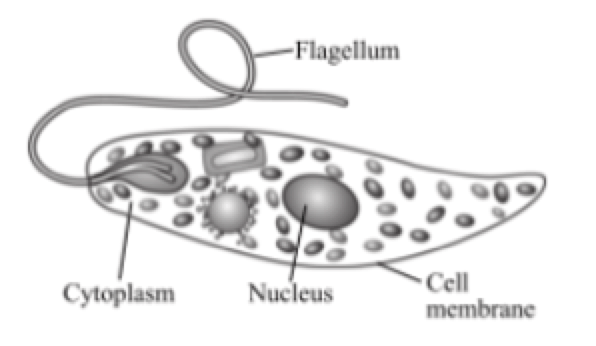
The diagram below represents a single-celled organism. Which labeled part identifies this single-celled organism as eukaryotic?
A.cell membrane
B.cytoplasm
C.flagellum
D.nucleus
17
Multiple Choice
Which of the following types of organisms have cell walls composed of cellulose?
A. amoebas
B. birds
C. grasses
D. worms
18
Multiple Choice
Which of the following is a function of the nucleus?
A. absorbing sunlight
B. releasing usable energy
C. storing genetic material
D. producing food molecules
19
Multiple Choice
A scientist discovered a new organism in some caves in Pennsylvania. The organism has the following characteristics:
•It is multicellular.
•Its cells lack cell walls.
•It is motile.
•It is heterotrophic.
Based on this information, to which kingdom does the organism belong?
Animalia
B.Eubacteria
C.Fungi
D.Plantae
20
Multiple Choice
A cell from an organism has the structures listed below.
nucleus mitochondria cell wall chloroplasts .The organism is most likely classified as which of the following?
A.animal
B.bacterium
C.fungus
D.plant
21
Multiple Choice
3. Several parts of an animal cell are involved in the processes of protein synthesis, packaging, and export. Which of the following correctly places the cell parts in the order in which they are involved?
A.nucleus → vacuole → cell membrane
B.mitochondria → vacuole → cell membrane
C.ribosome → endoplasmic reticulum → Golgi complex → cell membrane
D.lysosome → endoplasmic reticulum → Golgi complex → cell membrane
22
Multiple Choice
A scientist is studying gene expression in a prokaryote. Which of the following organisms could the scientist be studying?
A. Bacillus subtilis, a bacterium
B. Leucobryum glaucum, a moss
C. Lycoperdon pyriforme, a fungus
D. Caenorhabditis elegans, a roundworm
23
24
Multiple Choice
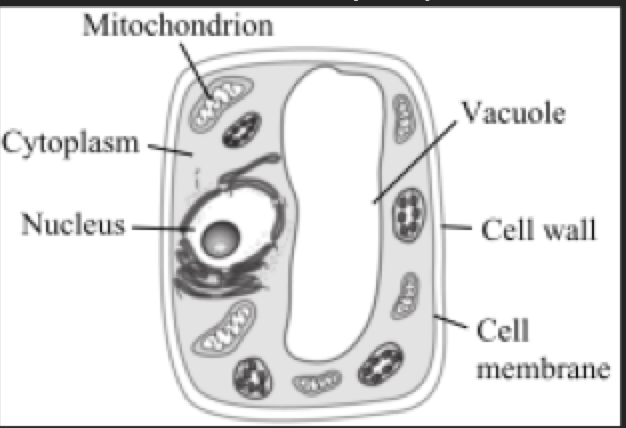
A cell is shown in the diagram below. Which of the following cell characteristics provides evidence that this cell comes from a plant and not from an animal?
A.a large vacuole
B.a single nucleus
C.a functional mitochondrion
D.a semipermeable cell membrane
25
Multiple Choice

A. moving genetic material
B. converting light to chemical energy
C. providing structural support to the cell
D. synthesizing proteins for cellular functions
26
Multiple Choice
Which of the following statements describes a way in which plant cells and animal cells are similar
A.Both types of cells are prokaryotic.
B.Both types of cells are autotrophic.
C.Both types of cells have cell walls.
D.Both types of cells contain mitochondria.
27
Multiple Choice
Which of the following organisms has the simplest cellular structure?
A. bacterium
B. earthworm
C. mushroom
D. sunflower
28
Multiple Choice
A student is looking at a picture of a cell taken through a microscope. The presence of which of the following would indicate that the cell is eukaryotic?
A. cytoplasm
B. DNA
C. nucleus
D. plasma membrane
29

30
Multiple Choice
The illustration below shows the external features of a prokaryotic organism. Which of the following can be concluded about the internal cellular contents of this prokaryote?
A. The cell does not contain ribosomes
B. The cell does not contain a nucleus.
C. The cell contains mitochondria.
D. The cell contains a vacuole.
31

32
Multiple Choice
Which of the following is a function performed by the cell part labeled X and Y?
A. moving genetic material
B. converting light to chemical energy
C. providing structural support to the cell
D. synthesizing proteins for cellular functions
Mcas cells structure and function
Show answer
Auto Play
Slide 1 / 32
SLIDE
Similar Resources on Wayground

24 questions
Darwin, evolución y selección natural
Presentation
•
10th Grade
25 questions
Intro to Bacteria
Presentation
•
9th - 10th Grade
25 questions
The Reformation
Presentation
•
9th Grade
28 questions
Intro to Viruses
Presentation
•
9th Grade
28 questions
Cell Organelles
Presentation
•
9th Grade
26 questions
DNA Day 1
Presentation
•
9th Grade
25 questions
Body Organization
Presentation
•
9th Grade
25 questions
5 Types of Reactions-Lesson
Presentation
•
9th Grade
Popular Resources on Wayground
10 questions
How much do you know about our Portrait of an Eagle?

Quiz
•
10th Grade
10 questions
Fast Food Slogans
Quiz
•
6th - 8th Grade
21 questions
Continents and Oceans
Quiz
•
6th Grade
20 questions
Parts of Speech
Quiz
•
5th Grade
16 questions
Subject & Predicate
Quiz
•
5th Grade
25 questions
Multiplication Facts
Quiz
•
5th Grade
12 questions
Map Skills
Quiz
•
3rd Grade
22 questions
Continents and Oceans
Quiz
•
5th Grade
Discover more resources for Biology
20 questions
Characteristics of Life
Quiz
•
9th - 10th Grade
10 questions
Exploring the 4 Major Macromolecules and Their Functions

Interactive video
•
9th - 12th Grade
20 questions
Cell Transport
Quiz
•
9th - 12th Grade
25 questions
photosynthesis and cellular respiration
Quiz
•
9th Grade
16 questions
Population Ecology
Quiz
•
9th - 12th Grade
20 questions
Cell Organelles
Quiz
•
9th Grade
18 questions
Water Properties
Quiz
•
9th Grade
36 questions
U3 Review Cell Cycle and Specialization Quiz
Quiz
•
9th Grade