

The Outer Planets / Study Guide

Presentation
•
Science
•
4th - 7th Grade
•
Practice Problem
•
Medium
+5
Standards-aligned

Keenan Hart
Used 12+ times
FREE Resource
44 Slides • 28 Questions
1
The Outer Planets / Study Guide
2
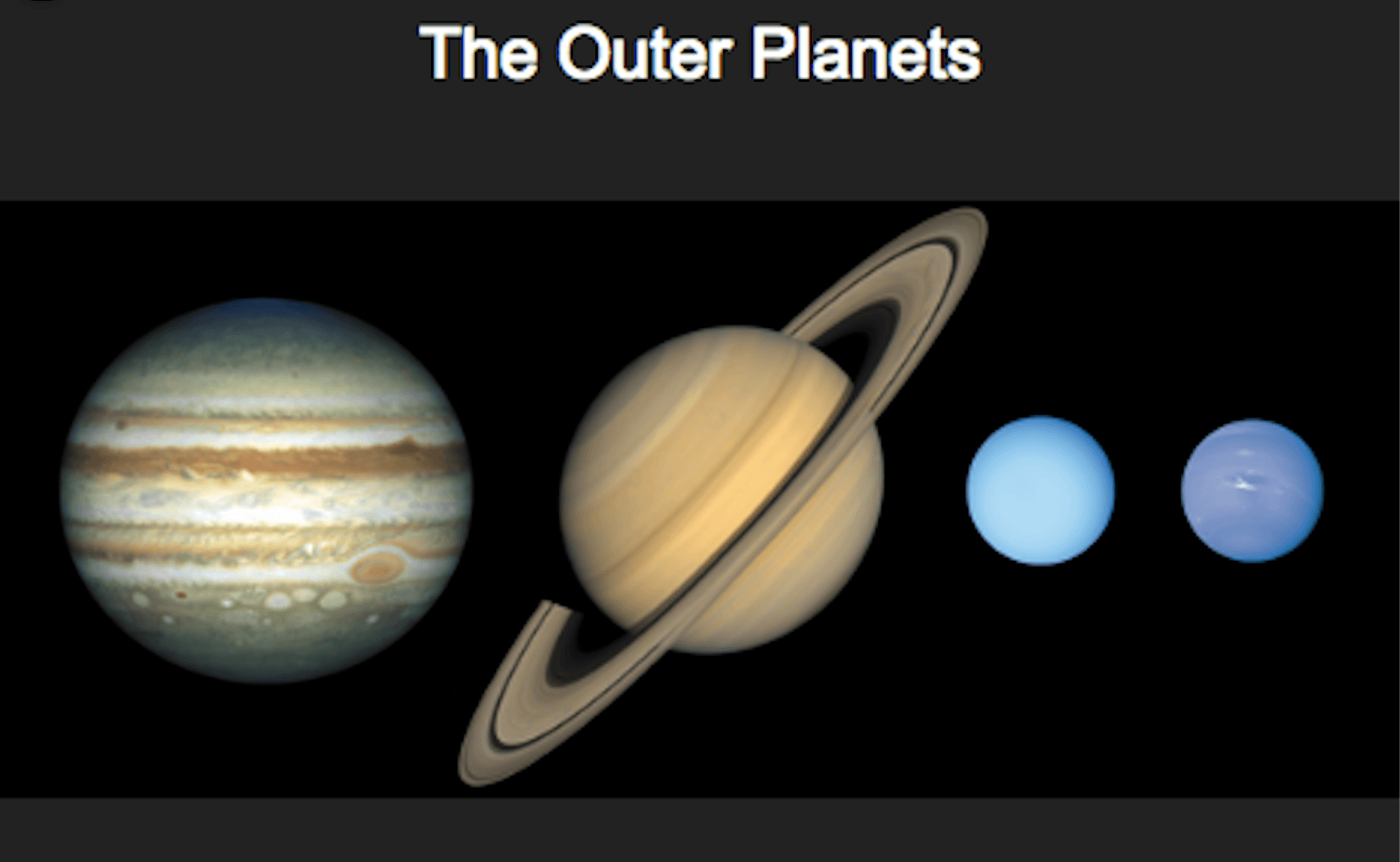
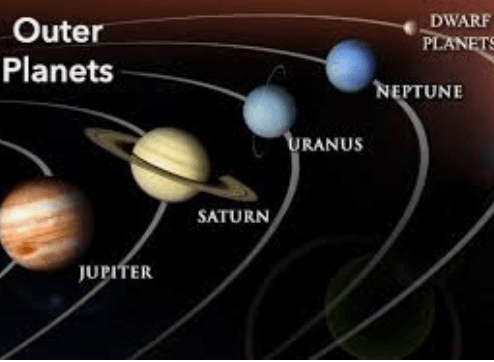
The four outer planets are Jupiter, Saturn, Uranus, and Neptune. They are also known as the gas giants because they are large and composed of mostly helium and hydrogen. However, the materials inside of the outer planets is actually liquid due to the high pressure levels inside of the planets. The outer layers of the planets are extremely cold because the planets are so far from the Sun.

3
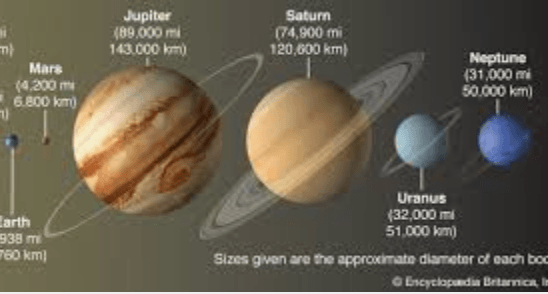
All of the outer planets are much larger and more massive than the inner planets. Neptune is the smallest of the outer planets, but it still has a volume that is almost 60 times greater than Earth's.
4
All four of the outer planets are surrounded by a set of rings. The rings are made of rock, ice, and dust. Saturn's are the largest and most defined of the four outer planets. The outer planets also all have several more moons than the inner planets. Neptune as at least 13 moons, while Jupiter has over 60 moons.
5
Multiple Choice

Use the chart at left (click to enlarge) to determine what determines a planets period of revolution (how long it takes to revolve around the sun).
6

7
Multiple Select
8

9

10
Jupiter
The largest planet in the solar system, over 1,321 Earths could fit inside of Jupiter! It has the largest mass and gravity of all the planets. Jupiter has a thick hydrogen and helium. Some hypothesize that Jupiter may have a solid core of metal and rock surrounded by a large layer of liquid metallic hydrogen. Like the other gas giants, Jupiter has extremely cold temps. It's average temp is -150 degrees

11
There is a massive storm on Jupiter called the Great Red Spot. The swirling winds of the storm are similar to those of a hurricane on Earth. Astronomers have observed the storm for over 350 years, and there are no signs that the storm will go away anytime soon.

12
Jupiter has the most moons of any planet. There are over 60 moons that orbit Jupiter. Jupiter has four particularly large moons, which are named Io, Europa, Ganymede, and Callisto. Ganymede is larger than the planet Mercury. Scientists believe that Jupiter's moon Io is volcanically active.

13
Multiple Select
14

15
Multiple Choice
16

17

18
Saturn
Saturn is the second largest planet in the solar system. Like Jupiter, Saturn is an extremely massive planet, as its mass is 95 times greater than the mass of earth. Around 763 Earths could fit inside of Saturn.

19
Scientists believe that Saturn has a solid core made of rock and metal that is surrounded by a layer of liquid metallic hydrogen. While Saturn is one of the largest planets, it has the lowest density of any planet in the solar system. Its density is less than that of water!

20
Saturn has the most defined ring system of any planet in the solar system. The rings that orbit Saturn are made of chunks of ice and rock. The chunks of ice and rock range in size from a few millimeters to several hundred meters in size. The rings each orbit individually, but they form larger, more complex bands. Between each of the bands is a gap that may be occupied by one of Saturn's many moons.

21
There are 53 named moons orbiting Saturn. There are also many more, smaller moons, called moonlets, among Saturn's rings. Titan, Saturn's largest moon, is larger than the planet Mercury. It has a thick atmosphere composed of nitrogen and methane. Titan is the only moon in the solar system with a thick atmosphere.

22
Scientists believe that one of Saturn's moons, Enceladus, holds liquid water underneath its surface. NASA's Cassini spacecraft discovered geysers that release water vapor on the surface of Enceladus. Scientists are now gathering evidence that points toward the existence of an ocean of liquid water underneath the surface of this moon. Some scientists even think there might be microbial life on Enceladus.

23
Multiple Choice
24
Multiple Choice
25
Multiple Choice
26

27
Multiple Choice
28
Multiple Choice
29
Multiple Choice
30
Multiple Choice
31

32
Multiple Select
33

34

35
Uranus
Uranus is the seventh planet from the Sun. It has about 15 times the mass of Earth and 63 times the diameter. However, it is still significantly smaller than Jupiter and Saturn. Uranus has at least 27 moons in its orbit. It also has a group of thin, flat rings in its orbit. However, these rings are less prominent, and much darker, than Saturn's. Uranus looks blue-green because of the methane int its atmosphere.

36
Uranus has a unique axis of rotation, as it is tilted about 98 degrees. The rings and moons of Uranus still orbit its equator. Therefore, when Uranus is viewed from the Earth, it appears as though it rotates from top to bottom instead of from side to side like the other planets.

37
38
Multiple Choice
39

40

41
Neptune
Neptune is the farthest planet from the Sun. Neptune has about 58 times the volume of Earth. It is also the coldest planet, with an average surface temperature of -220 degrees Celsius. Sunlight on Neptune is 900 times fainter than sunlight on Earth.

42
Neptune is the smallest of the outer planets and just slightly smaller than Uranus. Similar to Uranus, Neptune has an atmosphere of helium and hydrogen with some methane. The methane gives Neptune its deep blue color. Its interior is made up of liquid hydrogen, helium, and methane ice. Neptune's atmosphere also contains visible clouds.

43
Neptune has the strongest winds of any planet. The wind speeds can reach up to 2,000 km/h. These winds are caued by Neptune's warm interior, which produces more energy than the planet receives from sunlight. In 1989, NASA's space probe Voyager 2 passed by Neptune and photographed a large dark area on the planet that was about the size of Earth. Named the great Dark Spot, scientists concluded that it was probably a giant storm, similar to the Great Red Spot on Jupiter.

44
Neptune has 13 moons compared to Uranus's 27. Triton is Neptune's largest moon. Unlike most moons, Triton orbits Neptune in the opposite direction of Neptune's rotation. Triton has a thin atmosphere that is composed of mostly nitrogen and some methane. There is also volcanic activity on Triton's surface. However, the volcanoes do not erupt liquid rock like on Earth. The lava has an icy mixture of water and ammonia.

45
Multiple Select
46

47
Multiple Choice
48

49

50

51
Multiple Choice
52

53
Multiple Choice

Use the table at left (click to enlarge) to answer the following question: What is the density of Saturn?
Hint: The density of earth is 1.0
54

55
Multiple Select
56

57
Multiple Choice
58
Multiple Choice
59
Multiple Choice
60
Multiple Choice
61

62
Multiple Select
63

64
Multiple Choice
65

66
Multiple Choice
67

68
Multiple Choice

Which planet is pictured at left?
69

70
Multiple Choice

Travis writes a description of Neptune (at left) for science class. Which of the following statements corrects Travis's description
71

72
Multiple Choice
Travis writes a description of Neptune (at left) for science class. Which of the following statements corrects Travis's description
The Outer Planets / Study Guide
Show answer
Auto Play
Slide 1 / 72
SLIDE


