

Photosynthesis & Transpiration

Presentation
•
Science
•
7th Grade
•
Easy
+2
Standards-aligned

MATTHEW WILLIAMS
Used 24+ times
FREE Resource
59 Slides • 15 Questions
1
Photosynthesis & Transpiration
Article published by the Smithsonian Science Education Center... except for the transpiration part.

2
When you get hungry, you grab a snack from your fridge or pantry.

3
But what can plants do when they get hungry?

4
You are probably aware that plants need sunlight, water, and a home (like soil) to grow, but where do they get their food?

5
They make it themselves!

6
Plants are called autotrophs because they can use energy from light to synthesize, or make, their own food source.

7
Open Ended
8
Many people believe they are “feeding” a plant when they put it in soil, water it, or place it outside in the Sun, but none of these things are considered food.

9
Multiple Choice
10
Rather, plants use sunlight, water, and the gases in the air to make glucose, which is a form of sugar that plants need to survive.

11
Multiple Choice
12
This process is called photosynthesis and is performed by all plants, algae, and even some microorganisms.

13
To perform photosynthesis, plants need three things: carbon dioxide, water, and sunlight.

14
Multiple Select
15
By taking in water (H2O) through the roots, carbon dioxide (CO2) from the air, and light energy from the Sun, plants can perform photosynthesis to make glucose (sugars) and oxygen (O2).

16
Multiple Choice
17
Just like you, plants need to take in gases in order to live.

18
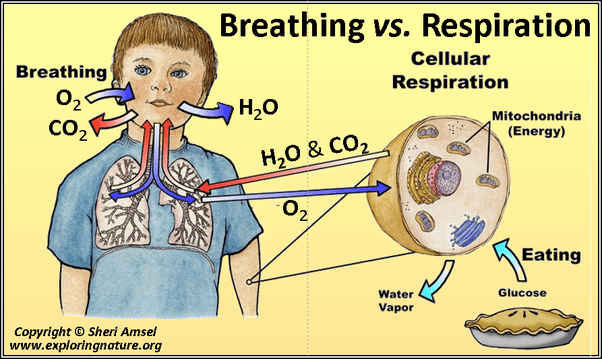
Animals take in gases through a process called respiration.
19
During the respiration process, animals inhale all of the gases in the atmosphere, but the only gas that is retained and not immediately exhaled is oxygen.

20
Plants, however, take in and use carbon dioxide gas for photosynthesis.

21
Multiple Choice
22
Carbon dioxide enters through tiny holes called stomata in a plant’s leaves, flowers, branches, stems, and roots.

23
Multiple Choice
24
Plants also require water to make their food.

25
Depending on the environment, a plant’s access to water will vary.

26
For example, desert plants, like a cactus, have less available water than a lilypad in a pond, but every photosynthetic organism has some sort of adaptation, or special structure, designed to collect water.

27
For most plants, roots are responsible for absorbing water.

28
The last requirement for photosynthesis is an important one because it provides the energy to make sugar.

29
How does a plant take carbon dioxide and water molecules and make a food molecule?

30
The Sun!

31
The energy from light causes a chemical reaction that breaks down the molecules of carbon dioxide and water and reorganizes them to make the sugar (glucose) and oxygen gas.

32
Multiple Select
33
After the sugar is produced, it is then broken down by the mitochondria into energy that can be used for growth and repair.

34
The oxygen that is produced is released from the same tiny holes through which the carbon dioxide entered.

35
Even the oxygen that is released serves another purpose. Other organisms, such as animals, use oxygen to aid in their survival.

36
If we were to write a formula for photosynthesis, it would look like this:

37
6CO2 + 6H2O + Light energy → C6H12O6 (sugar) + 6O2

38
Multiple Choice
39
The whole process of photosynthesis is a transfer of energy from the Sun to a plant.

40
Open Ended
41
In each sugar molecule created, there is a little bit of the energy from the Sun, which the plant can either use or store for later.

42
Imagine a pea plant. If that pea plant is forming new pods, it requires a large amount of sugar energy to grow larger.

43
This is similar to how you eat food to grow taller and stronger.

44
But rather than going to the store and buying groceries, the pea plant will use sunlight to obtain the energy to build sugar.

45
When the pea pods are fully grown, the plant may no longer need as much sugar and will store it in its cells.

46
A hungry rabbit comes along and decides to eat some of the plant, which provides the energy that allows the rabbit to hop back to its home.

47
Where did the rabbit’s energy come from?

48
Consider the process of photosynthesis.

49
With the help of carbon dioxide and water, the pea pod used the energy from sunlight to construct the sugar molecules.

50
When the rabbit ate the pea pod, it indirectly received energy from sunlight, which was stored in the sugar molecules in the plant.

51
Bread is Made from Flour
We can thank photosynthesis for bread! Wheat grains, like the ones pictured, are grown in huge fields. When they are harvested, they are ground into a powder that we might recognize as flour.

52
Humans, other animals, fungi, and some microorganisms cannot make food in their own bodies like autotrophs, but they still rely on photosynthesis.

53
Multiple Choice
54
Through the transfer of energy from the Sun to plants, plants build sugars that humans consume to drive our daily activities.

55
Even when we eat things like chicken or fish, we are transferring energy from the Sun into our bodies because, at some point, one organism consumed a photosynthetic organism (e.g., the fish ate algae).

56
So the next time you grab a snack to replenish your energy, thank the Sun for it!

57
Multiple Select
58
Multiple Select
59
Transpiration
Transpiration is the evaporation of water from plants.

60
Multiple Choice
61
Transpiration occurs chiefly at the leaves while their stomata are open for the passage of CO2 and O2 during photosynthesis.

62
The evaporation of water molecules from leaves is the main force pulling the water column up from its origin in the roots.

63
When water evaporates from a leaf, water deeper in the leaf is pulled to the surface of that leaf.

64
At the same time, water is pulled from the stem where the leaf is attached.

65
At the same time, water is pulled from the branch the stem is attached to.

66
At the same time, water is pulled from the trunk the branch is attached to.

67
At the same time, water is pulled from the roots of the tree or plant.

68
At the same time, water is absorbed by the roots of a tree or plant from the soil in which the tree or plant is planted.

69
If there is too much water in the soil, the stoma of a plant's leaves will open all the way to evaporate as much extra water as possible.

70
If there isn't enough water in the soil, the stoma of a plant's leaves will close to slow down evaporation and conserve water.

71
Transpiration is the process of water moving through a plant from it's roots to it's leaves where water will then evaporate through the stomata of the leaves.

72
Open Ended
73
Now open another tab and Google search "infamy definition."

74
After you finish this Quizizz, read the article A Date Which Will Live In Infamy under Daily Assignments in Google Classroom and complete the Google Quiz form underneath that article in Google Classroom.

Photosynthesis & Transpiration
Article published by the Smithsonian Science Education Center... except for the transpiration part.
Show answer
Auto Play
Slide 1 / 74
SLIDE


