Newton's Second Law of Motion
Presentation
•
Science
•
7th - 8th Grade
•
Medium
Standards-aligned
John Toje
Used 75+ times
FREE Resource
30 Slides • 34 Questions
1
Newton's Second Law of Motion
By John Toje
2
Newton's 2nd Law of Motion
Law of Acceleration
3
We will investigate and analyze Newton’s second law of motion (law of force and acceleration).
I will calculate the acceleration of an object given its mass and the force used on it.
4
Newton's 2nd Law
The Law of Acceleration. Newton's second law of motion states that the acceleration of an object equals the net force acting on the object divided by the object's mass.
5
Acceleration and Mass
If the same force is applied to two objects:
As the mass increases the acceleration decreases.
Objects with more mass accelerate less.
Objects with less mass accelerate more.
6
Multiple Choice
If both rocks are pushed with the same amount of force, which rock would accelerate more?
The 400kg Rock because it weighs more.
The 40kg rock because it weighs less.
7
The 40kg rock will accelerate more because it weighs less. Remember the less mass, the more inertia.
8
Open Ended
Which object will accelerate more, the baseball or bowling ball? Explain your answer.
9
The baseball will accelerate more than the bowling ball because the baseball has more mass.
10
Multiple Choice
Which rock will accelerate the least?
The Small Rock
The Large Rock
11
The Large Rock accelerates the least because it has more mass than the small rock.
12
Multiple Choice
Which grocery basket will have the least acceleration, if both grocery baskets are pushed with the same amount of force?
The one without groceries because it has more mass.
The one with groceries because it has more mass.
The one without groceries because it has the least mass.
The one with groceries because it has least mass.
13
Multiple Choice
Both objects are pushed with the same amount of force, which object will accelerate more the car or the basket ball?
The basketball will accelerate the the most because it has the less mass than the car.
The basketball will accelerate the least because it has the more mass than the car.
The car will accelerate the the most because it has the less mass than the car.
The car will accelerate the least because it has the more mass than the basketball.
14
Multiple Choice
15
Multiple Choice
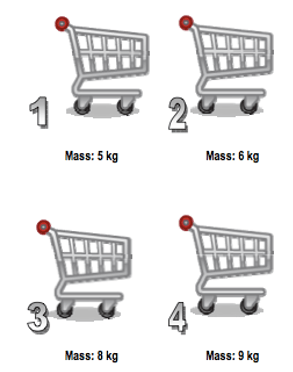
A force of 90N is applied to each cart below, which one will accelerate the fastest?
Cart 1
Cart 2
Cart 3
Cart 4
16
Acceleration and Force
As the force increases the acceleration increases.
Objects with less force accelerate less.
Objects with more force accelerate more.
17
Multiple Choice
The child applies a force of 5N when she pushes the swing. Her dad applies a force of 25N when he pushes the swing. Which swing will accelerate more2
The swing the Dad pushes.
The swing the child pushes.
18
The swing the dad pushes will accelerate more because the dad applies a greater force to the swing.
19
Multiple Choice
Johnny throws a baseball with 75 N of force. Roger throws a baseball with 200 N of force. Which person's baseball will accelerate the least?
Johnny's Baseball
Roger's Baseball
20
Johnny's baseball will accelerate the least because Johnny used 75N of force. Johnny used less force than Roger.
21
Multiple Choice
Joshua and Elijah are playing cars. Joshua pushed his car with 12N of force towards the finish line. Elijah pushed his car with 20N of force towards the finish line. Who's car made it to the finish line first?
Joshua's car made it to the finish line first because he applied more force so it accelerated more.
Joshua's car made it to the finish line first because he applied less force so it accelerated more.
Elijah's car made it to the finish line first because he applied more force so it accelerated more.
Elijah's car made it to the finish line first because he applied more less so it accelerated more.
22
Multiple Choice
23
Newton's 2nd Law of Motion
Law of Acceleration
There is an equation.
F=MA
Study the Triangle
24
Multiple Choice
Using the triangle. What is the formula for force?
Force = Mass x Acceleration
Accleration=Force ÷ Mass
Mass=Force ÷AcclerationÂ
25
Force =
Mass x Acceleration
26
Multiple Choice
Using the triangle. What is the formula for Acceleration?
Force = Mass x Acceleration
Accleration=Force ÷ Mass
Mass=Force ÷AcclerationÂ
27
Acceleration=
Force / Mass
28
Multiple Choice
Using the triangle. What is the formula for Mass?
Force = Mass x Acceleration
Accleration=Force ÷ Mass
Mass=Force ÷AcclerationÂ
29
Mass=
Force / Acceleration
30
To Find Force
Multiply the Mass and the Acceleration
Mass=kg
Acceleration=m/s2
31
Let's Practice Finding Force
An object with a mass of 2.0 kg accelerates 2.0 m/s2 when an unknown force is applied to it. What is the amount of the force?
32
Multiple Choice
An object with a mass of 2.0 kg accelerates 2.0 m/s2 when an unknown force is applied to it. What is the amount of the force?
What is the question asking you tp solve?
force
mass
acceleration
33
The question is asking you to find the force. I underlined it so you would know.
An object with a mass of 2.0 kg accelerates 2.0 m/s2 when an unknown force is applied to it. What is the amount of the force?
34
Multiple Select
According to the formula(f=mxa), and the triangle. What 2 variables are needed to calculate the force?
Mass
Acceleration
Force
35
You need to determine the mass and acceleration in the question.
I highlighted the Mass and Acceleration below. An object with a mass of 2.0 kg accelerates 2.0 m/s2 when an unknown force
is applied to it. What is the amount of the force?
36
Multiple Choice
An object with a mass of 2.0 kg accelerates 2.0 m/s2 when an unknown force is applied to it. What is the amount of the force?
2.0kg
2.0m/s2
4N
20N
37
The answer is 4N.
F=MA
M=2kg
A=2.0m/s2
F=2kgx2m/s2
38
Multiple Choice
A 25 kg bike accelerates at 10 m/s2. What was the force?
250 N
2.5 N
25 N
15 N
39
To Find Acceleration
Divide the Force and the Mass
Mass=kg
Force =N
40
Let's Practice Finding Acceleration
An object with a mass of 5.0 kg has a force of 20.0 newtons applied to it. What is the resulting acceleration of the object?
41
Multiple Choice
An object with a mass of 5.0 kg has a force of 20.0 newtons applied to it. What is the resulting acceleration of the object?
What is this question asking you to solve for?
Mass
Acceleration
Speed
Force
42
The question is asking you to find the ACCERLERATION. I underlined it so you would know.
An object with a mass of 5.0 kg has a force of 20.0 newtons applied to it. What is the resulting acceleration of the object?
43
Multiple Select
According to the formula(f=mxa), and the triangle. What 2 variables are needed to calculate the acceleration?
Remember Acceleration = Force/Mass
Mass
Acceleration
Force
44
You need to determine the mass and acceleration in the question.
I underlined the Force and Mass below. An object with a mass of 5.0 kg has a force of 20.0 newtons applied to it. What is the resulting acceleration of the object?
45
Multiple Choice
An object with a mass of 5.0 kg has a force of 20.0 newtons applied to it. What is the resulting acceleration of the object?(Remember to divide the force and the mass.)
5kg
20 N
100 m/s2
4 m/s2
46
The Answer is 4 m/s2.
47
Multiple Choice
48
To Find Mass
Divide the Force and the Acceleration
Force =N
Acceleration=m/s2
49
Let's Practice Finding Mass
An object accelerates 12.0 m/s2 when a force of 6.0 newtons is applied to it. What is the mass of the object?
50
Multiple Choice
An object accelerates 12.0 m/s2 when a force of 6.0 newtons is applied to it. What is the mass of the object?
What is this question asking you to solve for?
Mass
Acceleration
Speed
Force
51
The question is asking you to find the Mass. I underlined it so you would know.
An object accelerates 12.0 m/s2 when a force of 6.0 newtons is applied to it. What is the mass of the object?
52
Multiple Select
According to the formula(f=mxa), and the triangle. What 2 variables are needed to calculate the mass?
Remember Mass=Force/Acceleration
Mass
Acceleration
Force
Speed
53
You need to determine the FORCE and ACCELERATION in the question.
I highlighted the Force and Acceleration below. An object accelerates 12.0 m/s2 when a force of 6.0 newtons is applied to it. What is the mass of the object?
54
Multiple Choice
An object accelerates 12.0 m/s2 when a force of 6.0 newtons is applied to it. What is the mass of the object?
2 kg
0.5kg
6 kg
24 kg
55
The Answer is 0.5 kg.
undefined
F = 6N
A = 12.0 m/s 2
Mass = 6N / 12.0m/s2
Mass = 0.5KG
56
Multiple Choice
If an object was accelerating at 5 m/s2, and a force of 10 newtons was required to accelerate it, what was the object's mass?
50 kg
2 kg
0.5 kg
5 kg
57
Multiple Choice
58
Multiple Choice
59
Multiple Choice
60
Multiple Choice
61
Multiple Choice
62
Multiple Choice
63
Multiple Choice
64
Multiple Choice
Newton's Second Law of Motion
By John Toje
Show answer
Auto Play
Slide 1 / 64
SLIDE

Similar Resources on Wayground
60 questions
Electromagnetic Waves
Lesson
•
8th Grade
56 questions
Earth's History
Lesson
•
8th Grade
56 questions
Grade 7 Ecology Unit HW
Lesson
•
7th Grade
57 questions
Energy Transformations
Lesson
•
6th - 8th Grade
57 questions
10.4 Lesson - Two-Way Tables
Lesson
•
8th Grade
59 questions
Biosphere Unit Review
Lesson
•
6th - 8th Grade
62 questions
Lesson on 1st Law of Motion
Lesson
•
8th Grade
Popular Resources on Wayground
15 questions
Fractions on a Number Line
Quiz
•
3rd Grade
14 questions
Boundaries & Healthy Relationships
Lesson
•
6th - 8th Grade
13 questions
SMS Cafeteria Expectations Quiz
Quiz
•
6th - 8th Grade
20 questions
Equivalent Fractions
Quiz
•
3rd Grade
25 questions
Multiplication Facts
Quiz
•
5th Grade
12 questions
SMS Restroom Expectations Quiz
Quiz
•
6th - 8th Grade
20 questions
Main Idea and Details
Quiz
•
5th Grade
10 questions
Pi Day Trivia!
Quiz
•
6th - 9th Grade
Discover more resources for Science
20 questions
Cell Organelles and Functions
Quiz
•
6th - 8th Grade
10 questions
Exploring the Layers of the Earth
Interactive video
•
6th - 10th Grade
21 questions
Waves and Wave Properties
Quiz
•
6th - 8th Grade
20 questions
Newton's Laws of Motion
Quiz
•
8th Grade
16 questions
Photosynthesis and Cellular Respiration Review
Quiz
•
7th Grade
20 questions
Heredity Punnett square review
Quiz
•
8th Grade
13 questions
Plate Tectonics and Earth's Structure
Lesson
•
6th - 8th Grade
16 questions
Pedigree
Quiz
•
8th Grade