

Unit 5 Adaptations

Presentation
•
Science
•
7th Grade
•
Practice Problem
•
Medium
+7
Standards-aligned

Renee Crawford
Used 31+ times
FREE Resource
36 Slides • 20 Questions
1
Unit 5 Adaptations
2

3
4

5

6

7
8

9

10

11

12

13

14

15

16

17

18

19

20

21

22

23

24

25

26

27

28

29
30

31
32

33

34

35

36

37
Multiple Choice
Animals hibernate or migrate to
find food
find a mate
escape extremely cold weather
find food, a mate, or escape extremely cold weather
38
Multiple Choice
Hibernation and migration are examples of
structural adaptations
behavioral adaptations
physiological adaptations
all of the above
39
Multiple Choice
Mimicry is when an one organism copies successful another organism. Examples of mimicry would be
A Viceroy butterfly's structural adaptation to look like the poisonous Monarch butterfly
swimming in a school
hibernation
migration
40
Multiple Choice
Adaptations help organisms survive in their environment. Adaptations may be
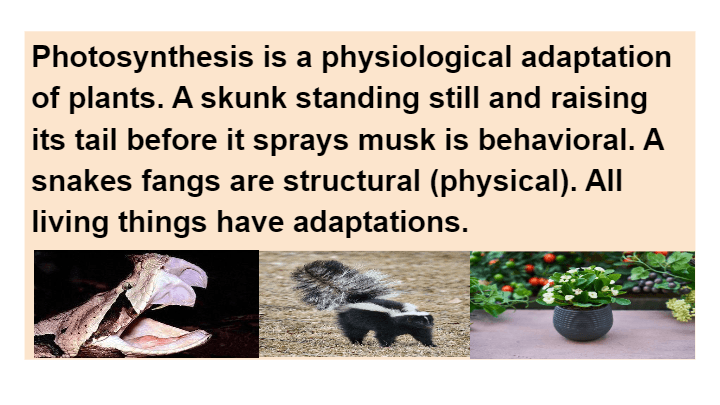
structural (physical)
behavioral
physiological
structural, behavioral, and/or physiological
41
Multiple Choice
A drip tips on plants in the rain forest biomes are common. This is an example of
a physiological adaptation
A structural adaptation
a behavioral adaptation
all of the above
42
Multiple Choice
Structural adaptations are features, internal or external, that help an organism live long enough to reproduce. Examples of structural adaptations would be
gills in fish, bird beaks, snake fangs, hinged legs
living in a group
calling for a mate
producing venom
43
Multiple Choice
Photosynthesis and cellular respiration are examples of plant's
structural adaptions
behavioral adaptations
physiological adaptations
none of the above
44
Multiple Choice
Living in a group, calling for a mate, displaying tail feathers, and a rattlesnake shaking its rattle are examples of
structural adaptations
behavioral adaptations
physiological adaptations
all of the above
45
Multiple Choice
Behavioral adaptations in plants would be
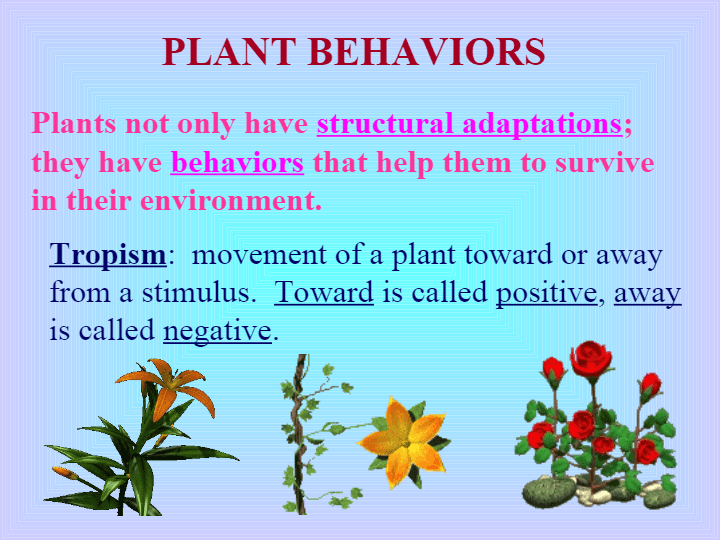
phototropism
geotropism (gravitropism)
long, anchoring roots to withstand storms
geotropism and phototropism
46
Multiple Choice
A bulb's unique adaptation is its ability
to look interesting
to store food for longer periods of time than seeds
to photosynthesize
to be grown on top of the ground
47
Multiple Choice
An octopus's ability to produce ink, an oyster's ability to make its shell, and spiders ability to produce poison are examples of
behavioral adaptations
structural adaptations
physiological adaptations
none of the above
48
Multiple Choice
Otters hold "hands" while swimming so mates and families aren't separated by the currents they swim in. This is an example of a
structural adaptation
physiological adapation
an unexplained occurrence
behavioral adaptation
49
Multiple Choice
Most prey have eyes on the side of their heads while most predators have eyes facing forward. These are examples of
behavioral adaptations
structural adaptations
physiological adaptations
behavioral, structural, and physiological adaptations
50
Multiple Choice
A Venus Fly Trap is a carnivorous plant. The plants ability to make a sticky glue to suffocate insects is a _____adaptation, while its ability to snap its trap shut on contact is a _____ adaptation.
physiological, behavioral
structural, physiological
behavioral, structural and physiological
none of the above
51
Multiple Choice
Seeds have adaptations. Most seeds have only _______ adaptations, that allow them to be dispersed.
behavioral
structural
physiological
all of the above
52
Multiple Choice

These are called
"hitchhiker" seeds. What is most likely the reason
They are frequently seen on the side of the road
There is no known reason
They travel by animals, humans, and in the thick down of some birds by attaching to their fur or a human's clothes
Their structure allows to be easily dispersed by cars
53
Multiple Choice
Dormancy could be describes as an organism in a state of
rest
activity
migration
all of the above
54
Multiple Choice
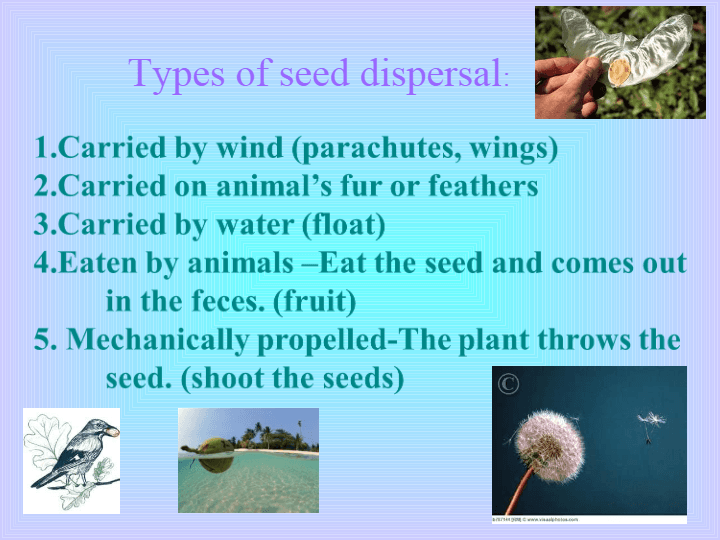
Seed dispersal is how seeds are carried from one place to another so that they do not compete with parent plants. Examples of dispersal methods are
animals carrying them in fur and being eaten- pooped out by animals
water, gravity, mechanical propulsion (stepping on a mushroom, and the change in air pressure forces spores to shoot in the air)
wind
wind, water, animals, gravity, and mechanical propulsion
55
Multiple Choice
Flowers have special adaptations to attract pollinators. These might include
Thorns
A strong odor
Soft petals, fragrance, nectar, and color
Lack of coloration
56
Multiple Choice
Adaptation may be defined as
coloration
inherited traits that help both plants and animals survive in their environments-they may be structural, behavioral, or physiological
the ability to get along with others
only structural features that help organisms survive
Unit 5 Adaptations
Show answer
Auto Play
Slide 1 / 56
SLIDE
Similar Resources on Wayground

54 questions
Original Biomes
Presentation
•
7th Grade
48 questions
Magnets
Presentation
•
8th Grade
47 questions
Age of Contact-Lesson
Presentation
•
7th Grade
51 questions
Solar Radiation
Presentation
•
6th Grade
51 questions
DESIGNING THE EXPERIMENT
Presentation
•
7th Grade
49 questions
2.7 Energy & Power
Presentation
•
7th Grade
48 questions
Plate Motion 1.3
Presentation
•
7th Grade
53 questions
Matter in Organisms
Presentation
•
7th Grade
Popular Resources on Wayground
10 questions
Safety Day 2026 – Student Review

Quiz
•
9th Grade
21 questions
Continents and Oceans
Quiz
•
6th Grade
20 questions
Parts of Speech
Quiz
•
5th Grade
16 questions
Subject & Predicate
Quiz
•
5th Grade
25 questions
Multiplication Facts
Quiz
•
5th Grade
12 questions
Map Skills
Quiz
•
3rd Grade
22 questions
Continents and Oceans
Quiz
•
5th Grade
15 questions
Rounding Decimals
Quiz
•
5th Grade
Discover more resources for Science
10 questions
Exploring Chemical and Physical Changes

Interactive video
•
6th - 10th Grade
14 questions
Week 1 Falcon Flex Fast and Curious
Quiz
•
7th Grade
42 questions
Explore Plate Tectonics and Boundaries
Quiz
•
7th Grade
21 questions
Waves and Wave Properties
Quiz
•
6th - 8th Grade
16 questions
Photosynthesis and Cellular Respiration Review
Quiz
•
7th Grade
20 questions
Food Webs + Energy Pyramids
Quiz
•
7th Grade
9 questions
Biology: Cell Structure
Interactive video
•
7th Grade
8 questions
Diffusion and Osmosis Review
Presentation
•
6th - 8th Grade