Integrated Science Final Review
Presentation
•
Science
•
9th Grade
•
Medium
+2
Standards-aligned
Margaret Mott
Used 12+ times
FREE Resource
4 Slides • 66 Questions
1
Integrated Science Final Review
2
Unit 4: Earth's Processes
Boundary Types
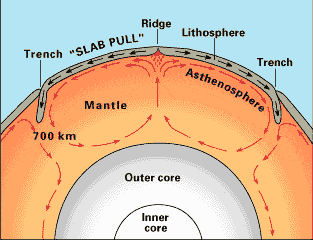
Convection Currents
Cause and Effects
3
Multiple Choice
What is the source of energy that drives plate movement?
the subducton of the sea floor
the different densities of the oceanic and crustal plates
convection currents in the asthenosphere
the friction force between the plates that move past each other
4
Multiple Choice
New oceanic crust (sea floor) is created at this boundary.
Divergent Oceanic
Divergent Continental
Convergent Oceanic
Transform
5
Multiple Choice
Two plates spread or move apart at what boundary?
Convergent
Divergent
Transform
6
Multiple Choice
Two plates come together or collide at what boundary?
Convergent
Divergent
Transform
7
Multiple Choice
What geologic feature/event would you most likely to find at a convergent boundary between two pieces of continental crust?
Volcano
Mountain
Rift
Island Arc
8
Multiple Choice
What geologic feature/event would you most likely to find at a divergent boundary between two pieces of oceanic crust?
Rift Valley
Mid-Ocean Ridge
Island Arc
Flat land
9
Multiple Choice
What geologic feature/event you be most likely to find at a transform boundary?
Earthquakes
Volcanoes
Mountains
Rift Valleys
10
Multiple Choice
What kind of plate boundary is shown here?
divergent
convergent
transform
submergent
11
Multiple Choice
What is occurring at the Nazca Plate?
Trasformation
Subduction
Lithification
Compaction
12
Multiple Choice
Use the diagram to answer the question. What results as the two oceanic plates converge?
formation of a deep sea trench and island volcanoes
earthquake activity and appearance of a transform fault
volcanic eruption along both oceanic plate edges
formation of a continental mountain range
13
Multiple Choice
The diagram shows a landform on Earth. How did the movement of Earth’s plates form the landform?
Two oceanic plates slid past each other.
Two continental plates collided.
One continental plate slid past an oceanic plate.
One continental plate subducted beneath an oceanic plate.
14
Multiple Choice
The diagram shows a cross section of a portion of the Earth. Which letter represents a mid-ocean ridge?
W
X
Y
Z
15
Multiple Choice
Molten rock from Earth's mantle
lava
magma
16
Multiple Choice
A theory of how Earth's continents move over its surface.
Pangea
Contintntal Drift
Yesterday
Pandemonium
17
Multiple Choice
Melted rock at Earth's surface is called
lava
the mantle
the lithosphere
magma
18
Multiple Choice
Is the Outer core solid or liquid?
solid
liquid
19
Multiple Choice
which one is hotter?
the crust
mantle
Inner core
20
Multiple Choice
Who developed the theory of Continental Drift?
Harry Hess
Mrs. Mott
Alfred Wegner
21
Multiple Choice
22
Multiple Choice
23
Multiple Choice
24
Multiple Choice
Which part of the Earth’s crust is less dense and makes up the continents?
Oceanic Crust
Lithosphere
Continental Crust
Crust
25
Multiple Choice
Which layer of the Earth is SOLID iron and nickel?
Mantle
Outer Core
Inner Core
Crust
26
Multiple Choice
27
Multiple Choice
In which layer do convection currents occur?
Outer Core
Crust
Inner Core
Mantle
28
Multiple Choice
Which is the thickest layer found between the crust and the core?
Lithosphere
Crust
Outer Core
Mantle
29
Unit 6 Water Cycle, Energy and Sustainabilty
Renewable and Nonrenewable Energy
30
Multiple Select
Advantages of Non-renewable energy...
they can be stored for use at later time
they are cheap
they are not easily replaced
they cause pollution to the environment
31
Multiple Select
Disadvantages of fossil fuels...
they are not easily replaced
they create pollution in the environment
they are cheap
they can be stored for later use
32
Multiple Choice
What is needed for all fossil fuels to form?
Heat
Pressure
A lot of time
All of these
33
Multiple Choice
In the United States, what percent (%) of our energy comes from fossil fuels?
85%
30%
75%
99%
34
Multiple Select
What are the main fossil fuels?
Coal
Oil
Natural Gas
Nuclear Energy
35
Multiple Choice
Fossil fuels are considered nonrenewable because they
do not produce pollution
are no longer used by humans
are created so quickly
take millions of years to form, so once they're gone, they're gone
36
Multiple Choice
Which one of these is NOT a type of renewable energy?
solar
wind
biomass
nuclear
37
Multiple Choice
Energy created from wood, peat moss, and manure is called __________________ energy.
biomass
geothermal
natural
solar
38
Multiple Choice
____________________ energy is created by transforming radiant energy from the sun.
geothermal
biomass
solar
nuclear
39
Multiple Choice
____________________ is energy that can be replaced as quickly as it is used.
nonrenewable
renewable
nuclear
kinetic
40
Multiple Choice
Water begins to evaporate when you add _______ to it.
cold
ice
water cycle
heat
41
Multiple Choice
Which stage does ground water try to return to the ocean or soak into the ground?
condensation
evaporation
precipitation
run off
42
Multiple Choice
43
Multiple Choice
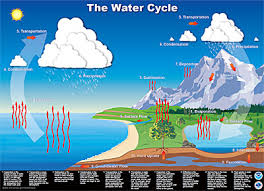
The water cycle has no start or end
true
false
44
Multiple Choice
45
Multiple Choice
46
Multiple Choice
47
Multiple Choice
48
Multiple Choice
What is it called when plants give off water vapor as a waste product?
condensation
evaporation
sublimation
transpiration
49
Multiple Choice
Snow, sleet, hail, and rain are all examples of ________________.
evaporation
condensation
accumulation
precipitation
50
Multiple Choice
Which is the opposite of condensation?
runoff
evaporation
precipitation
transpiration
51
Multiple Choice
What is the water cycle?
the 3 forms of water
the movement of water on, above, or below the surface of the Earth
when water melts
when clouds form
52
Unit 5: Weather and Climate
Climate Factors
Where should they live?
53
Multiple Choice
The biggest factor in determining climate is?
elevation
an ocean
latitude
mountain
54
Multiple Choice
Which side of a mountain is the driest?
Windward
Leeward
Desert
55
Multiple Choice
The data is averaged on a monthly or annual basis for a period of at least ______ years to determine the normals, which are the standard values for a location's climate.
5
10
30
100
300
56
Multiple Choice
Near what latitude(s) is angle of sunlight highest?
Equator
The Poles
57
Multiple Choice
The _______ of a mountain range is the side that receives a lot of precipitation.
windward side
leeward side
58
Multiple Choice
Two factors to determine climate are
precipitation and temperature
hurricanes and tornadoes
humidity and pressure
59
Multiple Choice
Elevation (Altitude) affects the climate of an area.
True
False
60
Multiple Choice
Latitude affects the climate of an area.
True
False
61
Multiple Choice
The _______ of a mountain range is the side that receives a lot of precipitation.
dry side
leeward/dry side
windward/wet side
cloudy side
62
Multiple Choice
As altitude _____________ temperature ___________.
decreases, decreases
increases, increases
increases, decreases
decreases, increases
63
Multiple Choice
Ocean currents circulate the sun's heat.
True
False
64
Multiple Choice
Winds that blow from the west are called ____.
Easterlies
Polars
Westerlies
Temperates
65
Multiple Choice
As you go to the top of a mountain, what happens to temperature?
Nothing
It increases
It decreases
It goes up and down
66
Multiple Choice
What is weather over a long period of time?
A tropical vacation
Weather
Climate
Science
67
Multiple Choice
The planetary winds on Earth are indicated by the curving arrows in the diagram.
The curved paths of the planetary winds are a result of
changes in humidity.
changes in temperature.
Earth's rotation on its axis
Earth's gravitational force
68
Multiple Choice
What effect does a large body of water usually have on a nearby landmass?
The water causes cooler summers and colder winters.
The water causes cooler summers and warmer winters.
The water causes hotter summers and warmer winters.
The water causes warmer summers and colder winters.
69
Multiple Choice
What is the best explanation for these two statements?
1. Some mountains located near the Earth's Equator have snow-covered peaks.
2. Icecaps exist at the Earth's poles.
High elevation and high latitude have a similar effect on climate.
Both mountain and polar regions have arid climates.
Mountain and polar regions receive more energy from the Sun than other regions.
An increase in snowfall and an increase in temperature have a similar effect on climate.
70
Multiple Choice
How does the average annual surface temperature compare from latitude to latitude?
As latitude increases, the average annual surface temperature decreases.
As latitude increases, the average annual surface temperature increases.
As latitude increases, the average annual surface temperature remains the same.
Well, it's not this one.
Integrated Science Final Review

Show answer
Auto Play
Slide 1 / 70
SLIDE

Similar Resources on Wayground
63 questions
Physical Science Introduction
Presentation
•
9th Grade
63 questions
8th Grade Unit 1 Digital Review
Presentation
•
8th - 9th Grade
65 questions
HAND TOOLS IN ICT-CSS
Presentation
•
9th Grade
66 questions
Forces
Presentation
•
8th Grade
63 questions
4/18 - Blitz - Levels of Organization
Presentation
•
8th Grade
60 questions
Listening Sample CEFR SPM F4 2021
Presentation
•
9th Grade
62 questions
Oceans
Presentation
•
8th Grade
65 questions
9 Chemistry Revision - MSHS
Presentation
•
9th Grade
Popular Resources on Wayground
20 questions
STAAR Review Quiz #3
Quiz
•
8th Grade
20 questions
Equivalent Fractions
Quiz
•
3rd Grade
6 questions
Marshmallow Farm Quiz
Quiz
•
2nd - 5th Grade
20 questions
Main Idea and Details
Quiz
•
5th Grade
20 questions
Context Clues
Quiz
•
6th Grade
20 questions
Inferences
Quiz
•
4th Grade
19 questions
Classifying Quadrilaterals
Quiz
•
3rd Grade
12 questions
What makes Nebraska's government unique?
Quiz
•
4th - 5th Grade
Discover more resources for Science
46 questions
Unit 4 Geosphere Test Review
Quiz
•
9th - 12th Grade
25 questions
Naming Ionic and Covalent Compounds
Quiz
•
9th Grade
20 questions
Human Impact on the Environment Review #2
Quiz
•
9th Grade
16 questions
Ecosystem Stability
Quiz
•
9th Grade
20 questions
Mendelian Genetics Review
Quiz
•
9th Grade
12 questions
Unit 6 Quiz #3 (Life Cycles of Stars)
Quiz
•
9th Grade
34 questions
Human Impact on Ecosystems Quiz
Quiz
•
9th Grade
10 questions
Exploring Alfred Wegener's Continental Drift Theory
Interactive video
•
6th - 10th Grade